
BEYOND THE AQUARIAN CONSPIRACY ~ A Conversation with Marilyn Ferguson

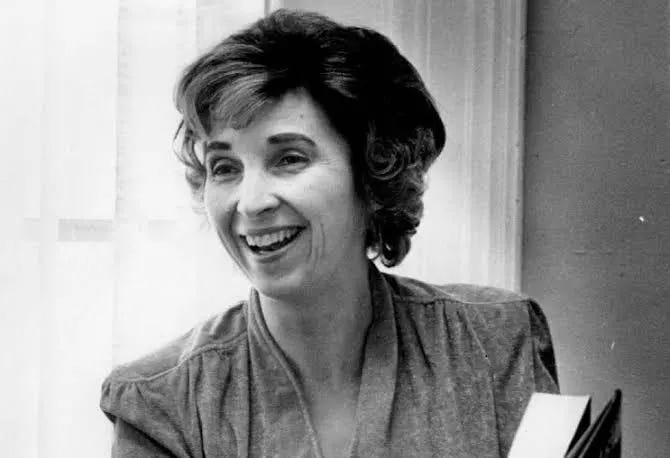
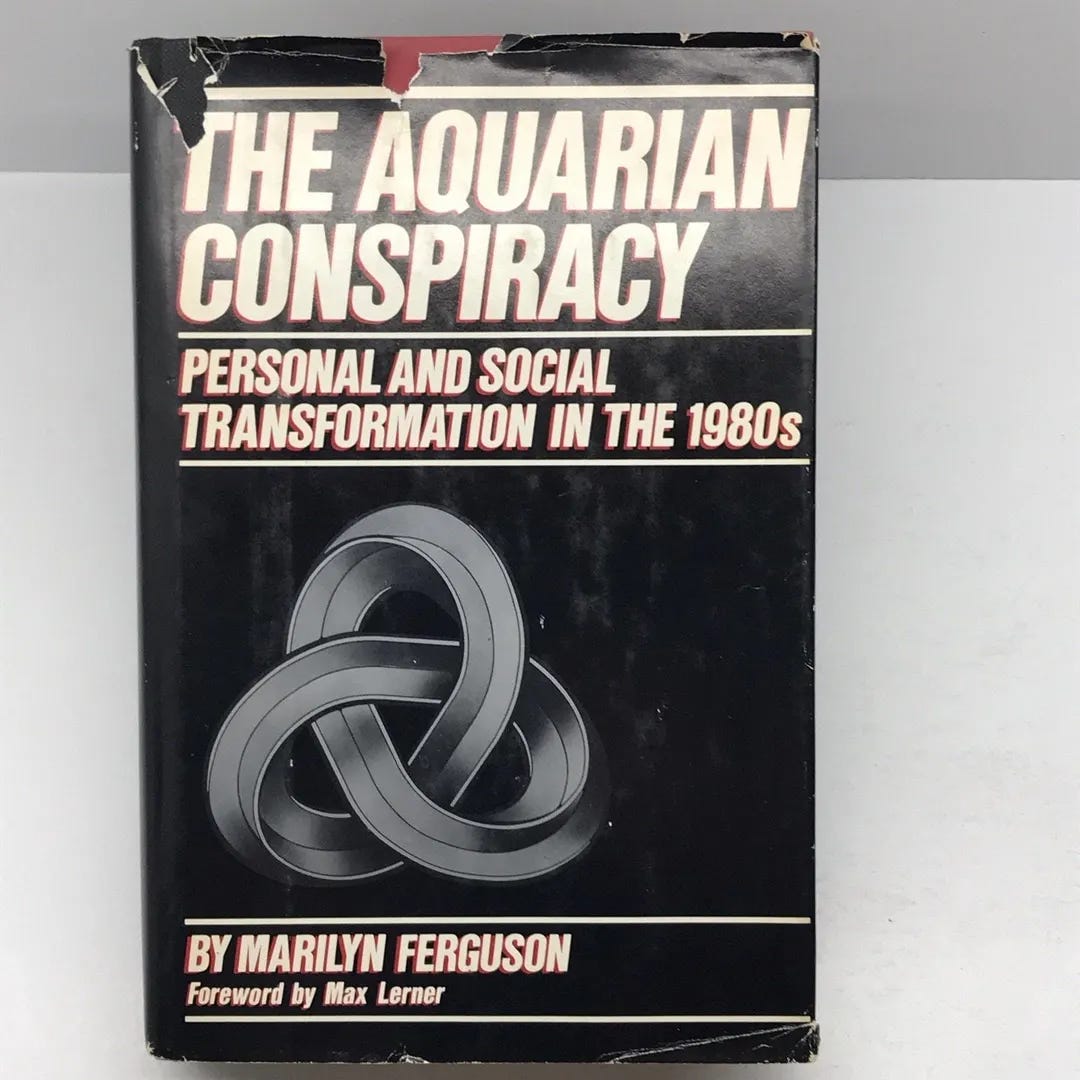
This is an interview I did with Marilyn Ferguson for Quest Magazine, which was run in its Autumn 1990 issue. Her book The Aquarian Conspiracy was a best-seller in the ‘80s, and became a topic of conversation in both New Age and political circles for years. In light of all that’s taken place since that time, I find it interesting revisiting her work now, to see just how much of what she discussed then has—or has not—come to pass. Marilyn died on Oct. 19, 2008 at the age of 70. --R.G.
Marilyn Ferguson has been called by some the dean of modern consciousness research. Her book The Aquarian Conspiracy, first published in 1980, is a classic in the field of New Age literature, and has been translated into Japanese, German, Spanish, Portuguese, Dutch, and Esperanto, among other languages. A new edition with a foreword by John Naisbitt and a new afterword by Ferguson was published in 1987. Her newsletter, Brain/ Mind Bulletin, chronicles cutting-edge research on human mental, physical, and spiritual potential. In recent years she has been exploring what she calls “the visionary factor,” the capacity of certain individuals to manifest their visions of change in the world. We spoke with her recently about her current work and observations.
Quest: Your book, The Aquarian Conspiracy, has become something of a standard text in the field of consciousness research. For those who may not be familiar with the term, how would you explain the “Aquarian conspiracy”?
Answer: I saw a book the other day, a dictionary of terms relating to new consciousness, and they had “aquarian conspiracy” as a lowercase item —which tickled me-like it was a generic term. I use the term “Aquarian conspiracy” to describe the cooperation that I saw among people who had gone through profound personal shifts in values, in my observation starting in about 1976. I use the term “conspiracy™ in a positive sense, calling on its original meaning, “to breathe together,” to be in harmony. People were conspiring, or plotting, to bring about a more humane society. And I used Aquarian as an adjective because it seemed to me that the mythic power of the idea of moving from a Piscean age into the age of Aquarius was helping to shape the thinking of at least a segment of the population.
You know, we can only have things we can imagine. The idea that was expressed in the song, “The Age of Aquarius,” of the “time of the mind’s true liberation,” I think had inspired a lot of people to think that there could be a time of the mind’s true liberation. So that was why I used the term. I also wanted to balance the word conspiracy, which has frightening connotations for some people, with a more positive adjective. I had also noticed that people in many different disciplines, in many different walks of life, had in fact begun cooperating with one another-sharing strategies, tricks of the trade, for bringing about social change.
Q: How would you describe some of the key characteristics of this shift you’re describing?
A: The key characteristics are more evident now, I think, than they were in 1980 when the book came out, because in fact there was such a trend, and this trend had is effects. There would, for example, be a greater interest in spiritual matters, and a diminishing of materialistic values. People are more concerned now with the quality of life and with relationships, compassion, and creativity than with things or with status symbols. There is greater openness to diversity; people are more interested in other cultures, in the native cultures of their own lands, and in learning from others. Particularly, I think, there is a growing interest in personal development, and in enhancing one’s creativity, and more people are wanting to be participants rather than just spectators.
Also I think there is a growing concern which has been justified about the short-term view that we have taken of the environment. And it isn’t just the environment: more and more we’re seeing the consequences of “small-picture thinking. “ We have tended as a society to kind of live for today, and to want immediate gratification. If there is a new television show, we have to know within two weeks if it’s going to make it. Books appear and disappear as quickly as magazines used to appear and disappear. You know, it’s one of those “eat, drink, and be merry” approaches that we’ve had.
Q: There have been a lot of changes since the book was written. Are there any ways in which your views have been modified by what you’ve seen happen in subsequent years, where things might have turned out differently than you expected?
A: Yes, on the positive side I think that there were very many more people than I had imagined who were harboring some kind of dream that things could be better. This was not just a kind of fluky thing where a few mystics and visionaries had the idea that maybe we could be living in a different world. Most people have, at some point in their life, wondered why things would have to be this way, but didn’t know what to do about it. These people really would like to be engaged, would like to do something, if they had any idea what it was. On the other side of the coin, the systems themselves are much more entrenched and resistant to change than I had imagined them to be.
Q: For example?
A: Let’s say the bureaucracies of politics and government — well, bureaucracies in general - such as we now see Gorbachev attempting to cope with. The problem with bureaucrats needing to maintain what they’re doing is deeply entrenched in every society. And the ferocity with which people will defend the status quo if they think that somehow they might lose their status, was much stronger than I had imagined. My sense was that if people saw there could be a better way, and that they themselves could be happier in a more conscious, more just society, then they would be willing to “cut the cord,” so to speak, to the kind of ill-gotten, so-called “security” that they had. In fact, people tend to dig in their heels. So the strategies that are needed to bring about change in the face of such entrenched and semiconscious forces, are going to have to be, well, creative.
In a nutshell, in ordinary circumstances social change is slower than I expected. On the other hand, all the revolutions in eastern Europe show that in extraordinary circum-stances, change can happen quickly. So I think what’s up for us is that we really have to understand more about large-scale political strategy; and those individuals whose orientation is more towards the spiritual have to be willing to go out and man the barricades, in terms of the actual society and the power brokering that goes on in the society, if we are ever to have heaven on earth.
Q: I get the impression from reading the book that you see America as playing an especially important role, as midwife perhaps, in this transformation process.
A: I think this was almost our charge as a nation. The founding fathers saw this as an important experiment in the history of humanity, and for that reason we have a relatively open structure for experiment. Certain regions of the country have an even more open structure than others and are more experimental; California comes obviously to mind, but is not the only one. And there are pockets in other parts of the world. In almost every country you will find regions and groups of people who are more experimental than others. The original American dream was not underdog-gets-rich. It was the freedom to dream, it was the freedom to create something new; and as long as you were not hurting anyone else or bothering anyone else, that was your prerogative. I think the idea of dreaming and creating is, in a way, what the United States brought to the world two hundred and some years ago. At the moment, and particularly over the past ten years, the United States often seems to be running coun ter to its own original vision. The historian, Arnold Toynbee, felt that we had lost the leadership in our own revolution. And I think this is something a lot of patriotic Americans are concerned about, that, as sometimes happens, you become fossilized and you lose your sense of dynamic purpose. There’s a concern right now that we are not taking the leadership in environmental issues as we should, that in fact, we’re dragging our heels.
Q: Because of your association with the Brain/ Mind Bulletin, you are in a particularly good position to get a sense of what’s going on in consciousness and brain research. What trends do you see taking shape among all the developments that have been occurring?
A: I would say that in the last decade or more, there’s been a very strong validation of the power of what I call the “psycho-technologies.” In fact, we’re just writing a story for the Brain/ Mind Bulletin, a meta-analysis of the effects of Transcendental Meditation as compared to progressive relaxation and other techniques of meditation. It was published in a major journal, and the senior author is a physicist at Stanford. This kind of thing certainly wouldn’t have happened fifteen years ago, and probably not ten years ago.
I think that among avant-garde researchers there is an increasing interest in the effects of positive emotions and the role of challenge in altering the nervous system. This is fairly new-the realization that the brain gets better as it is challenged, that by pushing ourselves, by using stimulation in the educational process, we’re actually developing capabilities. The plasticity of the brain began to be obvious in research dating back to Berkeley in the 1960s, the research with stimulating animal —you remember the rats who played with toys? and has gone on and has flowered in many ways. They have found that if an animal is stimulated, even its third and fourth generation [offspring will show effects of being superior even though they have not been directly living in an enriched environment.
Q: How about in the area of health, and the relation of brain and mind to health?
A: Psychoneuroimmunology is becoming bigger and bigger, and there is no longer any question that your state of mind affect your health. This is something that was once believed by, you know, maybe a handful of Christian Scientists and a few other people. So I would say psychoneuroimmunology, the power of positive emotions, the benefit of challenge.
There is now also a new little wave of parapsychological experiments that are quite interesting and straightforward. Parapsychologists, who had been somewhat out of sight for a while, at least their work was not particularly in the news— are back in the news in part that give an idea of the usefulness of the phenomenon, rather than simply trying to prove it. It’s been shown, for example, in one experiment, that a healer can have an effect on a small, deliberately-created wound on various people without them knowing that they were being treated. And then in another study lit was shown] that people in a distant location could affect [others] by periodically altering what they were “sending”-whether it was energy activation, anxiety, or something more positive; that there were actual physiological changes that took place simultaneously in the [other] person even though they were not aware consciously of anything happening. This gives us an inkling of how we affect the people around us.
There are also ongoing discoveries about different aspects of the nervous system that are more important than had once been thought.!! was discovered, for example, that the glial cells. which were thought to be only the glue holding other cells together, are now known to be a crucial part of the [body’s] communications system. And the only thing that was unusual in Einstein’s brain was that he had a much higher ratio of glial cells to neurons in a particular region. It has recently been discovered that some cellular structures called astrocytes, whose significance had not been understood, are an important part of communications.
Q: What is your own personal sense of what the next step in consciousness is?
A: The empowerment of individuals! That seems to be the crucial next step, because the need for change at this point is so profound that there’s no way it can be effected just by leaders, or legislation, or handfuls of well-intentioned people. Individuals everywhere need to understand that it’s essential that they begin to change their mode of living. It was one thing when the conflict that faced us, the great fear that faced us, was nuclear war. The people could march for peace, they could pray for peace, but all in all they felt that, in a way, it was out of their hands. In this “new war” that we’re involved in, which is the battle to save our homelands, the answer is held in everybody’s everyday behavior.
And that is where we really truly have to “walk our talk.” If I say, for example, “What difference does it make if my household uses disposable diapers, or CFCs, or whatever?” and then I recognize how many other people are thinking that, there comes a point where I just have to say, “Okay, I don’t know if it’s going to do any good, but I have to change my ways.” The book that I’m nearing completion on, that I’ve been working on for about eight years, The New Common Sense: Secrets of the Visionary Life, is about the “how-to.” I felt that The Aquarian Conspiracy described the movement that was going on—what it was, why it was; but it didn’t really tell people enough about what to do if they wanted to become involved, what practical kinds of things. And I found over the years of hundreds and hundreds of lectures and seminars, that so many people were really wanting to help but they were not quite sure what they should be doing; or, if they had a project, how to make their project succeed. They didn’t necessarily have the implementation skills, or they would become discouraged, or the group they had become involved with would fall apart because there were interpersonal things going on.
I have been interested for a long time in why some people can have ideas again and again, and make things happen in the world. I know many such people, and I’ve known them for years, and [have wondered] why is it these people can have a vision and can make the vision happen? And they’re quite confident about it; they feel that anybody ought to be able to do it. Yet most people don’t know how to do it. Well, one of the reasons is that nobody taught us, nobody trained us. Some people just happened to stumble onto it, they had a role model, someone in their family, or a teacher, or some kind of life crisis that taught them. Yet once you know how to do it, you’re usually so busy doing it that you don’t stop to teach anybody else.
Q: What do you feel that skill actually is, if you could put it in words?
A: The key, the absolute—and I tell you this after having spent four months in Ireland looking at all of the data we collected from visionary people, and not just my own but objective tests done by people who give tests in the workplace—what distinguishes these people, are a number of what they call paradoxes, traits paired that usually don’t go together. For example, the people would tend to be high on one test on what is called authority”—meaning that you would tend to take on leadership in a group—but low on advantage,” meaning that you’re [not] looking for personal advantage; whereas in the business world most people who were high on authority were also high on advantage. The people in our study would be high on “activity,” that is, energy-activity, but not necessarily low in “structure.” And the people who were low in structure tended to be quite rebellious against structure. Well, that makes sense in a way, because if you’re an effective visionary, you really have to work within certain existing social structures, right?
But then there’s like this secret—there’s always a secret behind the secret! I saw that these were, in fact, habits or acquired behaviors in many ways. These people could even tell you when and how they had learned to do this, and in many instances they did on the survey.
So you could say yes, it’s true, the reason they say other people could do what they did is that it isn’t just that they were born a particular way. It’s also that they’ve discovered certain things, and have learned to function in certain ways. For example, if they make a mistake, from it, and go on to the next thing. Well, that’s something that you can teach people to do. What I realized is that what had happened to these people is that they had, unconsciously in most instances, adopted the behavior toward themselves of a good parent or a good teacher.
I brought this up because it seemed like a real breakthrough....So I asked several people whom I considered visionary, and their reaction was, “By golly, I think that’s true, but I never thought of it that way.” I was excited about that, because my sense is that people can learn to do that. If you think about it and go back to your own educational experience, can you, Ray, for example, think of good teachers you had who really believed in you?
Q: Sure.
A: And if you think about what they did, it’s probably that they encouraged you. They held high standards for you. They cheered you on when you did something good. But if you ran into problems, they didn’t destroy you. They didn’t give you a hard time. They just gave you a way of making the most of the mistake you had made and moving on. Now I think that for reasons that may involve guilt, and maybe because some negative experiences outweighed some positive experiences, most people don’t treat themselves that way. We’re more likely to incorporate negative stuff from our families, if they were insecure. You know how a lot of times you might have a parent, or it could be somebody else in your life, who says, “I knew you would screw up!” So then we tell ourselves “I knew you’d screw up!” You get the picture. What can happen is that, being conscious of this act—that we can be a good mother, a good father, good parent, good coach to ourselves— then we can start treating ourselves with a certain amount of kindness as well as urging ourselves on.

Q: So a big part of this is not simply with the individual, but modeling and teaching also play an important part in developing this particular quality you’re describing.
A: Yes, well it’s also-and I hadn’t thought of this until now—but I think that you need a society; you need institutions that are humane in that way. I haven’t really thought this out, but I think that there’s something here—Iet’s say within—our political system. There is all this terrible accusation that goes back and forth. This would be an example: the last presidential campaign. (We have this going on now in our governor’s race in California.) What does this say as an example to people on how to deal with themselves, when we have these kinds of epithets hurled back and forth, insincere epithets I must say? Some part of you says, well, I would never want to step out into public life.
Furthermore, there is this thing being modeled all the time, which is angry and accusing. Thank God that we at least have broken through some of that in terms of our dealing with the Russians. I think that whole sense of paranoia and enmity had to affect us terribly. There’s a continual second-guessing that’s going on. Look at the way the media are oriented; they’re oriented to criticism and questioning. The media help to make the political thing such a mess as well. They encourage conflict. I’m sure that somewhere along the line you’ve been interviewed by newspaper people, or other media people, and that they always approach the interview in a negatively challenging way. Because they’ve been taught this, this is the model; the model is, to get to the truth you have to attack. So I think we have a lot of negative models out there. For people to start to treat themselves-to have learned, maybe by trial and error, that they deal best with things when they are self-encouraging this is the exception. This is one of the things that I want to really illustrate in the book, and what the book is about: how to develop, and also how to strengthen different parts of yourself, how to see yourself heroically. If you see yourself heroically, you are more likely to behave heroically. In a way, I’m painting a different picture of how we can be, based on the examples of a lot of people who are unquestionably successful in living a rewarding life and making a contribution to society.
Q: So, to wrap this up, on a very practical level right now, what advice can you give me that I can take and put into practice right away to enact some of these things you’re talking about?
A: Well, I would say two things. Number one is: find a purpose. I’ve found that most people do not think they have a sense of purpose, including people who are involved in spiritual growth and who still don’t know what it is they should be doing. And the way I tell people how to find a purpose: look around you in the world over the next two weeks or so, and make a little list of everything that you think is a serious problem that needs to be handled. At the end of that period of time, look over your list and ask, of all these things on the list, which is the thing that most concerns me that I don’t think enough is being done about? And that’s your purpose. Then you’re like the little boy who saw the hole in the dike. You have no choice. You saw this thing, and you have identified the fact that not enough is being done about it, so it becomes personal to you.
Then number two is: if you will put the same amount of energy into your purpose that you spent in wondering whether or not you had one, then you will succeed beyond your wildest dreams.
Q: That’s pretty clever!
A: You like that, huh? Listen, when that occurred to me... there are a few lines that came to me in the course of writing this book that I knew were really key because I could feel them to my toes, and that was one of them.
Q: That reminds me of that famous Goethe quote about how there is boldness in the beginning of things.
A: Yeah, and that’s the point of the moment of commitment. The other point is that what used to be considered idealism or high-mindedness is the idea that new common sense.
This is the point where we finally get to live our ideals or else. So in a way, we can thank ourselves for the crisis; that is, we can thank the crisis for making it possible for us to start seeing whether, in fact, our ideals work.
Ray Grasse is a writer, photographer, and astrologer based in the American Midwest. He is author of ten books and contributor to many anthologies. His websites are www.raygrasse.com and www.raygrassephotography.com.
Great piece. Thanks for sharing. A question: how do you feel, as an astrologer about her method of finding purpose?
Thank you for sharing this. Something I'm so interested in! This plays along with Neville Goodard, Abraham Hicks etc. The rewiring of the mind is so very challenging nowadays. If only we were enlightened with this as early as elementary school. To be more aware of our nervous system, subconscious and how the outer world shapes us and how our inner world shapes us. Trying to undo old programming as an adult, whew.... not for the faint of heart!