
WHEN WORLDS COLLIDE: HOW WOULD “DISCLOSURE” AFFECT RELIGIOUS FOLLOWERS AROUND THE WORLD?

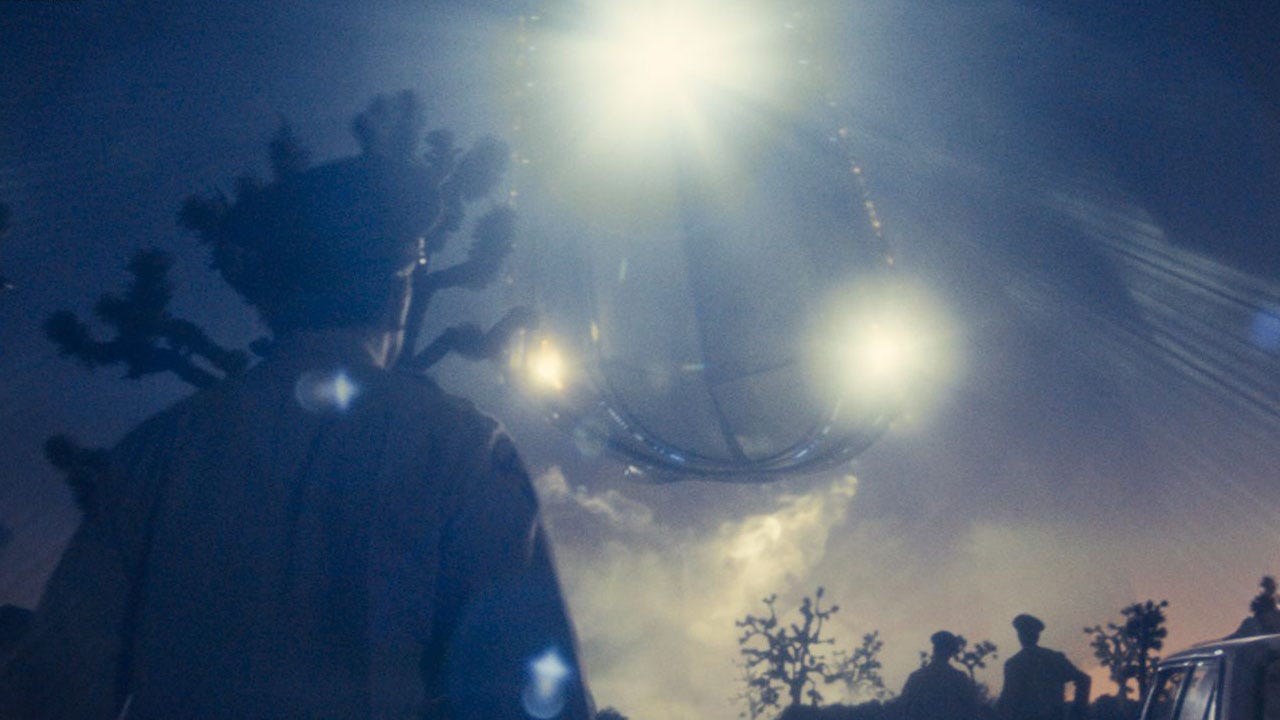
Publicity still from Steven Spielberg’s Day of Disclosure.
In recent years we’ve seen a growing discussion about the possibility of non-human intelligence elsewhere in the cosmos, and of humanity’s possible interaction with it. In the Spring of 2026, that interest was punctuated by a presidential directive ordering the release of government files pertaining to both filmed encounters and official sightings of phenomena that seemingly defy known laws of physics.
The central query at stake here is this: Has the Earth been visited by beings from elsewhere in the cosmos, or even from other dimensions? And if so, how would that impact society?
In particular, how would it impact those of a decidedly religious orientation, who may hold firm opinions of their own about the nature of our world, its origin, and ultimate purpose?
Needless to say, this is a complicated problem involving a host of variables. Scores of thinkers have devoted their energies to addressing the myriad dynamics that could arise in response to such a development. For example, my friend David Metcalfe recently suggested that not only could different religions react differently, but even different denominations or sub-groups within each religion might react differently—and even those could change over time.
As an example, David noted, evangelicals were fine with UFOs on a theological level (or simply didn’t care) for most of the post-1947 period. And it wasn’t until the mainline denominations started getting infected with ideas coming out of the spiritual warfare movement which really started taking root in the 1970’s that it became an issue. He then added this:
“I think this dynamic highlights something that often goes unaddressed in discussions about religion and UFOs: many believers take their cues from trusted religious pundits, institutions, and communities. So the key question may not be how believers as a whole will react, but how religious leaders, commentators, and denominational organizations interpret and present the issue. Those frameworks will play a significant role in shaping how their communities understand and respond to it.” 1
Like I said, it’s complicated.
What I’d like to do here is instead offer a few brief thoughts on this problem from a broader, more generalized perspective—namely, by addressing the distinction between religious followers of an exoteric sort versus those of a more esoteric nature.
What do I mean by that?
Simply put, an “exoteric” approach to religious belief would be one that subscribes to the more literal and external trappings of a given faith. In the Judeo-Christian tradition, say, that could include devotees who take the story of the Garden of Eden as historical fact, or who believe that the Earth is only 6000 years old; or who feel that accepting the historical Jesus as one’s savior is a necessary requisite for salvation. For such an individual, discovering that there are other races of beings in the cosmos not explicitly accounted for by scripture—let alone the possibility that humans might have been genetically modified by non-human intelligences (as some now believe)—would constitute an ontological shock of enormous consequences.
On the other hand, those who subscribe to their religion in its more “esoteric” vein tend to look to those teachings less for their literal, external meanings than for their internal implications or symbolism. To the esoteric Christian, for instance, Jesus might be seen as an exemplar of spiritual and ethical potentials more than as one’s divine “rescuer,” or cosmic lifeguard, as it were, who must be embraced in order to be redeemed. Likewise, for the esoterically-minded Muslim (such as a devout Sufi) learning about the existence of alien civilizations and their religious systems wouldn’t necessarily shake the foundations of their faith, for the simple reason that for them—like for the esoteric Christian—spiritual practice has more to do with the cultivation of one’s inner spark of divinity than with a strict adherence to external beliefs, practices, or historical narratives. Similarly, to someone for whom the essence of religious practice rests upon an ethos of virtuous behavior and compassion for all beings, learning that there are other intelligences beyond Earth wouldn’t impact that ethos much one way or another.

In short, the impact of disclosure on those following religious traditions depends largely on the depth and orientation of their approaches to those traditions.
The big question this naturally raises, of course, is this: Would disclosure force a revolution in the minds of more exoterically-inclined followers, those more emotionally invested in the literal truth of those teachings and practices, in turn causing them to transform their perspectives in more esoteric and mystical ways?
Or would the shock of disclosure be so great as to trigger a crisis or possibly even collapse of their worldviews?
It’s possible we may find out the answer to that before too terribly long.
© 2026 Ray Grasse
Notes
1. Quoted from private correspondence. David Metcalfe has written insightfully on this general topic for years—here is just one of his pieces : https://davidmetcalfe.wordpress.com/2025/11/26/evolution-apocalypse-and-flying-saucers-seeking-the-phenomena-outside-secular-and-religious-eschatologies/ .
Ray Grasse is author of ten books, including The Waking Dream, Under a Sacred Sky, and An Infinity of Gods. He studied extensively in the both the Kriya Yoga and Zen Buddhist traditions. His websites are www.raygrasse.com and www.raygrassephotography.com.
Disclosure will invoke no additional reaction then it has already. People strongly believe or disbelieve. I think religion, societal ideas, and fear are the greatest reasons for not admitting to it. I think we need to watch the old Michael Rennie movie, THE DAY THE EARTH STOOD STILL.
Or would the shock of disclosure be so great as to trigger a crisis or possibly even collapse of their worldviews?
For many it will. Disclosure may be a great sorting process leaving many adrift. We have lived through a period of loss in trust of societies leaders both civic and religious. Those more grounded in inner experience may have the balance of mind, the capability, and responsibility to shepherd us all ahead. A serious matter indeed; with no easy answers.