
What is "Mother"?


During the five months I spent at Zen Mountain Monastery in upstate New York during the mid-1980s, the head teacher in residence was an imposing American by the name of John Loori, though most students knew him by his Buddhist name, “Daido.” Of all the stories and teachings he shared with us throughout that time, one that stands out vividly in my memory centers around an incident involving his own teacher, Maezumi Roshi (1931-1995).
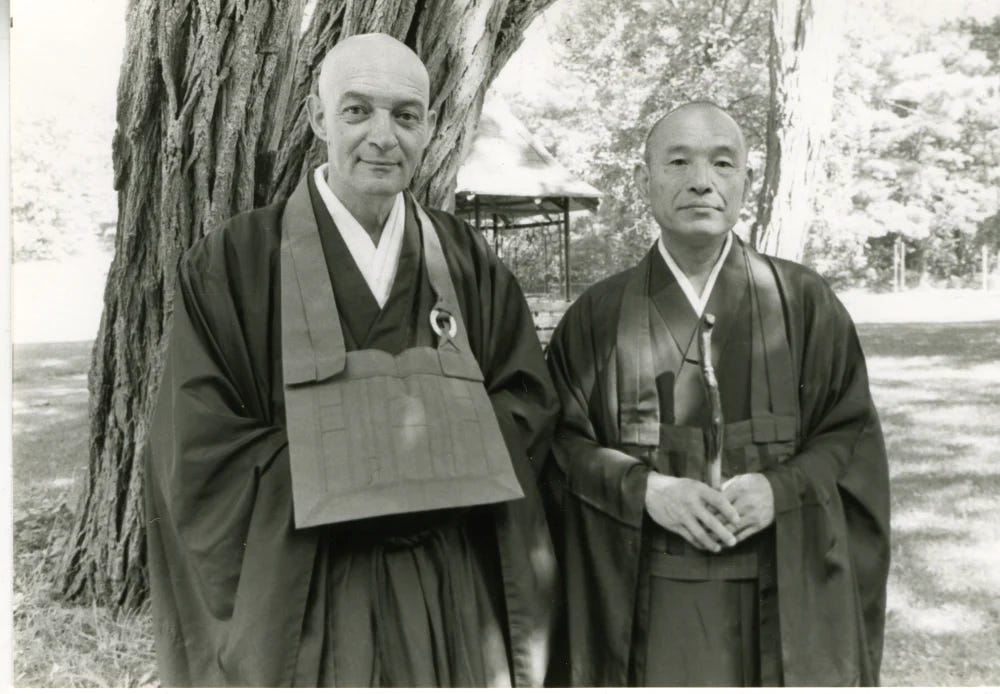
John “Daido” Loori (left) and Maezumi roshi (right). Photographer unknown.
Maezumi was holding forth one evening to his students, Daido explained, and engaged in a teaching practice known in Buddhist circles as dharma combat. This is where a teacher poses a comment or question to the sangha (spiritual community), ostensibly meant to both challenge the students and test their grasp of deeper Buddhist principles, while allowing those students to in turn challenge and test their teacher. Each student taking part comes up and sits in front of the teacher to offer their own take on the question or comment at hand, with the teacher then responding to what the student said.
To anyone new to such interactions, these exchanges can seem cryptic to the point of being impenetrable, even nonsensical. I should know; they often did to me.
On this particular occasion, Maezumi posed the question, “What is mother?” to the group.
A number of students came up to offer their own responses, until Daido’s fellow student and dharma brother, Bernie “Tetsugen” Glassman, finally had his turn to parry with the teacher. Bernie proceeded to deliver a characteristically abstract, Zen-like answer to his teacher’s query about the nature of “mother,” one that probably only fellow practitioners would understand.
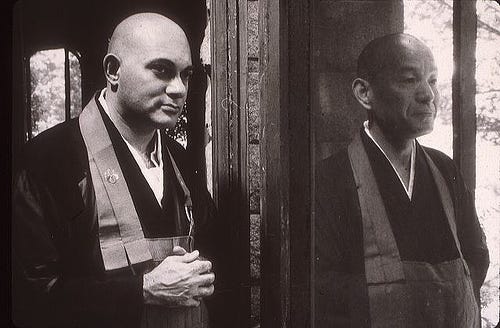
Bernard “Tetsugen” Glassman, Maezumi Roshi. Photographer unknown.
Upon hearing that, Maezumi firmly said, “No—THIS is mother!”— while pointing to a tear running down his cheek.
It was then that Bernie realized what Maezumi was getting at with his opening query. Bernie then began tearing up himself, with both of them now crying—as the rest of the students watching this exchange started tearing up as well.
So what does all this mean? In case the significance isn’t readily apparent to those reading this, I’ll offer a few words of explanation.
An integral aspect of Zen teaching emphasizes the need to balance the “Absolute and the Relative” in one’s life and practice. What is the “Absolute”? Simply put, this refers to the highest, most sublimely spiritual perspective on life, as realized in the subtlest and most awakened meditative states. Seen from this perspective, one recognizes that all phenomena are “empty,” surface appearances are fundamentally relative and transitory, to a certain extent even illusory.
On the other hand, the “Relative” refers to the ordinary experience of reality most of us perceive on a regular day-to-day basis. This is the world of conventional emotions and thoughts, with all the highs and lows of daily relationships, responsibilities, and concerns. It’s called the “Relative” because it hinges on one’s very personal and very subjective experience of life.
As I said, Zen stresses the need to balance one’s sense of the Absolute and the Relative, since either extreme can lead to problems. For instance, one can become so spiritual—that is, so anchored in the Absolute by seeing everything in those highly rarefied terms— that one loses touch with the everyday world, like the obsessive meditator who forgets to pay his bills or tend to his loved ones. Conversely, one can become so engrossed in the Relative that one loses all sense of higher perspective, where life simply becomes a robotic pursuit of money, sex, and status, solely perceiving the world in terms of conventional values and emotions.
Neither of these viewpoints is complete in itself and needs to be balanced with the other, Buddhism suggests. Maezumi’s gesture of acknowledging that tear flowing down his cheek demonstrated the need to value ordinary human emotions and experiences on their own terms—including the love felt for mother, and the grief felt upon her absence. Sure, one could put on one’s “Zen glasses” and see mother in purely Absolute terms—as an embodiment of a deeply mystical or cosmic principle, say—but that would not be true to the full reality of who she was, or of one’s deep emotional bond with her.
Here’s another example to help drive the point home a bit further. Imagine you discover that a close friend has just endured the death of their child, who perished in a horrific accident. You attend the wake and see your friend standing there, clearly grief-stricken and barely able to talk. Now, do you walk up to them and say, “I’m deeply sorry for your loss”?—or do you instead say, “This sense of loss you’re feeling is really an illusion, since all things are impermanent and insubstantial, so your grief itself is nothing to become engrossed in”?
It should be obvious which approach is the more appropriate one—presuming you’re a normal, compassionate human being, that is. Yes, the latter response about impermanence and illusion may well be more accurate or “true” from an ultimate mystical perspective, but that is actually the false one, spiritually, since it doesn’t recognize the truth of the moment—a truth that involves balancing the Absolute and the Relative, the mystical and the ordinary, the ultimate and the everyday.
Nor is this simply a Zen Buddhist teaching, as one finds much the same idea in other spiritual traditions. For instance, I feel it’s the esoteric meaning of Jesus telling his disciples to “render unto Caesar that which is Caesar’s, and unto God that which is God’s.” Said a little differently, it’s important to deal with the earth plane on its own terms, and the spiritual level on its own terms—and knowing how to keep those two in balance.
It’s also what I believe Goswami Kriyananda was getting at in his comment I cited in an earlier chapter, when he said, “Everyone is trying to find God when they haven’t even found their humanness yet.” As important as mystical ideals and aspirations are, spirituality is not simply a denial of the everyday or of ordinary human emotions and perspectives.
Rather, at its most integral, the spiritual path is about learning to walk that delicate tightrope between the two, and reconciling each of those respective truths into a broader, more all-encompassing Truth.
That is “mother.”
Postscript: Shortly before publication I shared this chapter with my old friend Ray Bonini, who was a young man (19) when I first met him at the monastery during my time there. He also was present when Daido related this story, and like me, had been deeply impacted by it. Though he liked what I wrote about it above, he suggested another layer of meaning to be considered, and shared what I thought were some extremely insightful comments about it. Rather than try to paraphrase what he said, I thought I’d simply include what he wrote, leaving his comments largely as he intended (edited slightly for clarity). Here they are:
“Daido’s story is a really good example not just of balancing the Absolute and the Relative, or of respecting the truth of each one on its own terms, so to speak, but also as a demonstration of how the Absolute IS the Relative. The tears running down his face, or saying ‘I’m sorry for your loss,’ is itself the coming together of Absolute and Relative. Each is a complete presentation of the whole, as Mumon says in his comments on the Koan ‘Mu’ in the Mumonkan. It shows how ordinary emotions that seem to be the opposite of the Absolute can also be seen as the manifestation of the Absolute in the here and now. A big point in Mahayana Buddhism is that samsara is nirvana—they’re not really two things. Absolute and Relative are not two things. If the ocean is the Absolute and the wave is the Relative, then the wave manifests the ocean—the entire ocean is manifested in one wave.”
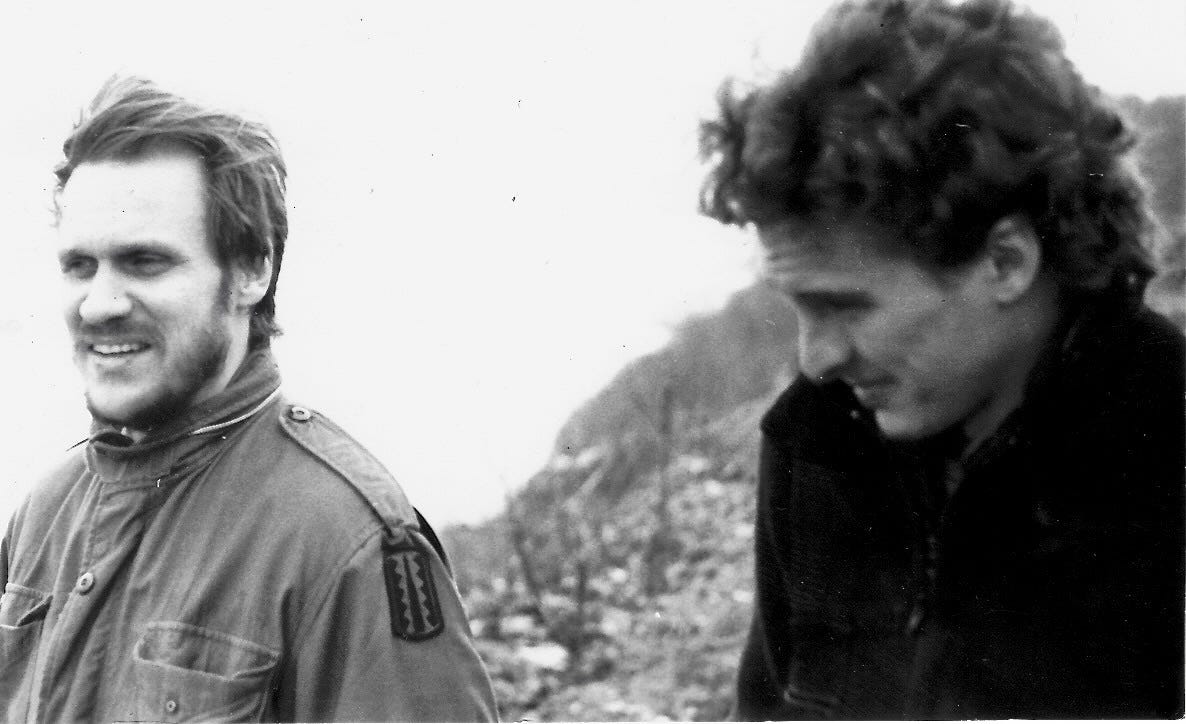
On a weekend walk away from the monastery with my friend Ray Bonini (right).
Excerpted from So, What Am I Doing Here, Anyway? Astrological and Philosophical Essays (Wessex Astrologer, 2024).
Ray Grasse is a writer, astrologer, and photographer living in the American Midwest, and is author of ten books. His website is www.raygrasse.com.