
Walt Disney's "Sorcerer's Apprentice" ~ A Cautionary Tale for Our Time

(Excerpted from When the Stars Align)
As those familiar with my writings will know, I often look to popular culture for important clues into the shifting astrological zeitgeist, but with a special emphasis on the imagery and narratives of cinema.
To my mind, one of the most interesting examples of that can be found in the 1940 Walt Disney movie, Fantasia.
Disney’s quasi-experimental film features a series of animated sequences illustrating various works of classical music, of which the most iconic—indeed, the one that's become emblematic for the Disney empire itself—is “The Sorcerer's Apprentice,” set to Paul Dukas’ music of the same name.
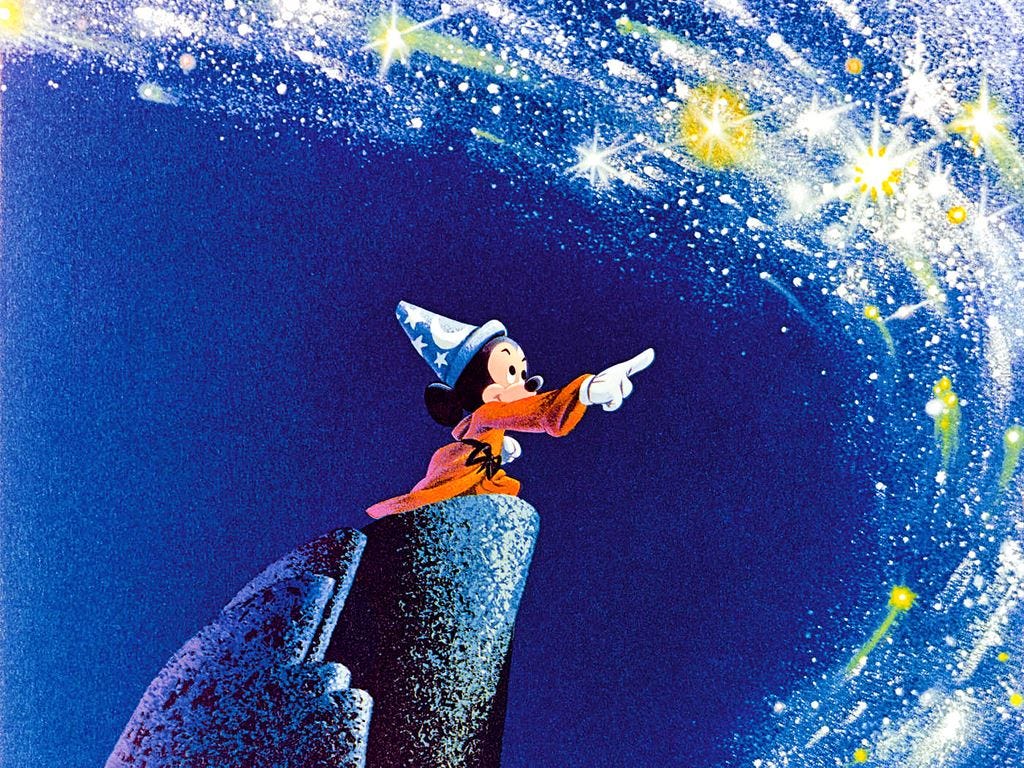
Spend time in any of Disney’s theme parks, or surf the web for signs of Disney’s impact on the world, and you’ll inevitably come across the image of Mickey Mouse dressed in his apprentice garb, using his hands to direct the cosmic energies around him, almost like an orchestra conductor. The imagery in this short segment holds some intriguing insights into the shifting energies of our time, I’d suggest—specifically the potentials and dangers of the emerging Age of Aquarius, the sign of the water bearer.
First of all, as we saw earlier, Walt Disney’s horoscope itself holds some clues along these lines, since he was born under the influence of a Sun/Uranus conjunction. At its most dramatic, that energy can indicate an attunement to futuristic or even revolutionary currents in society, as well as to technology and media in general. That’s obvious enough in Disney’s case, considering his impact on media and television across the world, as well as through the massively influential Disney empire, which ballooned to gargantuan proportions in his wake. But due to the connection between Uranus and the sign Aquarius, which this planet co-rules, that conjunction of his also implies a potential connection to the concerns of the Great Age emerging onto the world stage now at seemingly breakneck speed.
Although the link is subtle, it’s also worth noting the stylistic synchronicity between the musical composition which accompanies Disney’s “Sorcerer’s Apprentice” and another musical work composed several decades after Dukas composed his. I’m refer- ring to the “Uranus” suite from Gustav Holst’s famed The Planets, an orchestral work characterized by unconventional time signatures and abrupt key changes (stylistic elements distinctly different from those of the other planetary suites in Holst’s work). I once heard a musicologist claim there was no clear evidence Holst ever heard Dukas’s work; but even if he had, it wouldn’t really explain why Holst chose that particular style to represent the planetary qualities of Uranus. To my mind, that coincidence alone may hold a potential clue for us into the deeper nature of Uranus itself, and its powerful but potentially problematic energies.
Let's look deeper. In Disney's animated version of "Sorcerer's Apprentice," Mickey Mouse usurps the sorcerer’s magical powers and taps into energies far beyond his understanding and, eventually, his control. In the process, he nearly brings destruction down upon both himself and the world around him.
In one sense, that's also a fitting description of the role Uranus has played in modern times in terms of the energies and technological capacities it’s awakened for all of us. Curiously, in Disney’s version of the story, that awakening of powers is accomplished largely by means of a magical cap with stars and planets emblazoned on it—yet another Aquarian touch, hinting at the cosmic and celestial knowledge associated with this archetypal principle. (If we also go with the association between Uranus and the Greek mythic figure Prometheus suggested by astrologers like Richard Tarnas and Stephen Arroyo, we even find a parallel between Disney’s story with the theft of fire motif in that ancient tale, since Mickey is pilfering powers that are not rightly his.)
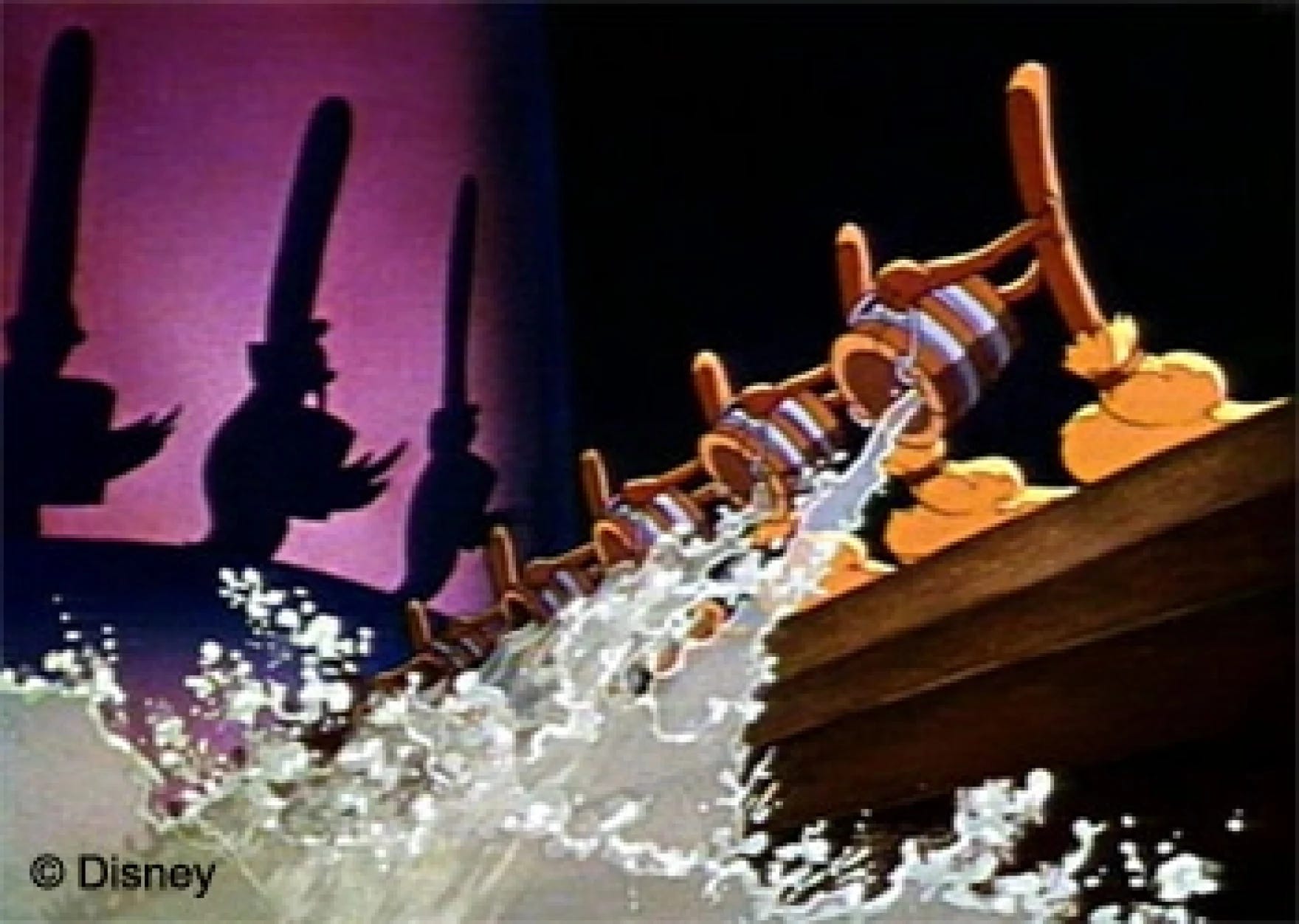
Here we encounter the familiar “man versus technology” motif so prevalent in the Western imagination. The broom that Mickey Mouse commands to perform his chores for him, carrying buckets of water, eventually splits into multiple copies of itself in a way that elicits images of assembly lines, and practically foreshadows cloning, curiously enough.
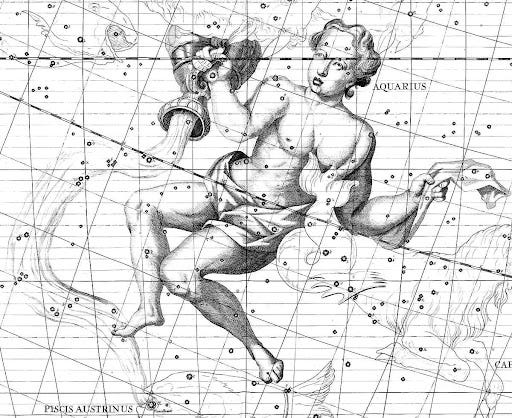
But note the symbolism of that task performed by those animated brooms: it’s none other than that of water-bearers! They carry water for him, but then go too far with their appointed task and unleash a dangerous flood. The symbolic figure most associated in the West with the sign of Aquarius is that of a water-bearer (Ganymede), a task which esoterically signifies the bringing forth of hidden energies into manifestation. The fact that Disney’s tale—and indeed, his entire empire—specifically centers around this core image is itself a remarkable testament to its importance as a cipher to our changing times.
In the end, I’d suggest that Disney’s depiction of “The Sorcerer's Apprentice” can be read as a cautionary tale for humanity as we step into the Aquarian Age, implying both the perils and promises of our newly awakened capabilities (which first burst onto the global stage around the time Uranus was discovered in 1781— also the period of the Industrial Revolution). The technologies we’ve created to take over our tasks for us, from the menial to the momentous, from microwaving meals to atomically powering our energy grids, now threaten to undermine our existence.
And notice that as Mickey is being carried away by his fantasies of controlling the world, it is specifically an environmental disaster he sets into motion: flooding.
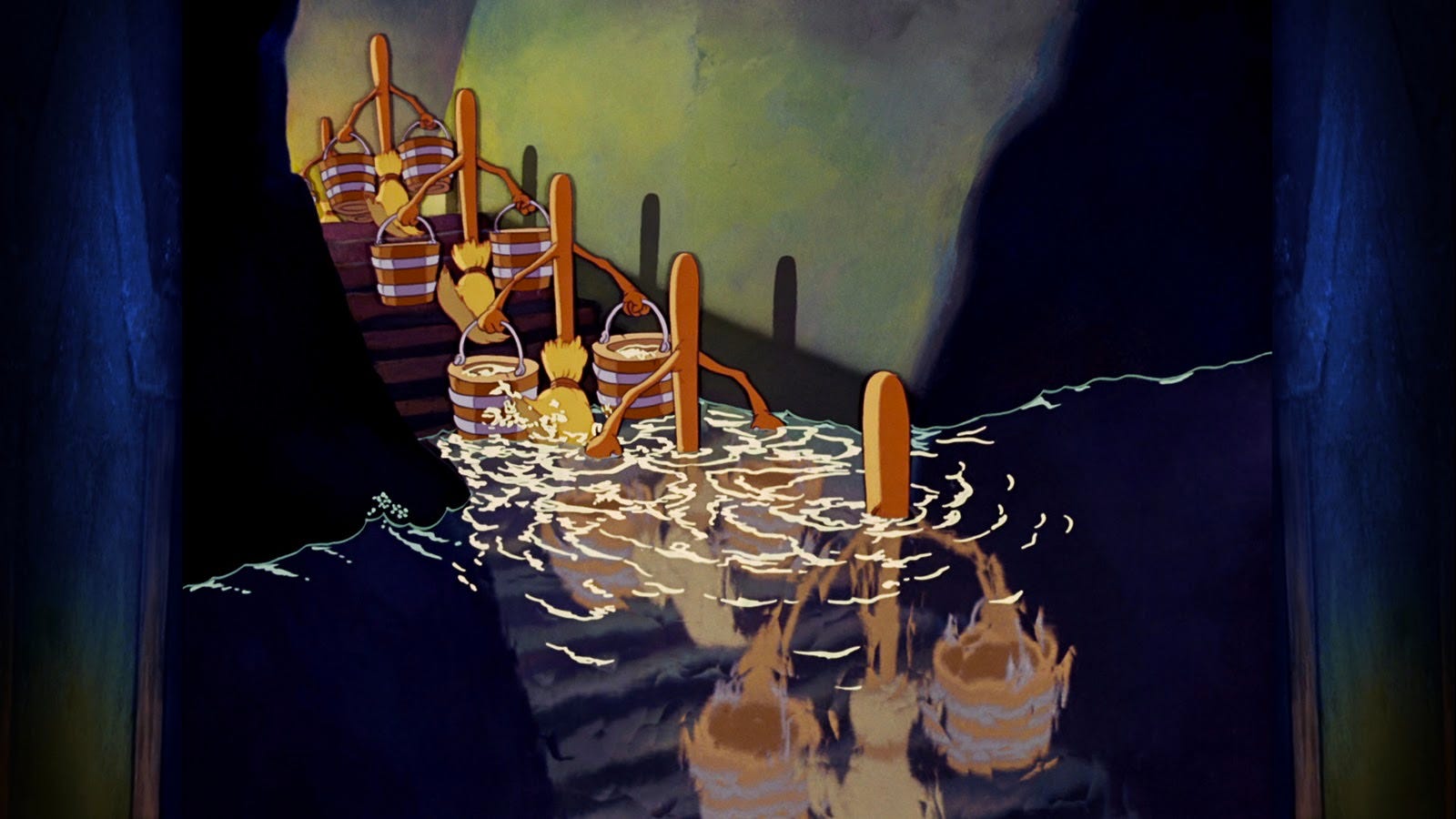
In the film, the water keeps rising ever higher, while Mickey remains oblivious to the mounting dangers around him until he’s practically drowning. As it so happens, one of today’s most pressing environmental dangers is that of massive flooding, due to the melting of the world’s ice caps resulting from a rise in global temperatures.
In Disney’s animated version of the tale, Mickey desperately turns to his master’s books for answers to his predicament; but by then it’s almost too late. I say “almost” because at the last minute the master sorcerer appears and uses his magical powers to avert complete disaster.
Will we likewise be lucky enough to be saved at the last minute by some masterful “sorcerer” in the form of a technological genius like Nikola Tesla, or by divine intervention, or even some altruistic aliens riding to our rescue (ala Arthur C. Clarke’s Childhood’s End)? Nice as it would be to believe so, I think it’s naïve to place our bets on someone other than ourselves to save us from the consequences of our own actions.
Either way, if there’s one thing Disney’s tale makes clear, it’s that this isn’t a child’s game we’re playing.
Ray Grasse is a writer, astrologer, and photographer based in the American Midwest. He is author of ten books, most recently In the Company of Gods. His websites are www.raygrasse.com and www.raygrassephotography.com.