
The Three Channels and the Subtle Body

[This excerpt is adapted from material in two of my books: An Infinity of Gods, a chronicle of my conversations with Shelly Trimmer, a one-time student of Paramahansa Yogananda; and In the Company of Gods, a discussion of public talks Shelly delivered in Chicago in 1985. These passages concern the nature of the chakras and the three subtle energy channels in the body.]
An essential key to understanding much of yogic philosophy is the doctrine of the three energy channels, or nadis, within the subtle body. The “left-hand” current is termed ida, and is associated with our emotional nature, dreaming consciousness, and the astral world; the “right-hand” channel is called pingala, and is associated with our rationality, waking consciousness, and the physical world; the middle channel, sushumna, is associated with balanced consciousness and represents the path of Kundalini, the so-called “serpent energy” of enlightened being.
An individual’s state of awareness at any given time is a reflection of where the prana, or life force, is concentrated within these three channels. When it’s predominantly in ida, one is asleep and dreaming. When it’s predominantly on the side of pingala, the person is awake and physically active. For most individuals, the experience of the middle channel is a far dimmer reality, but can be cultivated and enhanced through meditation. We also taste it momentarily on the border between waking and sleep.
Shelly often referred to the dual influence of ida and pingala on the right and left sides as “being on the wheel,” since it represents the realm of karma and phenomenal experience, fear and desire, and is akin to the “wheel of rebirth” described by Buddhists.
SHELLY: These three states are what you’re normally consciously aware of. If we are in a state of balance, within sushumna, the “wheel” ceases to exist; it comes to a stationary position. So all that is written upon it cannot function. So long as the wheel is moving and you are on the wheel, you’re in ida and pingala, and you’re bound by the law of what is written.
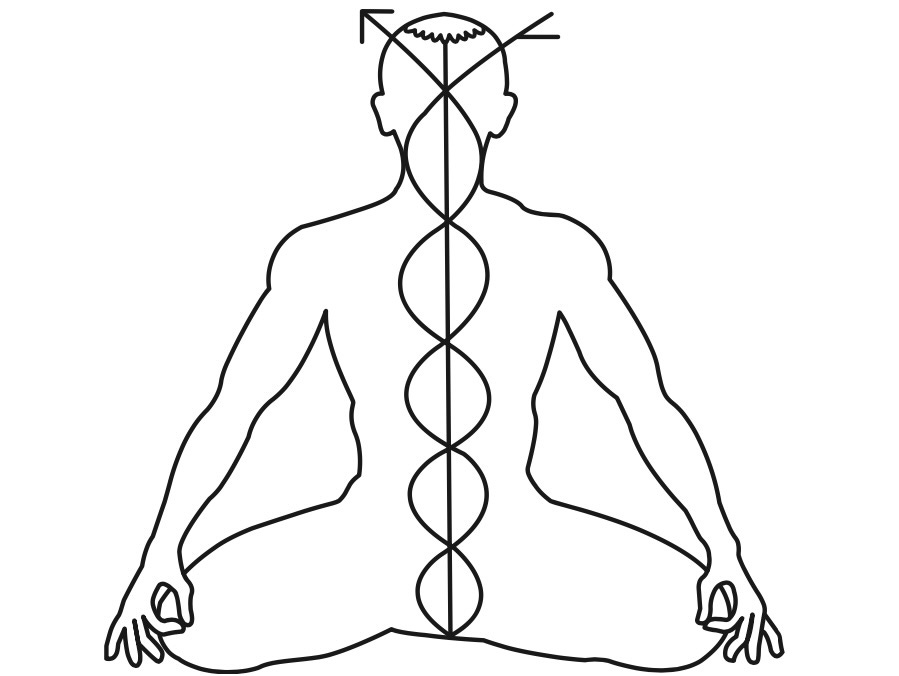
This depicts the three primary channels in the subtle body through which prana (life force) descends and ascends: ida, the feminine, downward-flowing current that relates to emotions and dream awareness; pingala, the masculine, upward-moving current relates to rationality and waking consciousness; and sushumna, the central channel through which kundalini flows when consciousness is balanced between ida and pingala, and which relates to the experience of very subtle feeling states. According to Kriyic mysticism, prana enters the body through the back of the head at the chandra chakra (referred to by Yogananda as the “mouth of God”), and on completing its journey through the chakric levels then exits the body through the ajna chakra, or “third eye,” in the forehead. The concept of these three currents may seem alien to some, but it’s actually a pervasive concept in modern-day society, at least in terms of its symbolism, due to its widespread association with the medical profession. I’m talking here of course about the iconography of the caduceus.

SHELLY: Every time you go to sleep, you pass through sushumna, but you’re only there for a fraction of a second. And every time you wake up, you come out of ida and you pass through sushumna, but just for a fraction of a second. What you’re trying to do is go to sleep consciously. Don’t go all the way into ida; stop before you get that far, stop in sushumna. That’s what you’re trying to accomplish. [What Shelly is describing there is a method for inducing “lucid dreaming”—wakefulness within the dream state. -RG]
When you divide the states of awareness an average person can experience, any kind of true spiritual revelation occurs in sushumnic awareness. That’s where your true saints and mystics draw from when they give predictions, things of that sort. That is sushumnic awareness. Pingalic awareness is what you’re mostly aware of now, in this physical waking world. And when you’re asleep, or you’ve crossed over after death, you’re in idic awareness.
You see, these are the three states of awareness which you’re automatically aware of. At this moment you’re dimly aware of ida, and you’re quite strongly aware of pingala. Now you may have a nightmare in ida, and wind up remaining much more aware of it than usual after waking up; it can be so strong, in fact, it survives after you wake up and essentially overrides your waking state. And if it becomes too strong, it can become an obsession, and now you’ve become not just a neurotic but truly psychotic. The stimulus from the idic world is then controlling your reactions in the pingalic world.
But sushumna brings both of those worlds to balance. When the energies in ida and pingala are equalized, there is no longer a sense of imbalance, and sushumnic awareness can now truly exist. It’s like seeing a child playing jump rope; if you go into meditation and reach sushumna, when that child is at the upward point of that jump they’ll stay in that upper position as if they’re frozen in time and space.
RAY: But would you even see that child standing still if you were truly in sushumna? Isn’t the image of that child a pingalic, physical manifestation?
SHELLY: If you’re in sushumna you can see both pingala and ida.
RAY: So if you’re in sushumna you would see—what, exactly?
SHELLY: You would see reality as it is stretched out in a different way from what you now call reality. It would look entirely different. A saint can also see the future, he can see “God’s plan,” since he’s viewing it in a wider scope than you have when you’re looking at it from either the idic or pinglic worlds. He’s looking at it from the sushumnic point of view.
*******
Goswami Kriyananda related the following story to me about Shelly and the spinal currents which I found intriguing. Shelly’s wife of several decades, Marjorie, had just passed away (1976), and to be supportive and helpful with practical matters, Kriyananda flew down to Florida to spend time with him and help get his affairs in order. But while sitting and watching Shelly walk around the room as they conversed, he clairvoyantly noticed something unusual: Shelly’s spinal energies were perfectly centered in the middle of the spine. It was obvious from the way Kriyananda described this to me that he felt this was both unusual and important. I couldn’t quite understand why, so I asked him, “What’s so odd about that?”
He responded by explaining that most people’s energies are mainly concentrated in either ida or pingala, in the left or right-hand channels. It’s far rarer for our consciousness to be focused in that central channel of sushumna, and that’s usually when the body is perfectly motionless in deep meditation. For anyone to be walking around and conversing the way Shelly was that day while remaining balanced in that central channel wasn’t simply impressive, it was nearly impossible, Kriyananda implied. “It was a great occult education,” Kriyananda whispered, almost as if in awe.
But there was more to the story. During that same conversation, Shelly asked how Kriyananda’s mother was faring, since she’d been sick up recently. Kriyananda replied that her condition wasn’t at good, that she’d fallen out of her hospital bed and broken her hip. Upon finishing that sentence, Kriyananada described seeing the energies at Shelly’s heart chakra veer off sharply, as if to send out a luminous burst of energy towards Kriyananda’s mother. Up to that point, Shelly had been perfectly centered in his spine, but chose to consciously divert his awareness outward to send energies to the ailing woman—this despite his own host of concerns at the moment. Kriyananda added, with a tone of respect, “The incredible unselfishness of the man...”
*******
SHELLY: In their purest form, the chakras are located within sushumna. But they have expressions in both ida and pingala as well. Most of the time we’re only aware of the chakras in their idic or pingalic states, off to the left or right-hand side. In the case of the third, “Martian” chakra, for example, Aries represents its pingalic or masculine expression, whereas Scorpio represents its idic or feminine expression. For the heart chakra, its idic expression is Taurus and its pingalic expression is Libra. And on it goes, for all of the levels. The (visible) planets symbolically relate to the different chakras—Saturn for the root chakra, Jupiter for the second chakra, Mars for the third chakra, Venus for the heart chakra, Mercury for the throat chakra, the Sun for the third eye, or ajna chakra, and the Moon for the feminine pole of that chakra, what Yogananda called the chandra chakra.
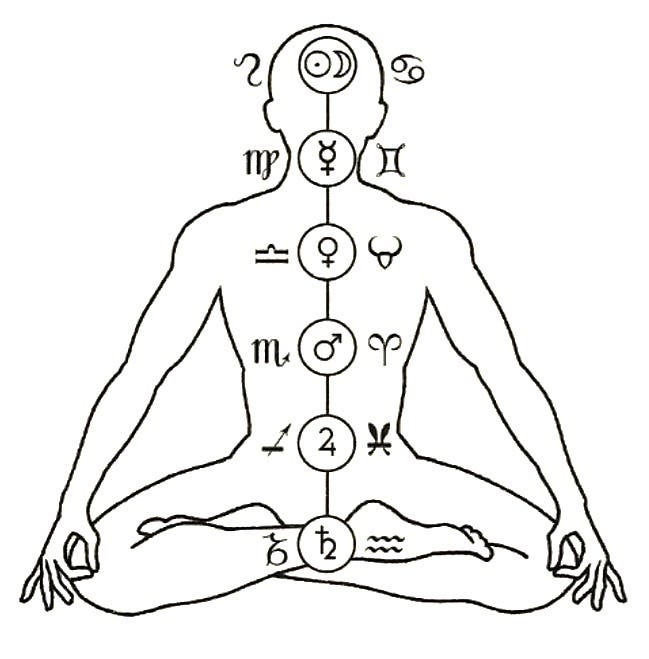
The “inner solar system” is a reflection of the outer universe, with the seven traditional planets corresponding to the seven primary chakras, and the twelve zodiacal signs corresponding to the masculine and feminine aspects of those chakras. (There is no clear astrological correlate to the chakra at the top of the head, called sahasrara, though various esotericists have proposed Neptune, Uranus, or even the North Node.)
RAY: What about the outer three planets, Uranus, Neptune and Pluto?
SHELLY: You can think of those as harmonics of the lower three chakras—Uranus represents an aspect of the Saturn chakra, Neptune is an aspect of the Jupiter chakra, and Pluto is an aspect of the Mars chakra.
RAY: Do the planets express what the different chakras are about exactly?
SHELLY: Exactly? No. The planets are very pingalic, but they come as close as we can in this world. It’s in the central, sushumnic channel where the chakra finds its purest, most balanced expression.
RAY: How different is the chakra in its pingalic nature from its more idic manifestation?
SHELLY: There is considerable difference.
RAY: And each chakra has its expression in the sushumnic channel as well?
SHELLY: Yes, that is the true essence of the chakra, in its balanced form. There are three worlds of phenomenal existence—(as the Kabbalists would label them) Assiah, Yetzirah, and Briah, or physical, astral, and spiritual—and a planet has different expressions in all three of those worlds. [Shelly often spoke about the fourth world described in Kabbalism, Atziluth, or fully transcendental divine consciousness, although this is entirely beyond the scope of the conventional chakras.—RG]
Look at the metals associated with each of the major chakras: lead with the root, Saturn chakra; tin with the second, or Jupiter chakra; iron with the third chakra, which is Mars; mercury or quicksilver with the throat chakra; silver with the Moon chakra in the back of the head; and gold with the third eye, or the Sun chakra. What meditative methods like the Kriya techniques are doing is akin to what the alchemists were talking about, in their esoteric significance, anyway—transmuting base lead into spiritual gold (pointing to his forehead). Then you will have attained the philosopher’s stone.
And strangely enough, though they knew nothing about electricity—at least according to what our textbooks say—each of those metals is more electropositive than the other in that particular order. In other words, if you take any two metals in this sequence and put them into an acid or alkaline solution, one will be positive, the other will be negative, and an electrical current will flow. So that each metal going up is more electropositive than the other. How they determined that back then, we don’t know.
Collapsing the Horoscope
In view of all this, the question naturally arises: Where does free will enter the picture? At the level of reality we’re currently at, according to teachers like Shelly, it’s seriously limited, if not completely dormant. In An Infinity of Gods, I mention how I asked him about this during our first conversation. “In the lower planes,” he replied, “you’re so controlled by desires that you haven’t got any real freedom at all. Your animalistic nature is in complete domination of your awareness.” But is there some way to break free of that domination, so that we can exercise more free will? His answer was “yes” – but to explain that further, I need to say a few more words about the chakras and the spinal currents.
As I said above, the left-hand channel of ida relates to both emotions and one’s awareness in the dream state, while the right-hand channel of pingala relates more to rationality and one’s awareness in the waking state. As also mentioned above, those two channels on the right and left sides comprise what Shelly symbolically referred to as “the wheel”— which is shorthand for the conventional world of time and space that we normally experience, with all its assortment of thoughts and emotions, fears and desires. Most of us are essentially trapped on the wheel, because of our extreme attachment to both emotions and rationality, to the impulses of ida and pingala.
In turn, the key to our freedom lies within that middle channel of sushumna, which is a more balanced state of consciousness that is neither emotional nor rational, neither entirely material or astral, and involves far subtler feelings and insights. In the esoteric Jewish system of the Kabbalah, this channel corresponds closely to the Middle Pillar of the so-called “Tree of Life,” a mystical diagram meant to depict our varied states of consciousness and the various levels of reality.
An extremely simple way of conveying what these three dimensions of consciousness are like, in a manner most readers would likely understand, would be as follows: Imagine you’re caught up in the emotions of a rock concert, a heated argument, sexual excitation, a colorful dream, or just whooping it up at a monster truck rally (if that’s your thing). In states of emotion like these, whether ecstatic or disturbing, your consciousness is focused primarily on “the wheel,” within one or both of those peripheral channels of ida or pingala. In those opposing channels, there is virtually always a strong element of compulsion or emotion (“e-motion”) involved, in a way where you feel driven to act or think in some fashion, whether constructively or destructively.
On the other hand, when your energies are comparatively more centered in that middle channel of sushumna, you’re more attuned to feelings of extreme peace and stillness, similar to what you might feel while contemplating a beautiful sunset, a sublime starry night, or an awe-inspiring work of art. Pay close attention during such moments and you will actually notice that central channel stirring in subtle ways. While such ordinary experiences may not be quite as profound as what mystics associate with full-blown sushumnic awareness (as might be experienced by someone in a truly deep state of meditation), they come far closer to it than when we’re caught up in more emotional or hyper-active states. When we center our consciousness more fully into that central channel during meditation or deep inspiration - or lift even further into the higher levels of consciousness associated with the uppermost chakras – we’re no longer driven by the compulsions and karmas associated with ida or pingala. It’s within that central channel that we essentially “collapse the horoscope,” as both Shelly and Kriyananda described it. That’s because the impulses of the horoscope relate more to the stored energies in ida and pingala, not sushumna. By balancing our consciousness in that middle channel, we essentially neutralize the impulses of the horoscope. Shelly touched on this briefly during his Chicago lectures:
SHELLY: We are enslaved by degrees of unbalance. If we move into a state of balance, though, the wheel [the energies of ida and pingala, and in turn, the horoscope] ceases to exist within us; it comes to a stationary position, so all that is written upon it cannot function. But as long as the wheel is moving and you’re on the wheel, as long as you’re in ida or pingala, you’re bound by the law of “what is written.”
So, when we center ourselves more fully in the middle of the spine, in sushumna, the influence of the horoscope increasingly diminishes, and we’re no longer driven by its compulsions. We are then freer to choose what we want to experience and where we want to go.
This central state of stillness has a host of profound implications. By balancing your energies fully within that inner channel, you not only escape from time, you not only escape from the influence of “the wheel” and your horoscope, but you’re no longer bound even by God’s cosmic dream. As Shelly said, “in the sushumnic world you can be free of this particular creation.”
The work of the mystic is therefore learning how to center within that middle channel, and ultimately move those energies up the spine into the seat of consciousness in the head regions —“surfing the wave” of kundalini up to the headwaters of that sushumnic stream. This can be achieved through certain Kriya-style techniques, and is reinforced by a disciplined and sustained control of one’s desires and impulses throughout waking life.
In turn, when one comes back down the spine and returns to the conventional world again, one’s unbalanced energies naturally re-activate that connection to “God’s cosmic dream” and its memory banks, at which point the horoscope, as well as conventional reality, begins moving again.
Yet that is all experienced now from a more balanced and controlled perspective than before,. Indeed, even if one’s experience of that central balanced channel or those higher centers lasts for just a moment, it can be just enough to shift one’s entire perspective in significant ways – like someone who’s been confined to a dungeon their entire life and is allowed only a brief glimpse of the open sky, and of freedom; from that point on, that individual would have a dramatically different conception of the world and its possibilities. Having tasted that balanced state, they’re in a better position to modify their personal reality, since they now have more intimate access to those deeper levels of consciousness from which their manifest realities spring.
Ray Grasse is a writer, astrologer, and photographer living in the American Midwest. He is author of ten books, most recently So, What Am I Doing Here, Anyway? and In the Company of Gods (a book of public discussions with Shelly Trimmer). His websites are www.raygrasse.com and www.raygrassephotography.com.