
THE CROWD WITHIN
MULTIPLE PERSONALITY DISORDER AND TRADITIONAL ESOTERIC PSYCHOLOGIES

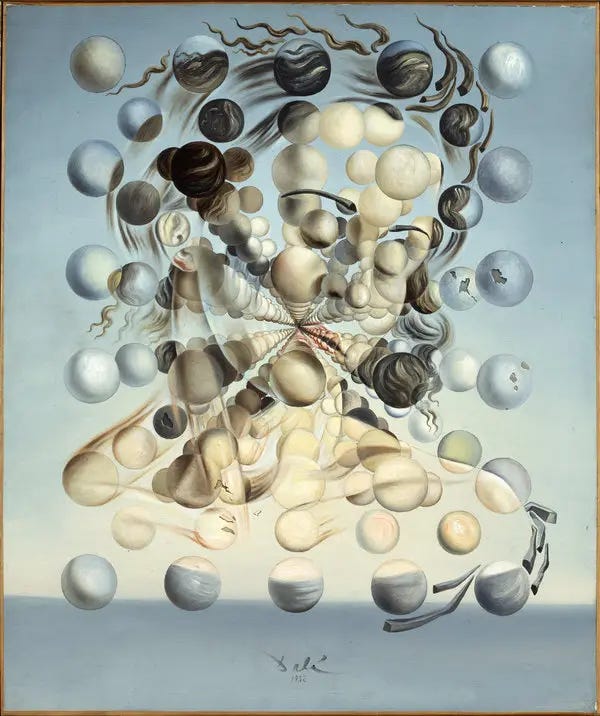
Salvador Dali, Galatea of the Spheres, 1952.
There has been a longstanding debate over the phenomenon of “multiple personality disorder, more commonly referred to now as “dissociative identity disorder,” or DID, including whether it even qualifies as a legitimate clinical condition. It’s a debate that’s continued since I first published this essay in 1992. Disagreements aside, I feel the essential point I made here remains a valid one—namely, that consciousness is essentially multiplistic in nature, whether we understand that through models like MPD/DID or traditional esoteric systems of consciousness like astrology or the chakras.—R.G.
“One of the most harmful illusions that can beguile us is probably the belief that we are an indivisible, immutable, totally consistent being... Each of us is a crowd. There can be the rebel and the intellectual, the seducer and the house- wife, the saboteur and the aesthete, the organizer and the bon vivant—each with its own mythology, and all more or less comfortably crowded into one single person.”
—Piero Ferrucci, What We May Be
In his novel Dr. Jeckyll and Mr. Hyde, Robert Louis Stevenson tells the tale of a man who behaves as if possessed of two separate personalities: at one moment, he’s the refined and mild-mannered Dr. Jekyll, in another moment, the brutal Mr. Hyde, capable of murderous behaviors. While intended on one level as a literary allegory for the dualities that characterize all of our lives, Stevenson may just as well have been describing a condition that has been gaining increasing attention in recent years among doctors and scientists—known as Multiple Personality Disorder (or MPD). Individuals with this condition have been known to display up to as many as several hundred distinct sub-personalities. While there are still many questions about the nature and treatment of this condition, what researchers have already learned could profoundly affect our understanding of both the human body and mind. In this article we will briefly review some of these findings and explore how they may be compared with models of the psyche found in more traditional systems of esoteric thought.
The Causes
While some believe the phenomenon of MPD has likely existed throughout history, it is only in recent decades that researchers have begun gaining their first clear clues into its probable dynamics and causes. In a great majority of cases, it’s believed that MPD- prone individuals share a history of extreme childhood trauma or abuse, either of an emotional or physical nature. Researchers theorize that in response to the overload of disturbing emotions generated by those early traumatic events, the conscious ego defensively splinters off (or “dissociates”) into various sub-personalities through which the buried emotions can then be acted out—usually without the knowledge of the central, organizing ego. Each of these sub-personalities may in turn develop elaborate personal his- tories, sometimes even forming complex relationships with other of the “alters.”
In the book The Minds of Billy Milligan, we find one individual’s intriguing account of how the various sub-personalities may co- exist as active potentials within an individual’s awareness:
“It’s a big white spotlight. Everybody stands around it, watching or sleeping in their beds. And whoever steps on the spot is out in the world... Whoever is on the spot holds the consciousness.” [1]
In recent years researchers such as Dr. Richard Kluft have begun suggesting the need for a more complex view of MPD and its causes. Without dismissing the potential importance of childhood trauma as a contributing factor, Kluft argues that the MPD condition be seen as a complex combination of influences, including such factors as genetic predisposition and suggestibility (or “hypnotizability”), as well as various environmental and sociocultural influences. Kluft theorizes that it is when several factors come together within the experience of one individual that we’re most likely to encounter the extreme dissociative characteristics associated with true MPD. [2]
MPD and the Mind/Body Connection
Among the more startling results of modern MPD research has been the way it’s forced us to reexamine the relationship between the mind and body. The well-known “placebo effect” aside, modern science has remained largely skeptical of claims linking the state of someone’s thoughts or feelings with the condition of their health. Yet in many cases of MPD, researchers have found dramatic evidence suggesting that individuals can exhibit radically different bodily symptoms in different sub-personalities.
For example, a person with severe allergies in their normal conscious state may, on shifting into one of their many “alters,” suddenly exhibit no signs at all of those same allergies. [3] Aside from providing tentative validation for the reality of MPD itself, examples like this raise the obvious question as to how a seemingly lifelong health condition can appear or disappear simply on the basis of a personality shift, unless the body-state was not indeed directly linked to that of the mind/brain. Equally provocative have been those instances in which MPD-prone individuals have shown a capacity to heal bodily injuries more quickly than other, non- MPD individuals. [4]
MPD and Psychology
The findings of MPD research are raising important questions in the field of psychology as well. Could it be, for instance, that the extreme form of splintering that we see in multiples actually reflect a more exaggerated form of a multiplicity that exists in all of us? In other words, is it possible that each of us is a “crowd,” with an inner “cast of characters” that interact to provide the illusion of a single, unified personality? By this model, the chief difference between a “normal” individual and someone with MPD would be that for the “normal” person, the wide array of potential sub-personalities are integrated into a relatively harmonious whole, under the control of a centrally overseeing ego (or “executive”). By contrast, within the extreme dissociative state of an MPD individual each of these different state shifts is magnified and experienced as a separate, autonomous personality.
By way of illustration, the various potential state-shifts might be likened to the “roles” donned by an actor stepping onto a stage. Whereas for the average, healthy individual there usually remains an underlying sense of distinction between the actor and the role being played, for the MPD individual it would be as if the actor fully became the role at hand each time, with little or no sense of distinction between pretending and reality.
For some, however, the possibility of inner multiplicity holds nothing less than the transforming power of revelation. In his book Avalanche, W. Brugh Joy writes:
“One of the most powerful renovations of my consciousness occurred when I entertained the almost taboo consideration that there may simply be no such thing as a single self, a single soul in a body. [This realization has come to] include the possibility that the basis of the human psyche... may be a collective of selves, independent and autonomous yet interrelating with one another, and mostly unknown to the outer awareness...The idea that unknown to the outer mind, many selves utilize the same eyes and the same ears in each body is an awesome creative thought that has profoundly changed how I perceive myself and others.” [5]
The “multiple” model of human nature suggested by MPD research naturally invites comparison with the theories of such thinkers as psychologist James Hillman. In contrast with more conventional psychological models where the personality is often described in terms of an all-important central ego around which other facets of our nature are seen as subordinate, Hillman argues for a psychology that acknowledges all the facets of psyche as important and integral to our psychic well-being.
In that sense, Western psychology has largely tended to be “monotheistic” with its emphasis on rational ego-awareness, whereas Hillman has suggested the need for a more “polytheistic” view of personality, one that could draw fruitfully from the pantheon of ancient mythology for a more fitting representation of psyche’s diversity and needs. [6]
Those considerations aside, the findings of MPD research raise important practical questions. For instance, if we are indeed an inner “crowd,” to what extent can such diverse facets of our personality be accessed or controlled at will? Consider the case of Billy Milligan, for whom the emergence of different sub-personalities was directly related to the needs of the moment. In situations of danger, a particularly strong alter named Ragen became dominant, while in more secure situations a sophisticated and intelligent alter named Arthur would emerge into consciousness. Although for most multiples that accessibility to inner potentials is a largely involuntary affair, it’s not difficult to imagine the benefits that voluntary control over inner multiples would provide.
As to how an individual can develop such skills, a possible starting point would be to explore those psychological systems which purport to help provide mastery over our inner potentials and “selves.” A partial list of these would include such techniques as visualization, the NLP method of “modeling,” and techniques found in Roberto Assagioli’s system of “psychosynthesis” whereby individuals learn to access the assorted facets of their personality by conceptualizing them as “sub-personalities.” Whether or not the philosophy behind each of these systems corroborates the more radical implications of MPD theory, it’s still worth considering what they may have to offer in any deeper understanding of our inner multiplicity and its mastery.
MPD and the Paranormal
By far the most controversial aspect of MPD research involves its potential application to the study of paranormal experiences. In such wide-ranging areas as “channeling,” past-life recall, possession, or even accounts of alien abduction, the theory of MPD has already been invoked as a possible explanation for phenomena that have long baffled scientists and psychologists. For instance, could it be that individuals who sincerely claim to be channeling information from discarnate entities are actually accessing nothing more than sub-personalities in themselves? Or, could an individual who claims to have been abducted by aliens actually have experienced a dissociative “splitting” in which fragmented aspects of the personality were misperceived as creatures external to themselves?
While explanations like that may indeed shed light on some otherwise mysterious phenomena, they have their limitations. That problem becomes even more apparent in those instances where the evidence itself flies in the face of existing materialistic theories. How, for instance, can we fall back on notions of “dissociative disorder” or “multiplicity” to understand substantiated cases of xenoglossy, where individuals are allegedly able to speak languages they couldn’t have learned during their present lifetimes? [7][8] Likewise, conventional theories strain to explain cases where an MPD-prone individual exhibits knowledge or skills absent in their normal conscious state. [9] While still largely anecdotal in nature, such cases would, with further substantiation, revolutionize not just our current theories about multiplicity but human nature itself.
The “Inner Self Helper”
Of the many types of sub-personalities exhibited in MPD cases, there is one in particular that has gained increasing attention for its potentially constructive potential. Termed the “Inner Self Helper” (or ISH for short) by Ralph Allison, this is a unique form of alter which appears to possess the characteristics of a spiritual, even transcendent observer. [10] In contrast with most conventional sub-personalities, which generally possess elaborate per- sonal histories and distinct ages, the ISH is frequently ageless, and often serves as a guide to both the MPD individual and the therapist working with them. This has even led to speculation by some researchers that the ISH might be synonymous with the “Higher Self” or “Inner Guru” described in many esoteric traditions. Other researchers remain skeptical, wondering whether the ISH phenomenon ever appears in clinical settings besides just those in which the therapist already believes in its existence, as if to suggest the possible role of subtle “cues” by the therapist in co-creating the ISH experience. Along a different line, some researchers question whether we can definitively say the ISH is a healthy expression of higher psycho-spiritual potentials or merely another expression of the multiple’s pathology, disguised as a detached, “spiritual” observer.
MPD and Traditional Esoteric Views of Psyche
Finally, let’s briefly consider some possible connections between MPD research and models of human psychology found in more ancient systems of thought. In fact, the notion of inner multiplicity is intrinsic to many traditional systems, of which astrology is perhaps the most well-known. The horoscope is not defined solely by the Sun, of course (even though most non-astrologers tend to think of it that way due to the popularity of “Sun-sign” astrology). Rather, the chart is a map which includes all the major celestial bodies of our solar system as if to suggest that the human psyche is as complex and multiplistic as the cosmos itself.
But there are other traditional systems besides astrology which express that sense of multiplicity, of which two in particular stand out: the Hindu yogic doctrine of the chakras, and the Hebrew system of the Kabbalah.
Within the yogic system of the “chakras” the human psyche is depicted as a complex system of psychic energy centers located along the length of the spine, each with its own psychological quality and concern. Together, these form a hierarchy of values, needs, desires, and emotional dispositions ranging from the most primitive drive towards survival to the highest expressions of spiritual awareness. Interestingly, as I’ve written about elsewhere in this volume, some schools of thought suggest there is a close correlation between these chakric centers and the planetary bodies of our solar system, suggesting that each of us houses an inner solar system mirroring the outer one.
Whereas in the yogic system it’s generally believed that there are seven or eight primary centers within the subtle body, in the Kabbalistic “Tree of Life,” consciousness is viewed as being comprised of ten primary centers of energy, termed “Sephiroth, which are located throughout the subtle body. As different as these two systems are superficially, there are actually striking similarities between them, such as the fact that each of them divvies conscious- ness (and the cosmos) into three vertical channels. In the yogic system, these are called Ida, Pingala, and Sushumna, while in the Kabbalistic system they are known as the Pillar of Mercy, the Pillar of Severity, and the Pillar of Balance, respectively.
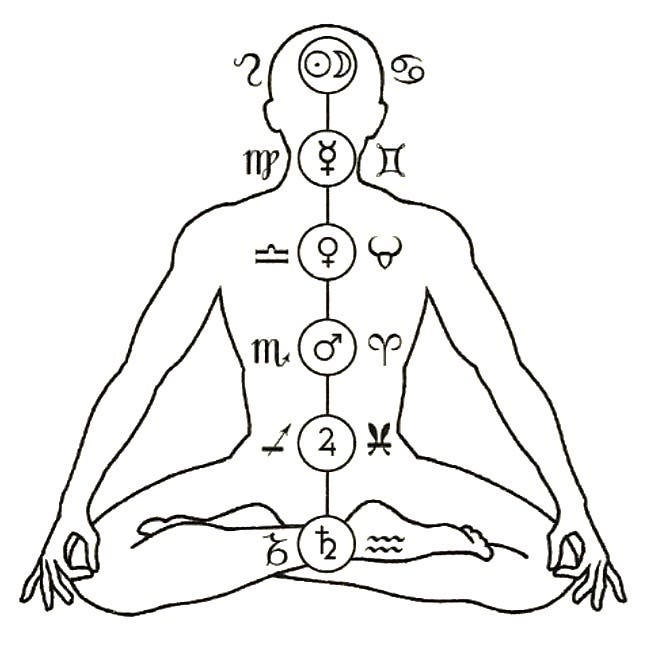
In both of these systems, it’s possible to describe each of these centers in terms of “personifications” appropriate to that center. For instance, in the Yogic system, the fourth, heart chakra (termed Anahata in Sanskrit), might be described as the “inner lover” or “inner artist”; whereas the third chakra (termed Manipura) might be personified as the “inner warrior”; while the fifth, throat chakra (termed Vishuddha) might be described as the “inner communicator” or “inner teacher.” Different individuals in turn express differing degrees of emphasis on different chakras or sephiroths. Genghis Khan, for example, would express a greater activation of the third chakra, because of his warrior nature, whereas a great intellectual like Aristotle might express an amplified throat center.
However, the vast majority of individuals should be viewed as a reflecting a complex blend of different chakras, with those various centers coalescing to comprise the overall state of their personality. Rather than simply being a static pattern, this network of chakric or sephirotic centers can be thought of a constantly chang- ing in accord with one’s varying moods and thoughts.
But to my mind, what’s most interesting about these systems is simply the fact that they depict human nature as multiple in nature, as a constellation of different sub-states in relation to one another. Could it be that within these ancient philosophical models we’re encountering early intuitions into the complexities of personality that modern investigators have only recently been rediscovering? Moreover, if we take the further step of accepting such systems indeed describe actual energy centers in our subtle being, then it’s also worth considering that the various sub-personalities exhibited by MPD individuals—indeed, by all of us in our varied moods and states—might well reflect different activations of these subtle chakras or siphiroths.
It’s also worth considering what insights these traditional systems might offer concerning the deeper mastery and control of our inner potentials. Within both the Yogic and Kabbalistic schools of thought, for example, great importance is placed on the ability to consciously access these various energy centers at will, and towards that end each employs a wide range of techniques. In Yogic chakric psychology, we find complex associations and symbolisms associated with each chakra, which can be used to activate the chakras in intended ways. For instance, if one wanted to activate one’s third chakra, the locus of one’s “inner warrior,” one could meditate on the various images, sounds, or gestures associated with that chakra, or perform certain rituals designed to act upon that center. In this way, one could learn to activate one’s chakric sub-personalities in increasingly complex and interrelated ways, with a degree of skill not unlike that of a concert pianist eliciting melodies from a keyboard.
Yet another potentially fruitful area of comparison between these perspectives is their relative views of psychological health and well-being. Whereas Western psychology has classically described this growth process as hinging on the development of an increasingly strong central ego (or “executive”), for the yogi, the Kabbalist, and some MPD theorists, a healthy personality is seen as one in which all of an individual’s sub-personalities (or energy centers) are harmoniously integrated within a balanced whole.
Ultimately, what this comparison of modern research with more traditional models may reveal to us is a glimpse of our inner potentials, but at different levels of consciousness. In other words, while the majority of sub-personalities displayed by MPD individuals reflect psychological potentials that are more pathological in nature, and therefore located at the lower end of our inner “ladder of selves” (to use Colin Wilson’s apt phrase), in more traditional systems like Yoga or the Kabbalah we encounter the possibility of experiences that extend upwards into much higher levels on that same ladder of consciousness. Indeed, how we as individuals evolve beyond our current stage of development may eventually hinge not only on our understanding of these myriad levels, but on our ability to control or re-direct their energies at will.
Notes:
Daniel Keyes, The Minds of Billy Milligan, New York: Bantam, 1981.
R. P. Kluft, “Treatment of Multiple Personality.” Psychiatric Clinics of North America 7:9-29, 1984.
“Multiplicity and the Mind-Body Problem.” Investigations: Institute of Noetic Sciences Research Bulletin, p. 19.
Ibid., p. 20.
W. Brugh Joy, Avalanche. New York: Ballantine, 1990, pp. 61-62.
James Hillman, ReVisioning Psychology. New York: Harper and
Row, 1977.
Ian Stevenson, Xenoglossy: A Review and Report of a Case. Charlottesville: University Press of Virginia, 1974.
Arthur Hastings, With the Tongues of Men and Angels. Fort Worth: Holt Rinehart and Winston, 1991, p. 163.
W. Brugh Joy, Ibid., pp. 79-80.
“Multiplicity and the Mind-Body Problem,” Ibid., p. 5.
This article first appeared in Quest magazine, Autumn 1992, and was later included in my 2020 anthology StarGates.
Ray Grasse is a writer, astrologer, and photographer living in the American Midwest. He is author of ten books and contributor to many anthologies. His websites are www.raygrasse.com and www.raygrassephotographer.com.