
Stage Fright

[Adapted from my book So, What Am I Doing Here, Anyway?]
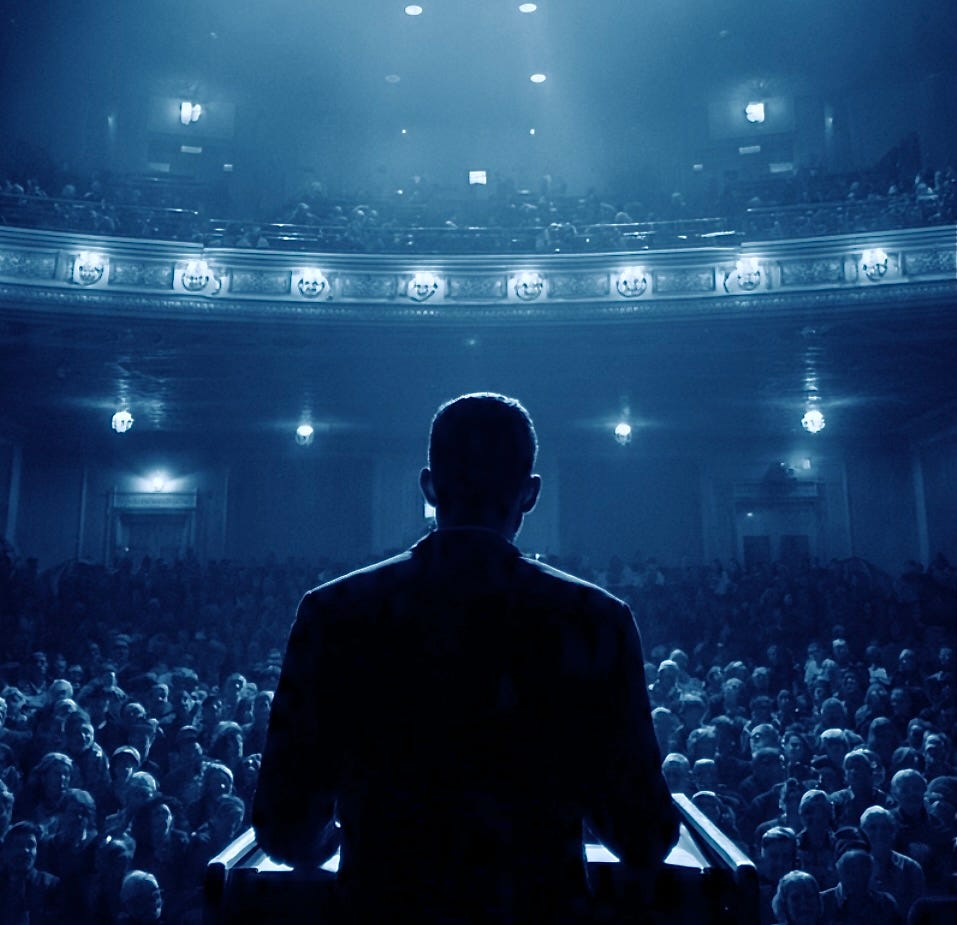
I remember the first time I got up to deliver a public talk. I was about 30 at the time. Only three people showed up, yet despite that small number I felt like my heart might explode. I’d been nervously anticipating the occasion for some time; in fact, I almost cancelled the talk earlier that day due to my nervousness. I managed to get through it, fortunately, concealing my fear as best as I could, but when I went home that day I collapsed from exhaustion, feeling like I’d just finished climbing Mt. Everest without the aid of oxygen.
Whenever I’d come across formal polls showing how so many people rated the fear of public speaking as being equal to or greater than the fear of dying, I understood that myself. It was a powerful phobia of mine for years, and looked like such a natural and easy thing for various friends and associates to do that I simply couldn’t understand why it was so difficult for me.
That case of social anxiety held me back in other areas besides just lecturing or teaching. I was extremely introverted around groups of people, so going to parties back in my teens and 20s was painfully difficult, almost impossible, the few times I even ventured to do it. I’d become a fairly good guitarist by then, to the point where I was asked on a several occasions to join one band or another in the area; yet each time I’d simply wind up making excuses for declining since getting up on stage was such an intimidating prospect.
When a therapist friend at the time suggested I struck them as being on the (autistic) “spectrum,” I couldn’t help but think he was on to something.
But I felt like I had to at least try to overcome it, even if the facing up to the challenge was an intimidating one. Even more intimidating, though, was the prospect of going to my grave with this problem hanging over my head, unresolved.
So, I finally took the plunge of taking a public speaking class in downtown Chicago, which proved difficult but moved the needle just a little. I also used self-hypnosis and affirmations for several years, which also made a dent. After that first small talk to those three people I mentioned, I continued to give talks to a few other small groups.
But surprisingly enough, the real turning point came from a most unexpected source: watching a celebrity being interviewed on a TV talk show.
Actress Barbara Hershey was a guest on the “The Tonight Show” plugging a movie she was appearing in at the time. She was speaking with host Johnny Carson about the paradox of performers like themselves being so outgoing onstage yet often so shy in private. He admitted to being that way.
At one point, Barbara interjected, “You know, Johnny, I think that shyness is really just a form of self-centeredness.”
Obviously taken aback by that comment, Johnny asked her to explain what she meant. She went on to suggest that shy people tend to focus too much on themselves, and it’s that fixation on themselves which often causes them to be so fearful and timid.
Whoa. That was an eye-opener, since I knew she was largely right. Sure, there was more to stage fright for some people than just that—such as hyper-sensitivity to stimuli, the after-effects of early trauma, or even various bio-chemical factors.
But for many of us, it really does come down to that all-consuming concern: “What are these people going to think about me? How are they going to judge me?”
To a large extent, in other words, it’s a matter of ego—not in the sense of “I’m so great!” but more in terms of a narcissistic focus on oneself. As the teacher in that early public speaking class said to us one day, “What makes you think those people out there in the audience are really that concerned about you?”
Several decades later I heard something that struck a very similar chord for me—this time also from a most unlikely source: professional boxer Mike Tyson. Someone asked him about being on the receiving end of harsh criticism and whether that was hard for him to deal with. His response was very wise, and surprisingly Zen-like:
“You know, when I think I’m somebody, I’m really offended by it. But when I remember I’m nobody, it’s okay.”
That says it all, really. Here as well, it comes down to that principle of self-importance. When I think I’m really special or important, the smallest criticism or judgment hurts; but if I remember I’m really no one special, then it’s not such a big deal if those people sitting out there don’t like me or what I’m saying. I’m not suggesting it doesn’t matter at all, just that it doesn’t matter nearly as much.
That early fear of being exposed as being less than perfect started lessening when I began letting go of that attachment to “self.” When I’d get up to present a talk, I made a concerted effort to focus more on the audience, or on the subject at hand, and far less on “ME!”
Simply getting more experience under my belt doing talks made a big difference, too, of course. I became certified as a yoga teacher at one point and taught that to small groups for years. I also taught an evening class at a local community college for two years (the College of DuPage, in Glen Ellyn, Illinois) - an experimental course I called “New Directions in Modern Thought.” The following year (1987) took an unexpected turn when I moved to Arizona for a while and I wound up teaching classes for celebrities and wealthy guests at an upscale resort called Canyon Ranch Spa. While there was still some residual nervousness involved during that time, through repetition the experience became easier. Most important of all, I was learning how to relax.
As a result of all this, I became reasonably good at public speaking. While there’s much room for improvement, it’s generally something I feel comfortable doing now, which I couldn’t have imagined happening back in the old days.
I’d be remiss not to mention another key step in this process for me, which was to always make sure I fully understood the material at hand - inside and out, almost to the point of over-preparing for talks. That allowed me to talk more casually and extemporaneously about the subject at hand, and to not be as worried about stumbling over facts or losing my way. To this day I will often use a rough outline to help guide my way, but I never deliver lectures in a word-for-word manner from precisely written notes. That precise approach may work for some others, but for me it was the kiss of death for any free-flowing presentation.
I’m reminded of a psychologist I once heard who said (paraphrasing James Hillman) that our greatest fears in childhood sometimes hold clues to our greatest potentials as adults. As he put it, it may simply be that the latent potentials inside of us are simply too great for our youthful personality to contain; so instead of feeling comfortable with those potentials, he explained, we respond with terror; we’re overwhelmed by their enormity.
Said another way, our biggest fears are sometimes the doorways to our biggest achievements.
It also reminded me of a story I once read concerning the ancient figure Demosthenes, which I’ve often referred to in my writings. According to the Greek historian Plutarch, Demosthenes was criticized early on by his peers for his problems speaking in public, among them being an “inarticulate and stammering pronunciation.” This prompted him to work especially hard at overcoming those shortcomings, which included going off to the seashore to shout into the surf as a way to develop projection, and also trying to speak with pebbles in his mouth as a way to develop better diction. As a result of efforts like those, Plutarch says, Demosthenes eventually became acclaimed as one of ancient Greek’s greatest orators. It’s a classic late-bloomer story, and offers a good illustration for how one’s greatest challenge can sometimes become one’s greatest talent.
While I may not go down as one of “history’s greatest orators,” that isn’t the point. I was able to finally deal with those early fears, and that’s good enough for me.
Ray Grasse is a writer, astrologer, and photographer living in the American Midwest. He is author of ten books, including An Infinity of Gods, The Waking Dream, and Under a Sacred Sky. His websites are www.raygrasse.com and www.raygrassephotography.com.
Thanks for this very insightful and inspiring piece, Ray.