
Some Thoughts on Christianity
Clarifying the Distinction Between Exoteric and Esoteric Religion

I live in a fairly conservative community, religiously speaking, and recently someone asked me, “What do you think about Christianity?”
It’s the not first time I’ve been asked that, and my answer has pretty much remained the same:
“Which Christianity?”
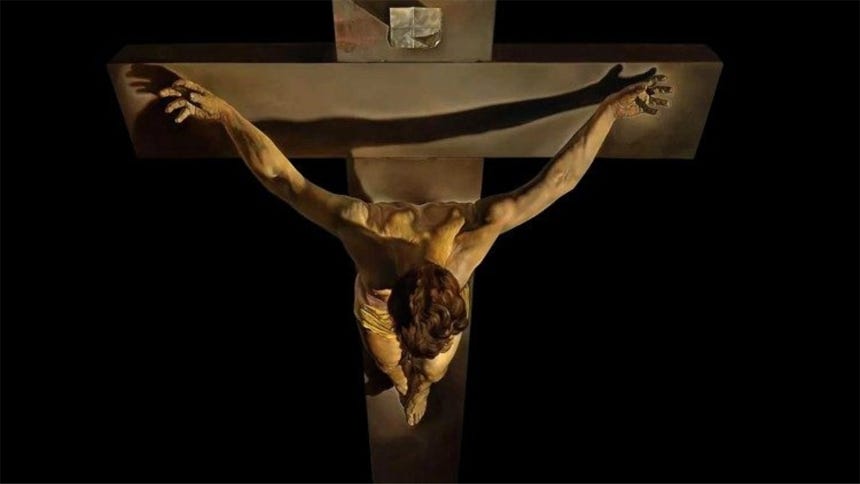
“Christ of St. John of the Cross” by Salvador Dali, 1951.
I didn’t mean that simply because there are different denominations of Christianity, but because when speaking about any religion it can be useful to distinguish between its “exoteric” and “esoteric” variants.
By “exoteric” I’m referring to those religious practices which tend to be more externally-focused, and generally appeal to those assuming a more literal interpretation of scripture – e.g., Jesus is the savior without whom we are damned; he was born from a virgin; he walked on water; rose from the dead, and so on. Generally speaking, exoteric religion is especially associated with those we call “fundamentalists,” those who not only take a more literal view of scripture but believe that accepting those stories as hard fact represents an essential part of their faith.
By “esoteric,” on the other hand, I’m referring to those religious practices which are more mystical in nature and inwardly-oriented, and that generally allow for more symbolic and metaphoric readings of texts. As a result, this perspective regards Jesus as more of an example to follow, exemplifying the potentials we all have within us. As such, for instance, the crucifixion and resurrection symbolizes a potential for sacrifice, selflessness and transformation that’s available to each of us. None of this necessarily suggests Jesus didn’t really exist, of course; it simply means that isn’t as critical a factor compared to how he exemplifies those inner potentials, as a path to follow as we “practice the presence of Christ,” so to speak. After all, the Bible itself says in Luke 17:21, “Heaven lies within you” - a line that to my mind, sums up the essence of “esoteric Christianity” as well as any. [1]
This distinction between exoteric and esoteric doesn’t just apply to Christianity, by the ways. For instance, the exoteric side of Islam tends to be more focused on external rituals, beliefs, and actions, whereas its more esoteric side is closer to what we find in Sufism, as expressed in the works of writers like Rumi and Hafiz, where there is more of an emphasis on inner awakening and communion with the Divine.
We even see this two-fold distinction in Buddhism, with its more exoteric side reflected in the various rituals, chants, and prayers when practiced as an end in themselves - or, to use an extreme example, like the woman I knew who admitted to worshipping the Buddha as a kind of deity. On the other hand, Buddhism in its more esoteric forms - such as we find in Zen or Dzog Chen - places greater emphasis on inner states and direct spiritual awakening. As the famous Zen saying put it, “If you meet the Buddha on the road, kill him!” – meaning that the Buddha represents a path and a potential for awakening, not a deity to be worshipped!
To be clear, I don’t mean to suggest that either of these – esoteric or exoteric – is better than the other; each has its place, depending on the needs and understanding of the individual. But they are definitely distinct!
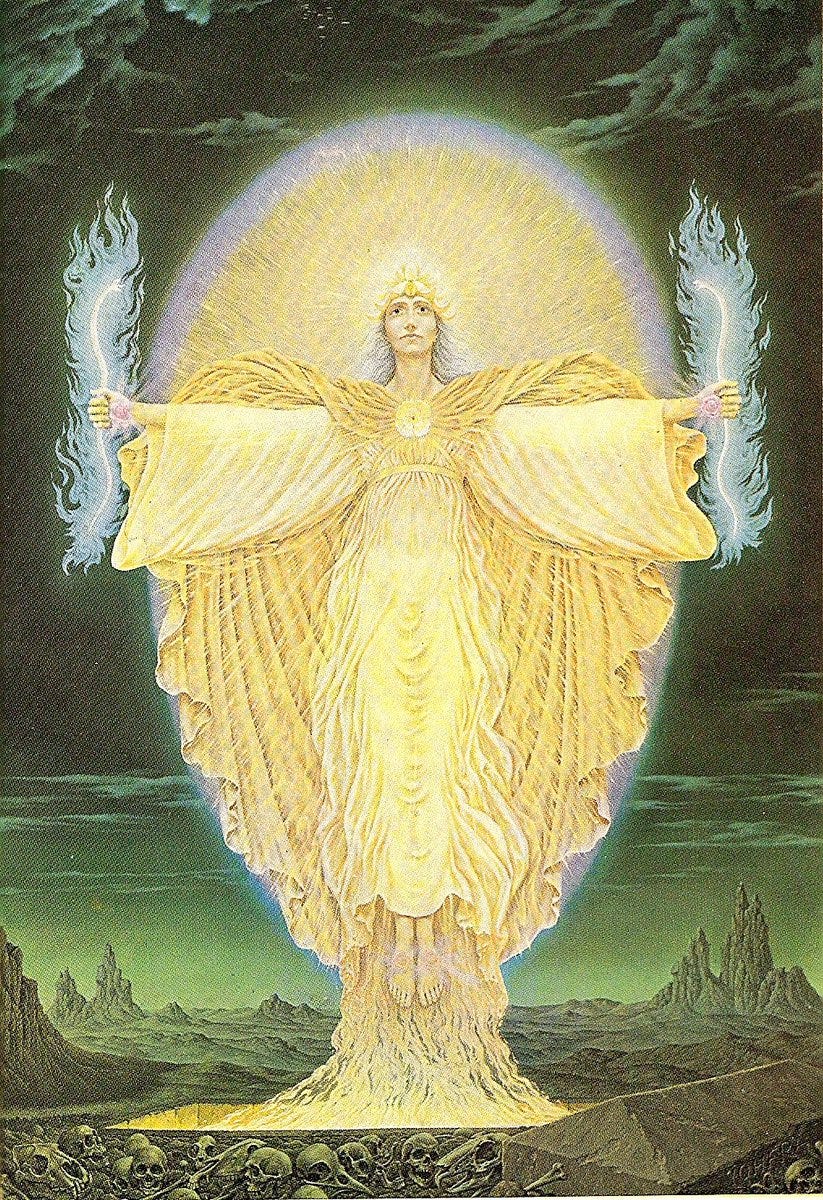
“The Cosmic Christ” by Johfra Bosschart
So, coming back to the question I opened with: What do I think about Christianity?
For those it speaks to in meaningful ways, it’s as profound a path as any. Personally, though, I lean more to its inward, esoteric side – as a religion of love, gnosis (i.e., direct spiritual knowledge), and the revelation of the Christ within.
© 2025 Ray Grasse
1. My friend Richard Smoley (who wrote an excellent book on esoteric Christianity titled Inner Christianity) has noted the way some modern translations interpret those same lines from Luke 17:21. The King James Version translates it accurately as “The kingdom of God is within you.” It is not ambiguous in the Greek, Richard points out; the preposition entos means “within” and not “among,” as some modern versions would have you believe. (Which naturally makes one wonder: were those mistranslations due simply to linguistic incompetence - or possibly because the translators didn’t really want people to believe the Divine could be found within, without any need for external churches or their intermediaries?)
Ray Grasse is a writer, astrologer, and photographer living in the American Midwest. He is author of ten books, most recently In the Company of Gods and So, What Am I Doing Here, Anyway? His websites are www.raygrasse.com and www.raygrassephotography.com.
I've observed that there are three groups who claim to be Christians.
The first group are what have been termed "churchianity" for over 100 years. These are ritualists who quote the NT while behaving opposite to what Christ taught. They are intolerant, rigid, narrow minded in their interpretations, and quick to dismiss and/or condemn everyone not "as devoted" as they are. These are the "prosperity gospel" nationalists who mock or dismiss all other faiths, including Christians who aren't as fundamentalist as they are. It is "religiousity" rather than based in the teachings of Christ.
The second group are followers of Christ, usually affiliated with a church, but are more focused on Christ's message of compassion than outer shows of proclaimed faith or belief in a prosperity gospel. They reject church interference and favoritism in politics, try to live how the Gospels dictate, and are not antagonistic to foreigners, immigrants, or the doctrines of other churches.
The third group actually try to live as Christ taught, without fanfare or making a show of it. They often avoid churches and their dogma, and tend to be welcoming of all other faiths, open to the truths of each and rejecting all teachings other than the Two Commandments and the Sermon on the Mount.
I suspect all religions have these three groups. The brazen, the faithful, and the quiet, corresponding to the outer court, the inner temple, and the "Most Holy Place."
Did you see the DOJ communication regarding religious pratice today? I don't want to say it here.