
Science and Imagination ~ A Psychoanalysis of Scientific Discovery

[The following essay was first published in the magazine Magical Blend in 1990, and has since been reprinted in Greg Taylor’s Darklore anthology (Vol. 8) and my own anthology So, What Am I Doing Here, Anyway?]

“Few men have imagination enough for the truth of reality.” —Goethe
During the last few hundred years our understanding of the universe has been altered in profound ways by the advent of modern science. Largely displacing the religious and mythological notions that shaped our perceptions for millennia there has been a new pantheon of material laws and principles dramatically different from the conceptions of earlier times. Relativity theory, quantum mechanics, entanglement, the quark, the laws of thermodynamics— these are just a few of the unusual new ideas that have come to populate the imaginal landscape of contemporary scientific thought.
But could there be a deeper significance to this process of scientific discovery than we’ve generally realized? Do the myriad findings of science describe for us the hard facts of an outside, physical world—or might they instead be ciphers to the exploration of an inner, more psychological universe that we’ve been engaged in?
In fact, as we’re about to see, the truth may well involve a good deal of both.
Science as Symbol
We’ve largely been taught that science is a dispassionate search for truth, using experimentation, deduction, and rational analysis as its primary tools. In this way, scientists have sought to uncover the objective laws of nature as they exist in the world “out there,” ideally unfiltered by personal bias or belief.
Yet there is good reason to believe that what we’ve been witnessing in the progress of science over the centuries has been as much the reflection of an inner process of psychological exploration, projected onto the outer world, as one of external discovery. This isn’t to say science is nothing more than a psychological construct, with no objective relevance, but rather that the relationship between these two spheres may be far more intimate and symbiotic than we’ve generally realized.
Said a bit differently, it’s entirely possible that the human imagination mirrors the world around it in ways that allows it to grasp those natural principles and laws commensurate with its own development and level of understanding. One only has to examine the history of scientific breakthroughs over time in relation to our shifting cultural values to notice the curious mirroring that’s always existed between these two.
Consider the fact that just as “relativity” began emerging in the sciences we find much the same principle emerging in other fields, too, from the visual relativism of cubist art and the narrative relativism of James Joyce’s novels, to the cultural relativism proposed by anthropologists. Or consider how just as our material universe was being decentralized by Copernicus, who dethroned the Sun as the center of our solar system, our religious universe was being “decentralized” by Luther and the Protestant Reformation, who were loosening the grip of Catholicism on the European imagination.
Understood this way, the ongoing history of scientific discovery begins to appear less like a succession of hard facts about the objective world than a series of shifting mirrors to changes in the human imagination. As the pioneer physicist Werner Heisenberg put it:
“(We have seen) that the changes in the foundation of modern science may perhaps be viewed as symptoms of shifts in the fundamentals of our existence, which then express themselves simultaneously in many places, be it changes in our way of life or our usual thought forms, be it in external catastrophes, wars, or revolutions.” (Emphasis mine) [1]
With this as our starting point, I’d like to briefly explore some other correspondences between scientific trends and corresponding changes in the collective imagination. In particular, I’d like to focus our attention on some of the major stages in our evolving views of the atom. Arguably more than any other, it’s this basic concept that has defined and shaped the course of science in its development from the ancient Greeks up through modern times.
As the essential building block of nature, it’s only natural to look toward this concept as an ideal screen on which to find the changing projections of our unfolding self-knowledge. As the basic unit of the world, the atom serves as a perfect analogy for that basic unit of human social experience—namely, the individual psyche. In this way, the history of the atom reveals itself to be a mirror to the unfolding history of the modern Western ego.

Image: Shutterstock
The Origins of Atomic Theory
The search for the origins of atomic theory takes us back to ancient Greece and the world of Democritus and Leucippus—the same general period as the origins of modern individualism and psychological thought. For just as Democritus was suggesting that the universe could be resolved into a world of indivisible particles, so Greek political philosophy was giving birth to the transformative idea that society could likewise be understood in terms of its primary component, the individual (from the Latin individuus, meaning “indivisible”).
With the decline of Greek philosophy and culture, it would be another two millennia before the concept of the atom would become integrated into the corpus of scientific thought with the rise of the modern scientific method in the 17th century. It was then that atomic theory joined hands with the mechanistic worldview suggested by scientists like Newton and Descartes, both of whom likened the interaction between nature’s discrete parts to the cause-and-effect interplay of billiard balls on a table.
Thus it was during that same period that we find the full-scale re- emergence of individualistic thought as well. As we view the world, so we view ourselves, and during an age when the archetypal building block of nature was increasingly defined in the discrete, analytic terms of the new science, so our view of human personality was becoming increasingly “atomistic” and independent as well, with the emerging belief that each individual’s experience represents the fundamental reference point of social reality.
Indeed, the mechanistic model that helped scientists understand the interactions of atoms also served as a model for social theorists like Thomas Hobbes and John Locke (one of the founding figures of modern democracy), who used it to help explain the behavior of human society. Just as the actions of a gas cloud could be understood in terms of the interaction between its essential atomic and molecular components, Locke believed that the economic and political patterns of a society could likewise be understood through an analysis of its individual members. [2]
Opening the Atom
Perhaps the single most dramatic change in our understanding of the atom came during the late 19th century, when scientists obtained their first glimpse into its mysterious interior. Prior to this point, most scientists regarded the atom as something fundamental and concrete—nature’s “ground floor” beyond which our conceptual tools would likely never penetrate. This appeared so certain and so final that some prominent scientists even suggested we’d finally solved most of nature’s essential mysteries, with the only tasks remaining being those of tying up loose ends of existing theories.
Then, with the epic discovery of the electron by J.J. Thompson in 1897, that longstanding view underwent a seismic shift with the realization that beneath the atom’s surface existed another, previously unknown dimension of reality: the “sub-atomic” level of matter. That is, it turned out that our visible world was just the proverbial tip of the iceberg beneath which there existed an even vaster realm of reality hidden from ordinary view.
At virtually the exact same time, an analogous development was taking place in our understanding of the individual psyche, with the advent of modern depth psychology and the discovery of the “subconscious mind.” Earlier psychologists had largely regarded the conscious personality as being—not unlike the atom— indivisible and concrete, and that our waking thoughts, perceptions, and rational mind represented the essential boundaries of personality.
With the publication of Sigmund Freud’s Interpretation of Dreams in November of 1899, that view was shaken to its core by an idea previously suspected mainly by poets and philosophers—namely, the human subconscious. In this groundbreaking volume, Freud argued that beneath the surface of everyday awareness lies a dimension of emotion and thought vastly greater than our conscious world of thoughts and feelings, but largely hidden from view like the submerged portion of an iceberg. While difficult to perceive, it was partially visible through such symbolic expressions as our nightly dreams and ordinary slips of the tongue. Whereas earlier psychologists sought to understand human nature in terms of our observable surface behaviors—not unlike how pre-20th century physicists studied the atom through its observable, quantifiable features—Freud believed the study of human psychology was properly understood only through a deeper understanding of this subconscious domain of experience. [3]
Continuing Revolutions in Atomic Theory
During the following decades, the discoveries unfolding in both of these spheres—the sub-atomic and the subconscious—continued to parallel each other in sometimes surprising ways.
At first, a simple “orbital” model was proposed to help explain the atom’s structure and behavior. Suggested first by Niels Bohr and Ernst Rutherford, this model depicted the atom as a kind of miniature solar system, containing a central nucleus surrounded by orbiting electrons. In psychology, that model became a template for both Freud and his student Carl Jung as well, who employed the orbital image to illustrate the dynamics of human psychology. Interestingly, whereas Freud chose to place the ego in the central position corresponding to the atom’s nucleus, Jung thought it more accurate to reserve that central position for his concept of the “self,” in turn exiling the ego out to psyche’s periphery.
It wasn’t long before this simplistic model gave way to more complex understandings on both fronts, scientific and psychological. Having stepped into the vast interior of the atom, physicists found themselves encountering a world of unprecedented strangeness that resembled nothing so much as Lewis Carroll’s tale of Alice through the looking glass. Here were particles that seemed capable of traveling both forwards and backwards in time, particles which could be in two places at once, or that might exist only as “probabilities.” At this level of matter, scientists encountered laws and characteristics that seemed to defy the orderly logic of everyday, macroscopic reality.
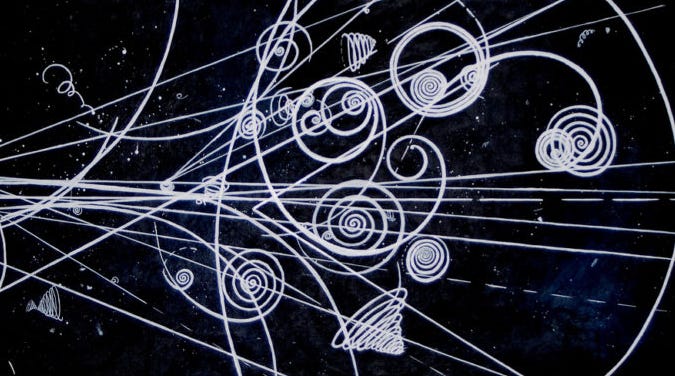
"Smashing Particles" by Senamile Masango University of the Western Cape M.Sc.
In the realm of psychology, researchers were arriving at conclusions almost as unusual as those emerging in science. As a result of the work by not only Freud but Carl Jung, we were encountering a dimension of experience where the prevailing laws seemed more akin to those of dream logic and myth than the linear characteristics of ordinary rationality. An especially graphic expression of that shift became apparent in the works of artists and writers influenced by unfolding developments in psychology like Salvador Dali, Rene Magritte, and Max Ernst, as well as novelists like James Joyce. In their own way, all of these aimed to give expression to the subtleties of the unconscious mind. In books like Joyce’s Ulysses and Finnegans Wake, for instance, we find a world of mythic resonances and dizzying correspondences that would seem perfectly at home in the newly emerging “zoo” of quantum physics. Indeed, there’s something fitting about the fact that the name chosen by scientists to designate one of sub-atomic physics’ most important particles—the quark—was drawn directly from the pages of Joyce’s Finnegans Wake!
The Holistic Atom
Among these new discoveries about the atom was the surprising insight that it might be best understood not as an isolated “thing” so much as a complex web of relationships. According to quantum physics, the physical world itself must be seen
“...not (as) a structure built out of independently existing unanalyzable entities, but rather a web of relationships between elements whose meanings arise wholly from their relationships to the whole.” [4]
In psychology, theorists like Harry Stack Sullivan were proposing a similarly holistic view of human nature with the suggestion that personality is best understood not in isolation but as inseparably entwined within a web of social relationships. Likewise, Carl Jung increasingly came to perceive the human personality as playing host to a dynamically interacting array of “complexes” and archetypal patterns. He further believed, with his theory of the collective unconscious, that the psychic roots of each person were fundamentally entwined with those of all beings.
No less revolutionary in the realm of science was the unsettling element of “unpredictability” which characterized the behavior of particles at the smallest levels. In direct contrast to the secure determinism of macroscopic, everyday phenomena, physicists discovered that the more closely one examined the atom’s interior, the less it lent itself to predictable analysis. At the level of sub- atomic matter, nature itself almost seemed to be ruled by chance. Yet as unpredictable as things appeared at the level of individual atoms, scientists learned that by examining atoms in large numbers they could establish a statistical curve which made accurate predictions possible. The larger the number of atoms, it turned out, the more accurate the predictions about them could be.
On a cultural level, that element of unpredictability was closely paralleled by the rise of a similar view in our understanding of human behavior. While the actions of any one individual may indeed be unpredictable, if analyzed in large enough numbers it was possible to predict behavioral patterns with great accuracy— an insight that held particular appeal for proponents of Marxism, with their emphasis on quantity over quality. As the philosopher Immanuel Kant said long before, whereas each lover may see their relationship as unique and all-encompassing, the man down at the registry office somehow knows there will be more marriages in Spring than in Winter!
Exploiting the Energies of the Atom
As important as these various developments were, they were superseded by an even more far-reaching development: unlocking the enormous energies within the atom. That began with Leo Szilárd’s hypothesis about the possibility of atomic “chain reactions” in 1933, followed by the discovery of fission in 1938, and culminating in a fiery climax with the detonation of the first atomic bomb in 1945. As Carl Jung suggested, we might look to this historical development as a profound symbol for humankind’s awakening to the enormous powers housed within the human psyche itself—energies that could be employed towards either constructive or destructive ends.

Importantly, 1933 was also the year Adolph Hitler began his ascent to power as Chancellor of Germany, and which likewise came to its apocalyptic climax in 1945 with Hitler’s death. It’s easy to see in the personality and life of Hitler an extraordinary—if horrifying— example of the human mind’s ability to draw upon the latent energies of the psyche to effect change in the world. From the standpoint of the ego, Hitler’s rise to power was indeed a “triumph of the will,” to borrow Leni Reifenstahl’s famed film title; yet it was a form of will that issued from the darkest instinctual layers of the psyche.
Some of those who witnessed Hitler’s speeches remarked on the nearly hypnotic power he exerted on audiences, as though he was channeling a force larger than himself, one rooted in the depths of the European psyche. Hitler’s political skills seem to have involved the realization that the secret of mass influence lay not in well-reasoned arguments, as most politicians believed, but in appealing to the primal impulses of the human psyche. Towards that end, Hitler and his associates often employed mythic and religious elements in Nazi ceremonies and iconography toward manipulating public opinion.
Carrying this analogy one important step further, we can see yet another correspondence in the scientific phenomenon known as the “chain reaction,” whereby energies released from a single atom can ignite the energies contained within many adjoining atoms. That presents an apt metaphor for the way certain charismatic individuals like Hitler, Mussolini or Hirohito, or even Churchill and Roosevelt, were able to ignite the passions of fellow citizens towards effecting social change, for good or ill.
New Directions
Since the time of Hiroshima and Nagasaki, scientists have continued to deepen our knowledge of the atom, and in the process have expanded the list of sub-atomic particles from the roughly two-dozen known at the end of World War II to the hundreds of nuclear particles and anti-particles now officially recognized by physicists.

Among the more speculative developments resulting from this ongoing process of investigation has been the “Many Worlds” hypothesis, which suggests an endlessly proliferating number of worlds from out of the probabilities described by quantum mechanics. Then there is the hotly debated notion of “String Theory,” with its proposed multiple dimensions of reality, as well as Alan Guth’s theory of the “inflationary universe” and its notion of multiple universes emerging out of the Big Bang. If confirmed, any one of these theories would represent a revolutionary development in the history of science; but what could they possibly mean as mirrors to shifts in the human mind? One possibility may lie in the research of figures like Russell Targ, Hal Putoff, and Dean Radin into the realm of psychic and “paranormal” phenomena, and the hidden powers of the human mind. We may well be standing on the threshold of a dramatically new view of our world, both outwardly and inwardly.
And what of scientific discovery over the next 50, 100, or even 10,000 years? In a curious echo of the late 19th century, we’ve once again heard some scientists proclaim we might again be on the verge of unlocking nearly all of nature’s essential secrets, and perhaps even creating an all-encompassing “theory of everything.”
Yet if scientific discovery is as much an inner process of exploration as an outer one, one has to wonder whether there can ever be an “end” to our explorations? For if the limits of our science indeed mirror those of the human imagination, then our grasp of the external universe will end only when we’ve ceased plumbing the fathomless depths of the human psyche.
Notes
1. Werner Heisenberg, “The Representation of Nature in Contemporary Physics,” Daedalus, Vol. 87, No. 3, Summer, 1958, p.101. There’s something worth adding here. In recent years several distinguished scientists have come forward to support the controversial theory of “intelligent design”— the notion that the intricate patterns and design found in nature likely point to the existence of a creator or “God” underlying it. (See “Return of the God Hypothesis,” by Stephen C. Meyer, as one prominent example.) Of course, few things trigger materialistically-minded scientists more vociferously than this theory, who dismiss its proponents as simply motivated by their pre-existing religious views. Yet if one chooses to invalidate Intelligent Design arguments solely on that basis, then one is essentially obliged to dismiss the work of figures like Isaac Newton, who also held strong religious beliefs fueling his search for the underlying laws of the universe.
2. For a more complete explanation of Locke’s theory of the relationship between atomic and social behavior, see Fritjof Capra’s The Turning Point, Simon and Shuster, New York, 1982, p.68, 69.
3. Freud’s Interpretation of Dreams wasn’t his first published statement about the subconscious (nor was he its only proponent; Josef Breuer suggested a similar idea in his book Hypnotic Theory back in 1882). However it’s the work most often seen as introducing the concept of the unconscious to a worldwide audience. (Worth noting, incidentally, is the fact that Sigmund Freud and his scientific “doppelganger,” J.J. Thompson, were almost exactly the same age, having been born just a few months apart in 1856.)
4. Henry Stapp, “S-Matrix Interpretation of Quantum Theory,” quoted by Gary Zukav in The Dancing Wu Li Masters, William Morrow and Company, 1979, p.72.
Ray Grasse is a writer, astrologer, and photographer based in the American Midwest. His websites are www.raygrasse.com and www.raygrassephotography.com.