
ONE SMALL STEP FOR MAN: ASTROLOGICAL REFLECTIONS ON THE FIRST LUNAR LANDING

[This is an excerpt from my book StarGates: Essays on Astrology, Symbolism and the Synchronistic Universe.]
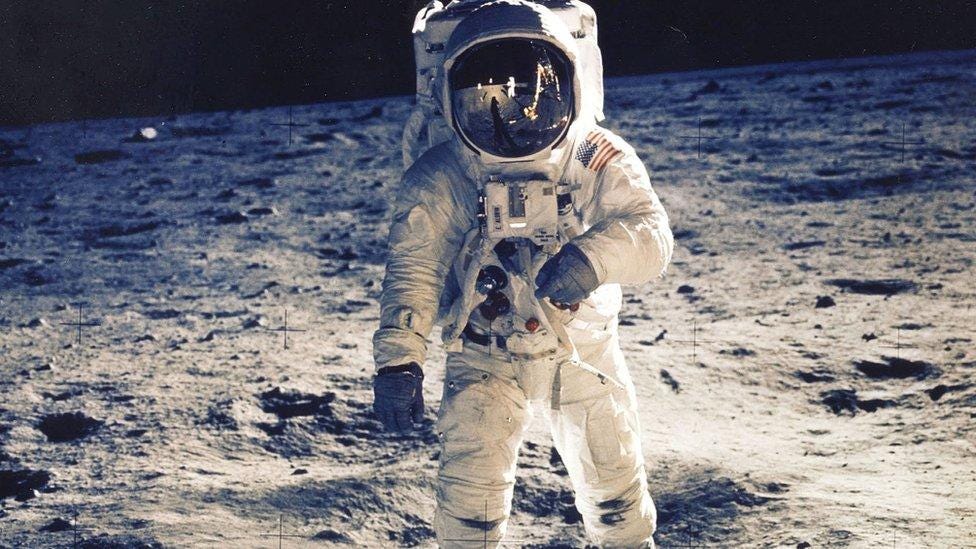
This was written on the 50th anniversary of humanity’s first walk on the surface of the Moon, which took place on July 20th, 1969.
One could likely fill an entire book with all the astrological implications of the first lunar landing—which happened 50 years ago today, the date of this writing. (And yes, the landing really did happen. If you doubt that, simply explain why NASA would go through the effort of faking not just one lunar mission but nine, with six of those missions involving actual landings and strolls across the lunar surface. Surely one faked mission would have sufficed to fool the public, so why bother faking so many more and increase the risk of being exposed? I rest my case.)
Among those astrological factors was the fact that exactly when JFK made his famous speech first announcing the goal to put a man on the Moon, Jupiter was turning direct in the futuristic sign Aquarius; or the fact there was a tight Uranus/Jupiter conjunction at the time of that first lunar landing; or when Neil Armstrong was born, his Moon in Sagittarius was conjuncting the Galactic Axis; or the fact that the first landing occurred on the Uranus opposition point from Charles Lindbergh’s solo flight across the Atlantic, 42 years earlier—and on it goes. [1]
But a somewhat different approach would be to view the mission in the context of the shifting Great Ages. After all, this was the first time humans had ever set foot on a celestial body beyond Earth, so this was clearly a watershed moment, both historically and symbolically—and one that might even hold archetypal significance as a key toward understanding the coming era. Because even if the Aquarian Age won’t be in full force for quite some time yet, it should be obvious we’re already seeing early harbingers of it in play, through developments like the Internet, space travel, and democracy, all of which are decidedly not Piscean Age manifestations!
I remember years ago hearing a radio interview with the late author Stephen Levine where he spoke about the live television broadcast of Neil Armstrong’s walk on the Moon in 1969. He mentioned hearing it suggested that the emerging Great Age would begin “with the one-pointed consciousness of the whole world on a single happenstance.” No doubt, that ties in closely with one key aspect of Aquarian symbolism—namely, the linking up of many minds across the planet. It’s fairly miraculous when you stop to think about it, really, the possibility of billions of people tuning into the exact same thought at the exact same moment, by means of technologies like TV, radio, or the internet.
But that’s a decidedly double-edged sword, since that “one-pointed consciousness of the whole world” could just as easily be in service of a totalitarian “hive mind” society as it could be for the uniting of people in more creative or spiritual ways. It’s good to remember Hitler was the first major politician to utilize the medium of television, when he inaugurated the opening of the Berlin Olympics in 1936 (a fact exploited to good effect in Carl Sagan’s novel Contact). So there’s no guarantee which way that collective mental link-up will go, whether for good or ill. Either way, though, the underlying archetype at work seems to be a decidedly Aquarian one.
But then we need to look at Neil Armstrong’s first comment on setting foot on the lunar surface: “That’s one small step for man, that’s one giant leap for mankind.” While it seems clear he botched that line (almost certainly intending to insert “a” before the word “man”), the comment still conveys a distinctly Aquarian message, and one that expands on Stephen Levine’s point: the interconnectedness of life, and how what one being does affects the all. That, too, is a decidedly double-edged Aquarian sword, since a single person with nefarious intentions can exploit that interconnectedness to burn down the world as much as to heal and unite it.
What came as a special surprise for me, though, was learning (thanks to my colleague Larry Ely) that Neil Armstrong himself read astrological implications into that first lunar landing. Here is an actual excerpt from the Congressional record from a talk he delivered to the United States Congress in the wake of that first mission, where he puts the lunar landing into the context of the shift from Pisces to Aquarius:
“We came in peace for all mankind whose nineteen hundred and sixty-nine years had constituted the majority of the age of Pisces—a twelfth of the Great Year that is mea- sured by the thousand generations the precession of the earth’s axis requires to scribe a giant circle in the heavens. In the next twenty centuries, the age of Aquarius of the Great Year, the age for which our young people have such high hopes, humanity may begin to understand its most baffling mystery—where are we going?”
(For years it was essentially impossible to obtain a video recording of that talk, but it’s finally been posted online, with Armstrong’s astrological comment coming in at around the 17-minute mark.)
I find it fascinating to think one of the most famous figures in modern history chose to use this occasion to speak before a group of secular-minded politicians and scientists about an unabashedly astrological view of history. But did Neil really understand the deeper astrological import of what he was saying? We may never know, since no one seems to have uncovered any other statements from him on the topic. I hope those turn up some day.
Whether he did or not, Neil’s setting foot on the lunar surface in 1969 nevertheless offers a useful point of contemplation in our understanding of where we are in the great arc of history, and might even help us solve that mystery he referred to in his address—namely, Where are we going?
Notes
1 . My thanks to E.Alan Meece for first noting the Uranian connection between the first lunar landing in 1969 and Lindbergh’s flight across the Atlantic in 1927.
Ray Grasse is a writer, astrologer, and photographer living in the American Midwest. He is author of ten books, and contributor to many anthologies. His websites are www.raygrasse.com and www.raygrassephotography.com.