
John Daido Loori
Memories of a Zen Teacher

[This is an excerpt from my book The Sky Stretched Out Before Me, adapted from a chapter about my experience at Zen Mountain Monastery in upstate New York, studying under John Daido Loori.]
I arrived at the building’s doorstep on April Fool’s Day of 1986, with a small suitcase in tow. I’d read that this was an old-style Zen monastery, located in the Catskill Mountains of New York and housed in a large A-frame structure that once served as a Christian retreat for young people. I felt nervous standing at the entrance to the building, since I had so little idea of what to expect.
Once inside, though, I was greeted by several friendly individuals who escorted me around the building and set my mind at ease. A few minutes later, the resident abbot, John Daido Loori, happened to pass through the office and introduced himself to me. An imposing but gentle presence, he was an American who served in the Navy for five years before entering the business world, only later becoming a Zen priest. Bald and fit, he appeared to be in his early 50s, and struck me as both gentle and rock-solid at the same time. He was warm and friendly to me, and the others at the center obviously treated him with respect.
As I’d experienced previously with both Shelly Trimmer and Goswami Kriyananda, Daido made no attempt to present himself as better than anyone else, and seemed perfectly ordinary in all his interactions with the others. But I could tell there was more that met the eye to that casual demeanor—a sense of grounded attentiveness that reflected his long years of meditating. He could lecture for hours on Zen when the occasion called for it, but the teaching I remember most of all from him was perhaps the simplest:
“You live your life in the moment. Miss the moment and you miss your life.”
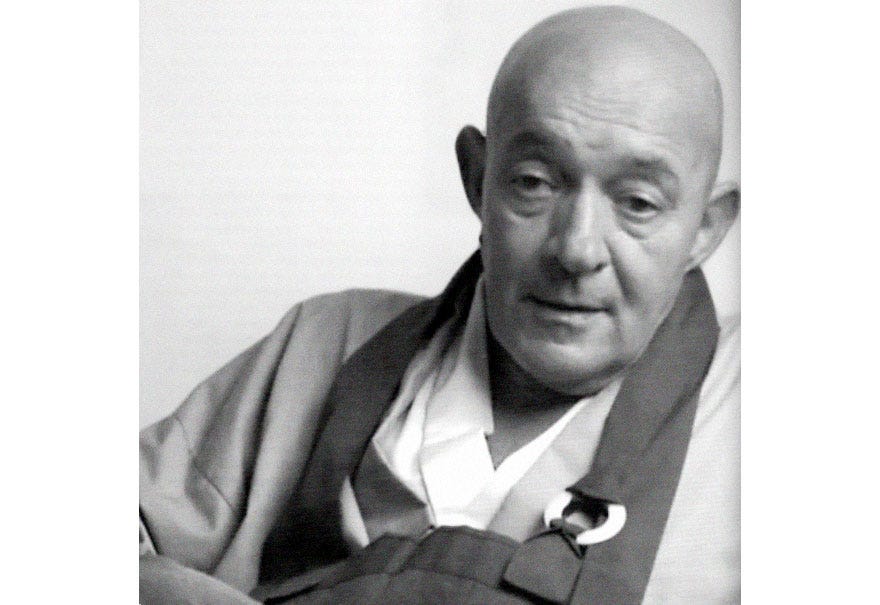
Photo by Stuart Soshin Gray
He was roughly the same age as Goswami Kriyananda (Loori was born in 1931, Kriyananda in 1928) , and there were some other parallels. Like Kriyananda, he too lost his father at a very young age, had a stint in the military, and both of them spent years working in the professional world as a chemist. One chief difference was Daido’s intimate involvement with the arts, having been an accomplished photographer earlier in life, and emphasizing “art practice” as an important activity amongst students at the monastery. In fact, he first got interested in Zen through his studies with the famed photographer Minor White, who exposed him to meditation, chanting, and breathing techniques. Indeed, it was White’s astrologer who told him he would eventually become involved with spiritual teaching and writing books. Upon being told that, he was incredulous.
“I laughed hysterically. I told her, ‘Lady, you have no idea how wrong you are. I’m an atheist! I hate religion!’ She said, ‘No, no— that’s what you’re going to be doing, many years from now. And this is all preparation for that.’”
In one of the books he eventually did write, he said, “I trust zazen because I was probably the most deluded, confused, angry, anti-religious person you could ever meet. There is no reason in heaven or hell why I should be a Zen teacher, sitting here, talking like this. All I know is I found out about zazen.” (“Zazen” is, simply put, sitting meditation as practiced in the Zen tradition.)
He had grown up in a rough-and-tumble neighborhood of New Jersey, and saw myself that he could be tough—well, firm is a better word—in running the monastery and its activities. He essentially struck me as kind-hearted, and his human side sometimes showed itself in unexpected ways. Like the fact that he still smoked cigarettes—a habit which eventually took its toll. Another way was the amusing fact he made no bones about not being terribly fond of the vegetarian cuisine at the monastery, preferring to eat at the truck stop down the road on occasion. I had the feeling he did that as much for spiritual reasons as culinary ones, opting for the gritty ordinariness of the truck stop as a counterbalance to the surreal austerity of the monastery. I say that because I once asked him directly about his philosophy of diet, and he replied how one should “taste a little bit of everything,” and it was obvious he meant that as much a philosophy of life as a dietary guideline.
There were also instances of his vulnerability, and some of those were deeply touching. During one meditation retreat, Daido was delivering his customary dharma talk—a lecture meant to motivate and inspire students in their practice—and recounted an ancient Japanese tale of forbidden love, centering around a young man and woman who encountered assorted obstacles in their efforts to share their love. Although it was just a fictional morality tale, it was a deeply moving one, and by story’s end Daido became so choked up with emotion that he stopped talking and blushed a shade of red so intense I could see it from across the darkened meditation hall. I’d never seen him that emotional before, as compassionate laughter among the students began rippling through the hall. Rather than make anyone feel uncomfortable, his vulnerability evoked great affection from everyone present—especially those of us who knew about the personal heartache he experienced several years earlier when his wife left him for another Zen practitioner at the center.
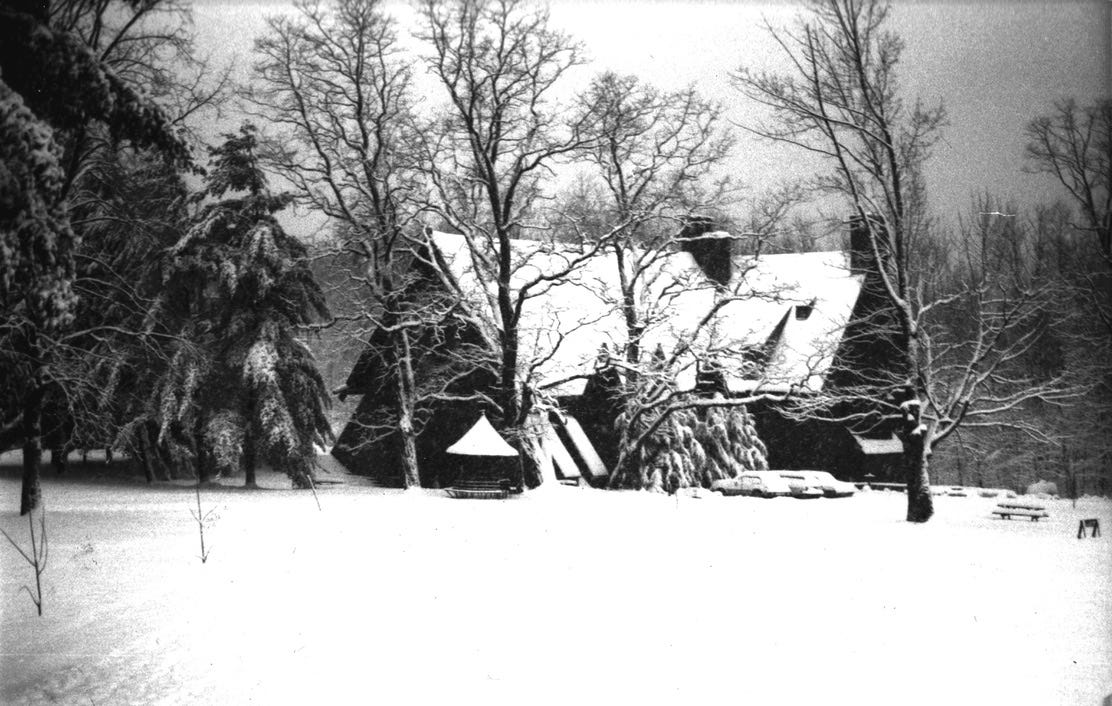
Zen Mountain Monastery, Mt. Tremper, New York. (Photo taken in 1985)
I discovered that Daido and I shared a love of movies. Whenever he had the time, especially on weekends, we knew that Daido watched movies on video cassettes that he rented from that same small video store I’d frequent. His own choice of viewing matter was surprisingly eclectic, and ranged from action films to romantic comedies and art house films, as well as, of course, spiritually-oriented movies. On one occasion, that fondness for film led to an exchange that revealed yet another facet of his life and personality.
Some of us were in the kitchen cleaning up after dinner, when a fellow student teasingly said to Daido, “Hey, aren’t all those movies you watch just an escape from reality?” Daido paused a second, then said, lightheartedly but not without purpose: “Hey, I get enough reality in the dokusan room. . .” The “dokusan room” was the small interview room off from the main hall where Daido would sit face-to-face with individual students ostensibly to discuss problems they were having with their meditation practice, or to discuss some other spiritual matter. But those encounters with students could become intense sometimes, judging from the sounds of crying I sometimes heard through the door to the room as I waited outside. It’s entirely possible those sounds may well have been due to tears of joy resulting from breakthroughs in their meditative practice, but just as often I suspect it was because of how some students approached those interviews more like therapy sessions. And his comment in the kitchen that day told me some- thing very important—namely, that even the most elevated spiritual teachers need some sort of “escape,” some creative outlet to let off steam. In Daido’s case, he had a hefty burden of responsibility on his shoulders overseeing the monastery and its residents, and it was obvious that movies were a key release valve for him.
As for my own release valve—I would sometimes go on hikes through the adjoining mountains, or drive into Woodstock for the afternoon with a fellow student or two, past Bob Dylan’s old home a few miles down the road. But I increasingly spent the bulk of my free time working on my writing projects. I was pleasantly surprised to discover Daido was supportive of my writing, not so much because of the topic itself but because of the intellectual discipline involved. I came to the monastery armed with certain misconceptions about how Zen Buddhists regarded mental activity of any kind, but Daido was careful to point out that Buddhism doesn’t think thoughts are inherently bad, only that unwise attachment to them can be—a point both Kriyananda and Shelly repeatedly made as well. To drive home the point about the importance of “right thought,” he told the following story.
Several years earlier during a brutally cold winter, some of the local residents thought they’d perform a good deed for the nearby wildlife, since it looked as though the local deer population might starve from a lack of food. A few of the townspeople banded together and paid to have a helicopter drop bales of hay onto a spot where the deer could find it. Just as expected, the deer did find it—but not so expectedly, they all died. The reason? Their stomachs had acclimated to eating bark off of the local trees and weren’t able to digest the hay as a result. As Daido explained, that illustrated how using compassion without also using the mind can lead to bigger problems than one began with.
*******
John Daido Loori died of cancer in 2009.
Ray Grasse is a writer, astrologer, and photographer living in the American Midwest. He is author of ten books, most recently In the Company of Gods and So, What Am I Doing Here, Anyway? His websites are www.raygrasse.com and www.raygrassephotography.com.