
India
Meeting a Descendant in the Kriya Yoga Lineage.

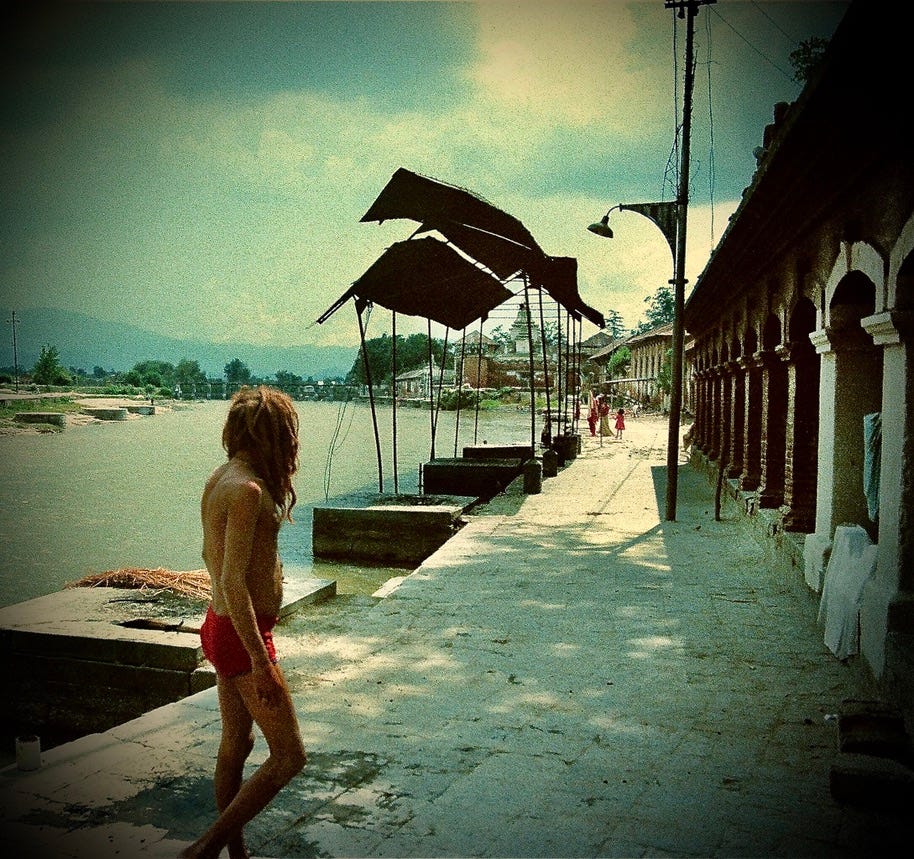
{In the midst of a three-month trip backpacking around the world in 1982, I spent four weeks traveling through India - primarily Delhi, Gaya, Kashmir, Ladakh, Benares, and Calcutta. I’ve recounted that trip in my book When the Stars Align (chapter 39). This short excerpt deals primarily with time I spent in Benares, where I visited a descendant of Lahiri Mayasaya, paramguru to Paramahansa Yogananda, at his family home in that city.]
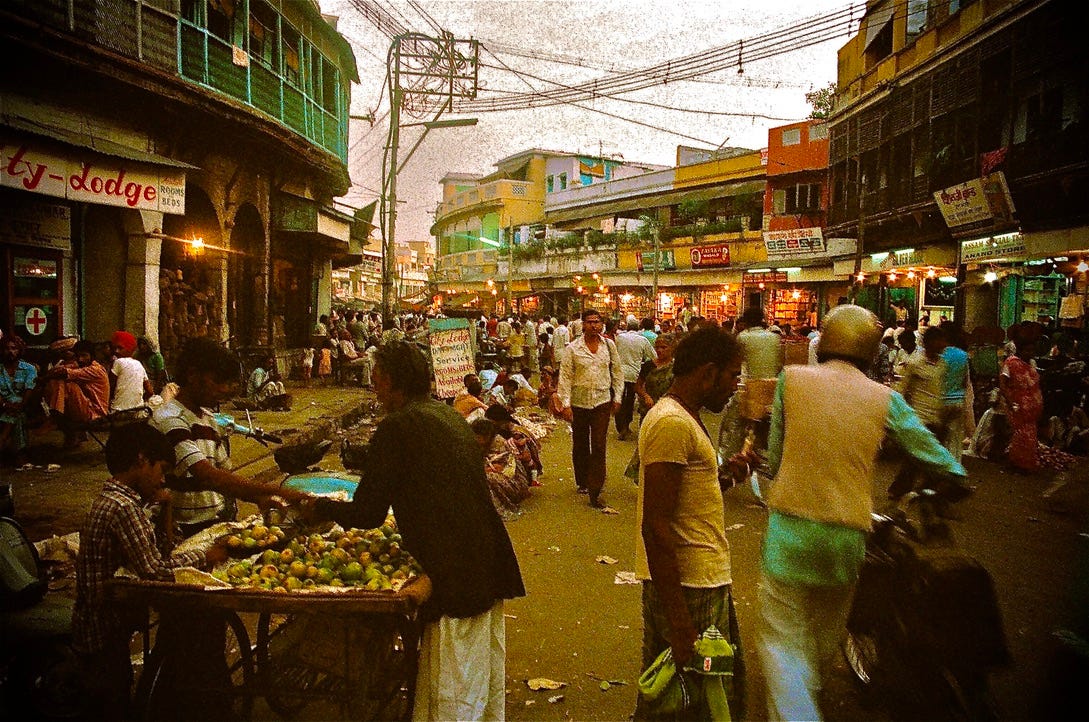
A few days after leaving England, on September 8, 1982, I caught a flight and headed towards Asia. After England, India offered a tidal wave of exotic new impressions, from the brightly colored fabrics and powders displayed in the marketplaces to the disfigured faces of beggar children coming up to me on the streets. I heard an American once describe this as a “dirty” country because of all the garbage, dust, and grime, yet in some ways those elements imbue this country with more life and authenticity than many comparatively antiseptic communities back in the U.S. In a word, it felt real.
Conversing with some of the locals, I found it interesting to discover how many in this country viewed America as a kind of utopia, a fantasy land where dreams naturally come true—an impression surely garnered from our TV shows and movies. But I spoke with one fellow who had traveled to the U.S., and he made a comment that caught my attention. He said he thought that Americans were somewhat “selfish.” When I asked him to explain, he said, “In America you can’t just drop in on people unannounced. They feel it’s an imposition to arrive that way. But in India, you do that all the time, and it’s no problem.”
In Calcutta I walked the streets for hours, simply taking in the sights and marveling at the astonishing poverty. While walking through one fairly dilapidated marketplace, I noticed a curious thing. I came upon a street vendor selling paperback books, most of them in English. Only about forty titles in all were displayed, yet four of those were by authors from my small home town back in Illinois—Oak Park. Ernest Hemingway, Edgar Rice Burroughs, Richard Bach, and Andrew Greeley. That seemed odd, considering such a small community across the planet would be so disproportionately represented on a bookstand thousands of miles away.
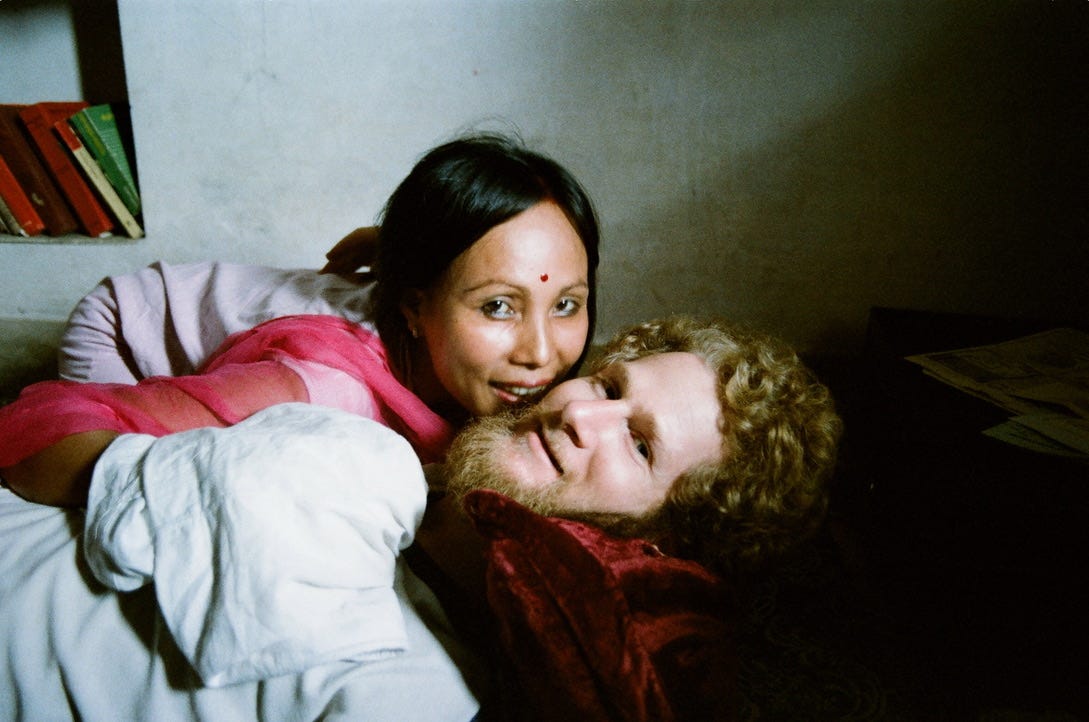
I spent time in Benares visiting my friend Scott, whom I knew from back in Illinois. He’d been in India for two years by this point, completing his PhD in Sanskrit. He had married a beautiful local woman named Roma, an accomplished classical singer and dancer. They lived in a small apartment in the heart of the city, and over the course of a week he showed me to numerous sites both in and around Benares. At one point he took me to see a couple of home-grown Indian movies, one of which was a conventional Bollywood romance, the other a four-hour depiction of the Hindu epic the Bhagavad Gita.
Scott’s own field of academic study was in comparative religion. Before walking into the theater, we spoke about the differences between world religions and their various mythologies, rather than their similarities, as Joseph Campbell tended to emphasize. That point became clear to me while watching the movie version of the Bhagavad Gita, which depicted Krishna as a sort of self-assured playboy, capable of great acts of violence. Whenever he killed one of his enemies, the audience cheered its approval. This was all quite different from the image of Jesus I’d grown up with as a child—although it wasn’t quite so different from the Old Testament stories I was taught back in grade school.
Unlike many other Westerners coming to India, I wasn’t drawn there to find a spiritual teacher, since I felt I ‘d already encountered some good ones back home. By the time I arrived, I’d been studying for ten years with teachers in the Kriya Yoga lineage, which is a branch of spiritual philosophy and meditation practices brought to the U.S. by Paramahansa Yogananda. One of the key teachers in that lineage (and Yogananda’s guru’s guru) was a fellow named Lahiri Mahasaya, who lived in this city back during the late 1800s and whose home still stands there. That house was the site of a few stories in Yogananda’s famed book Autobiography of a Yogi, so I was interested in seeing it, if possible.
Scott had visited there once himself, and spent some time talking with the current owner, the grandson of that original guru. One evening Scott decided to take me there. After we’d gotten lost on the dark side streets and alleyways of Benares, a patriarchal-looking gentleman sporting a white robe and beard stepped out from the shadows of a doorway saying, “Can I help you?” When Scott explained who we were looking for, the man causally said, “Oh, yes, that is me you are looking for. You’re welcome to come to my house.” It turned out he had seen us wandering aimlessly down those side streets and decided to follow us and see if we were indeed searching for his grandfather’s home.
We sat in the courtyard at the center of his house and spoke for three hours about a wide range of spiritual matters. He certainly fit the mold of a classical guru, and seemed both highly intelligent and sincere in his demeanor. When Scott informed him that I’d never actually taken on a guru myself, he seemed impressed by that. He himself had been an active practitioner of Kriya Yoga since childhood, and made a number of interesting comments about spiritual disciplines in general. Among them was the idea that while techniques have their place, they aren’t as important as one’s underlying sincerity. “Open yourself to God, if that works for you,” he said; “that’s what really counts.”
His most controversial comments involved the legacy of Yogananda and the organization he founded in California, called Self-Realization Fellowship, or SRF. To my surprise, he was critical of Yogananda and the fact that Yogananda went public in forming a large center. His own grandfather, Lahiri, laid down strict guidelines regarding the precepts of Kriya Yoga if one hoped to become an initiate. These included such things as meditating six hours a day—three in the morning, three at night. Also, one should never accept money for spiritual teachings, never seek fame, and never, ever announce your spiritual path publicly.
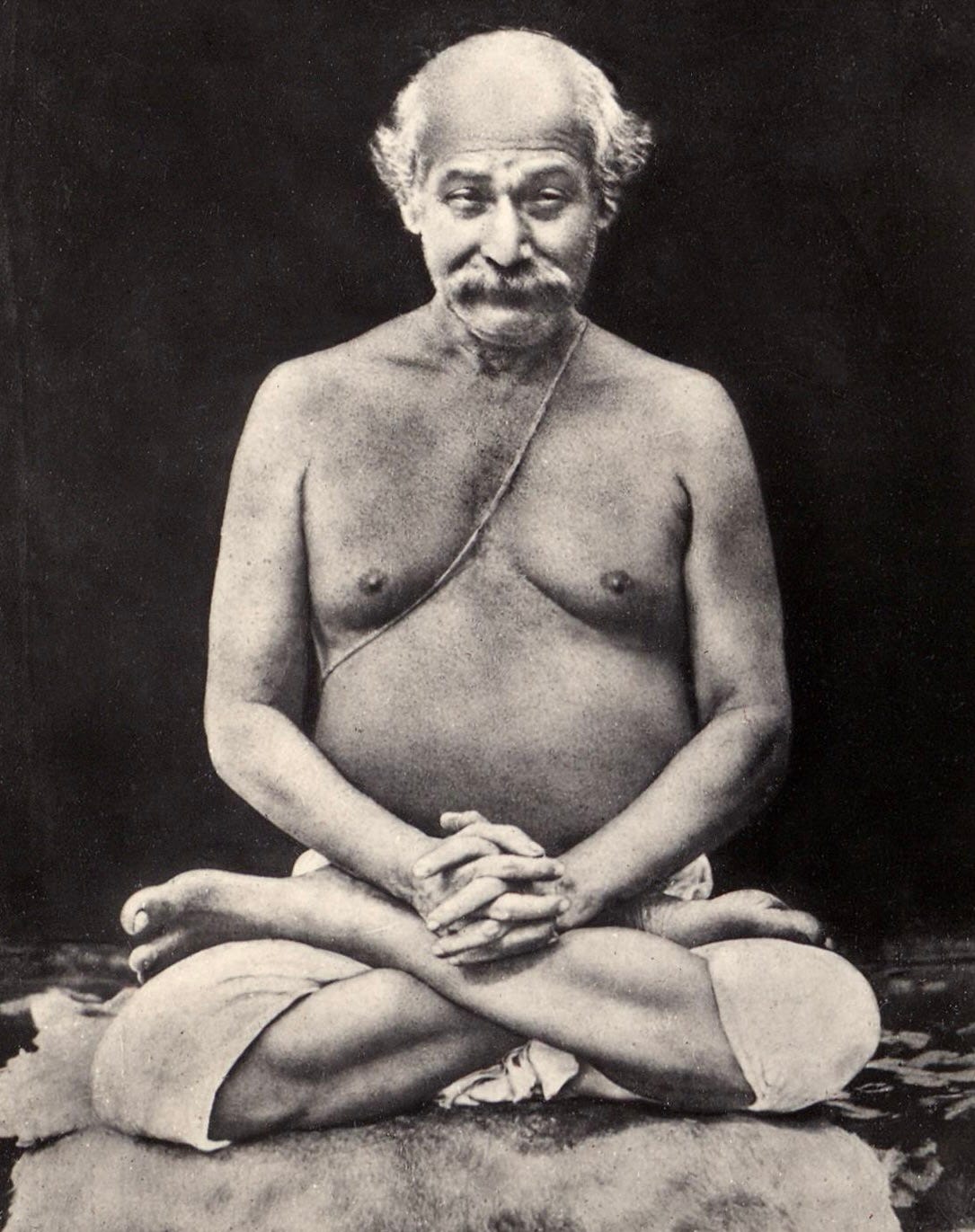
Lahiri Mahasaya (1828-1895)
By Lahiri’s standards, Yogananda struck out on all of those counts. The grandson suggested that Yogananda diluted the techniques of Kriya Yoga when he brought them to the West. He was clearly bothered by the way SRF touted itself as the only authorized outlet for Kriya Yoga teachings anywhere in the world. In fact, he pointed out, there were many legitimate teachers and heirs to this tradition, who are in no way affiliated with that organization. That was actually something I already knew through my own teachers, Goswami Kriyananda and Shelly Trimmer, who were not affiliated with SRF.
I sympathized with him on some of these points, especially the last one, but I came away thinking he was probably too severe in his judgments. By analogy, I’m sure the Buddha’s teachers were none too happy when he broke away from traditional Hinduism to forge his own religious path, but that doesn’t mean he was necessarily bastardizing the teachings. The teachings evolve and change through time, and must adapt to new environments. In that vein, Yogananda did what may well have been necessary to bring Kriya Yoga to the West. The fact that he changed some things along the way was not, in itself, necessarily a bad thing, I thought.
Throughout our conversation, Lahiri’s grandson seemed calm and down-to-earth. His compassion was obvious, and before we left I offered to give him some money, which he refused. Before leaving, he showed us around the house, specifically the areas mentioned in Yogananda’s autobiography, such as Lahiri’s meditation room.
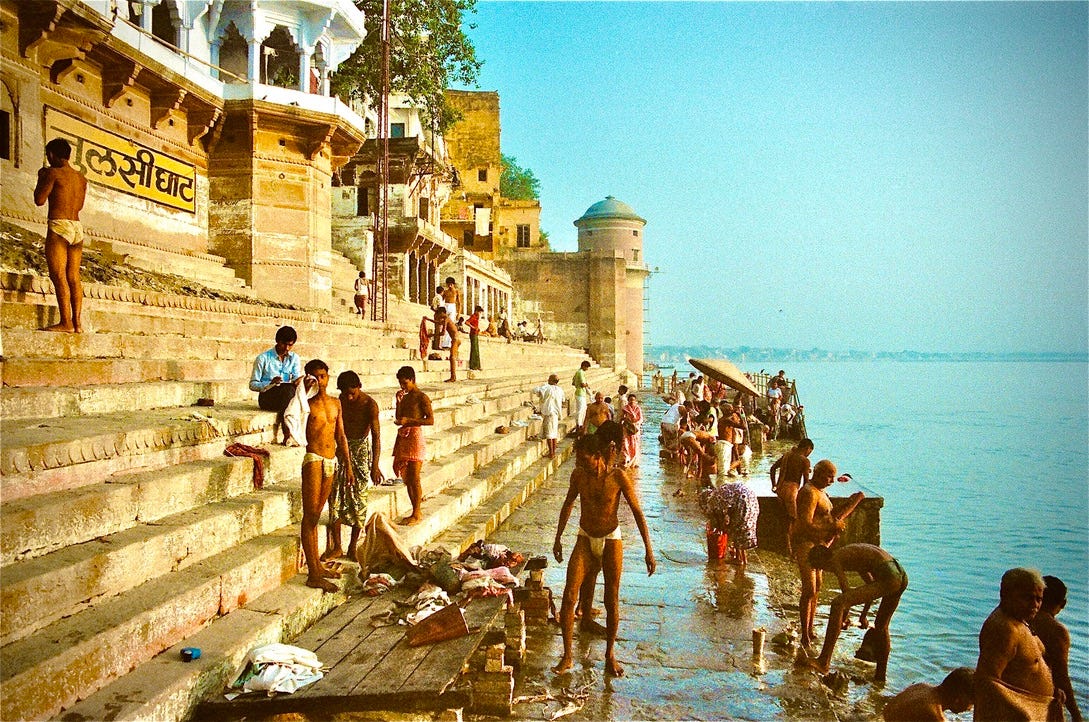
The next morning, I went down before dawn to the Ganges to watch devotees perform their rituals in the river’s shallows, while bodies burned on funeral pyres further downstream.
Ray Grasse is a writer, astrologer, and photographer living in the American Midwest. He is author of ten books, most recently In the Company of Gods and So, What Am I Doing Here, Anyway? His websites are www.raygrasse.com and www.raygrassephotography.com.