
Four Approaches Toward Understanding the Doctrine of the "Great Ages"

[Adapted from When the Stars Align.]
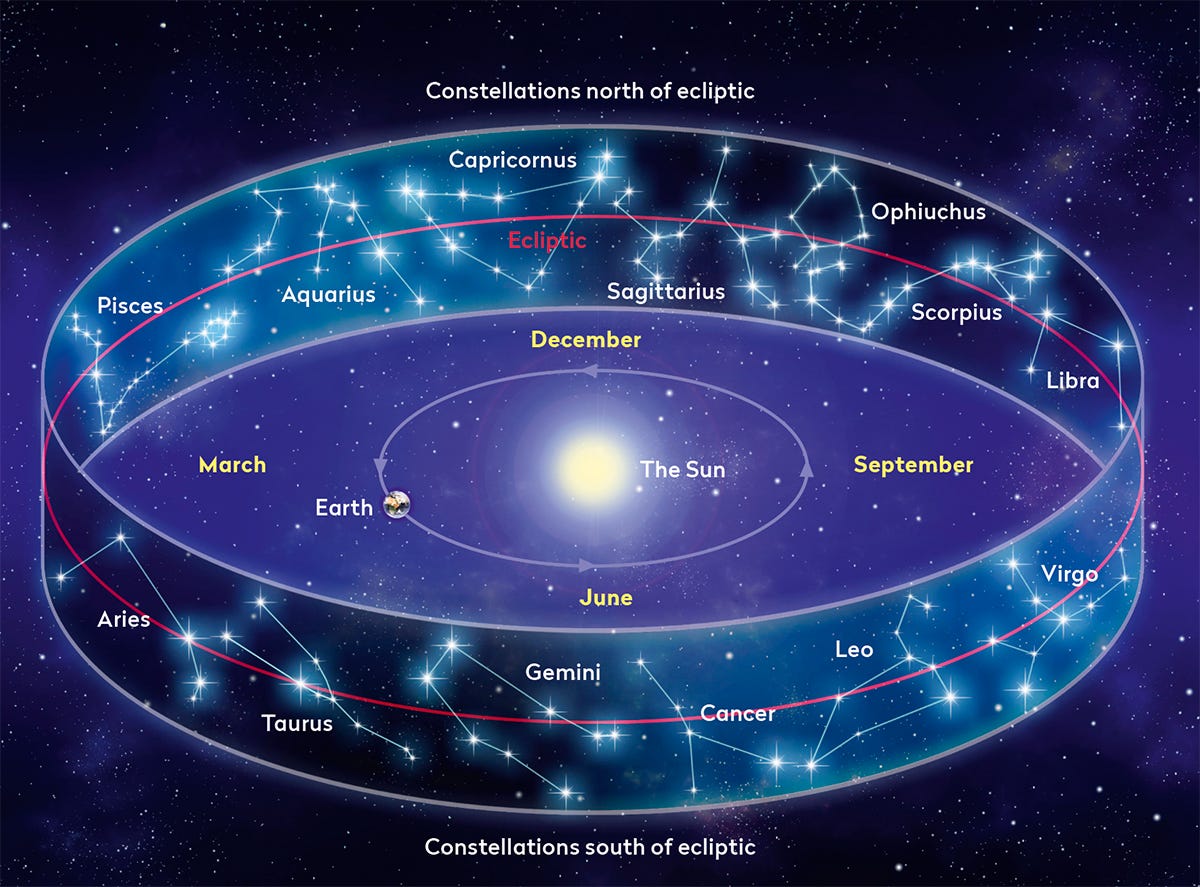
Image credit: BBC Sky at Night Magazine
Over the course of my studies into the Great Ages doctrine, I’ve noticed that researchers on this topic tend to fall into one of four categories. I’d like to summarize those approaches and their relative values in the simplest possible terms. Although there is considerable overlap between some of these in real-life situations, their focus is distinct enough to speak about each one in terms of their unique aims, which I see as follows:
The Astronomical Approach
This perspective focuses on the hard science of how the Great Ages actually occur, in terms of calculating and explaining the movement of the vernal point (the celestial point associated with Spring’s first moment) and the precession of the equinoxes, the influence of the Earth’s wobble on precession, determining the boundaries of the constellations, exploring extraneous influences on precession (such as whether our Sun is part of a binary star system, as proposed by Walter Cruttenden), and so on. Of all the different approaches, this is the most purely scientific, focusing chiefly on the hard astronomical facts behind the Great Ages doctrine.
The “Timing” Approach
This perspective focuses primarily on when the different Great Ages start or end, how long they last, what secondary and tertiary triggers factor may be involved, and similar questions. This can involve calculating when the vernal point crosses over key stars in the constellations along the ecliptic, establishing the varying sizes of those constellations, the role played by planetary cycles acting as sub-triggers, the role (and duration) of sub-cycles within each Great Age cycle, and so on.
Whereas the astronomical approach is more focused on questions of how, this approach focuses more on questions of when. Essays or sometimes even entire books have been devoted solely to this one concern, including trying to establish a particular year or even date for the start of the next Great Age, determining significant dates within that transition, or explaining how it might correlate with the timing of the Vedic yugas.
The Historiographic Approach
What is the cultural legacy of the beliefs and myths surrounding the Great Ages, and the Aquarian Age specifically? This approach takes a more scholarly stance toward determining such things as the first recorded instance of beliefs about the Great Ages, or how our modern conceptions about these epochs fit into the larger body of “Great Year” teachings through history from around the world, such as you find in ancient Greece or India.
Likewise, at what point did theories about precession merge with those about the Great Ages? (These weren’t always synonymous, as one finds now - i.e., one can talk about precession without touching at all on its symbolic significance, or the meaning of its movement through the various constellations. For example, while he completely subscribed to a Biblically-inspired timeline of history, Isaac Newton addressed the phenomena of precession without once talking about the Great Ages doctrine.) This approach explores the mythologies and folklores from different cultures about the various constellations and the role these played in the influence of our understanding of precession over time. A prime example of that is the controversial work Hamlet’s Mill, by Giorgio de Santillana and Hertha von Dechend, which suggested possible correlations between mythological traditions through history and the astrological ages. While that work touches on factors of both astronomy and timing, the authors primarily focused on those traditions and beliefs and less upon the symbolic implications of the ages themselves—such as we’ll see in our next, and final, approach.
The Symbolism or “Meaning” Approach
It’s one thing to talk about the Great Ages in terms of when they start or end, the astrophysics involved in their dynamics, or the historical record of what people believed and theorized about them, and quite another to focus on what any Great Age actually means, symbolically, and how it’s manifesting in the world.
For instance, when the Age of Aquarius fully sets in, how will its influence actually appear throughout society and culture? This is not simply a matter of examining peoples’ beliefs or theories about the Great Ages, or just its timing, but rather about looking at the deeper implications and actual manifestations of these epochs on peoples of the world.
For example, what key themes will be weaving their way through movies, literature, politics, and religion in the coming decades or centuries? What is the deeper archetypal significance of those themes - and of Aquarius itself as a zodiacal principle? What are the highest and lowest potentials of the Aquarian mythos? Can these in turn be related to other doctrines, such as I’ve written about frequently in connection with the chakras? What are the dynamics of the transition from one Great Age to another?
Questions like these are problems of symbolism and meaning, and require a more interpretive or hermeneutic mindset than our previous three approaches, which instead are more scholarly or quantitative in nature. My own interest has always leaned towards this last approach— understanding the Great Ages in terms of their meanings and the symbolic phenomena which manifest during them. Taking that approach, it seems obvious to me from developments like space travel, the Internet, and the rise of modern democracy that the Age of Aquarius has to some extent already begun, even if its full unfoldment may still be several centuries away.
Nonetheless, all four of these approaches have something important to offer and should to be taken into account in any fuller investigation into the Aquarian Age. Whatever your preferred method, though, I’d keep a close eye on these next two thousand years if I were you, since it could get very interesting!
© 2020 Ray Grasse
Ray Grasse is a writer, astrologer, and photographer living in the American Midwest. He is author of ten books, including The Waking Dream, Under a Sacred Sky, and An Infinity of Gods. His websites are www.raygrasse.com and www.raygrassephotography.com.
There is no one day or month or year when we shall see the shift from Pisces to Aquarius. As HPB makes clear in the SD, the overlap between Root Races and subraces can be many thousands of years. The concept of overlapping cycles pervades all of Nature.
As I read it, the "involutionary" half of the cycle takes longer to develop, while the evolutionary half of the cycles is somewhat shorter, like it takes months for a plant to develop from a seed, but only a short time to produce flowers and fruit once the stalk, stems, and leaves are adequate to the health of the plant.
If we take each "Great Age" as about 2160 years, that translates to about 72 years per degree. We can safely assume a "transition zone" where two Great Ages overlap as existing, a period where the old and new overlap as the old Age gives way to a new Age. Even with a conservative estimate, this yields a period of between 220 and 450 years where we are of both Ages.
As She also made clear in the SD, the overlap between subraces and root races lasts well into a new era, since all those of the old Age perpetuate the beliefs and behaviors of the old ways while the new, though emerging, is still undeveloped. That means an old Age doesn't miraculously "end" at Day X in month Y in year Z, but slowly fades, like an echo, for hundreds of years if not more.
We are in a time when we can see the ways of the past 2000 years are no longer adequate to deal with our planetary issues, both human and environmental. Pisces believes it can ignore problems and "they'll all work out in the end." Aquarius, being a Fixed sign, understands limits and holds the individuals of "the cosmic jazz band" together on the stage giving each the space to do its thing within the effort of the whole.
If Aquarius is electricity, complex machines, and industrialization, it's easy to see that yes, we've been in a transition zone for at least 200 years already. AND the atmosphere is currently fogged by Piscean belief systems, delusions, superstitions, and ambivalence. We have the internet spreading irrational and superstitious beliefs; we have AI tech used to spread deepfakes; and we have greedy destructive oligarchs gaslighting everyone into believing if they have limitless wealth the entire world will benefit. These are classic examples of the overlap between Pisces and Aquarius.
Thanks, Ray. I just read your "Problem with the..." and it focuses on the calculation of the yugas and then the comparison to the calculation of the great ages. I am more interested in the *evolution* that is assumed in each of the concepts, since humans are so very focused on change and "growth" (no pun intended from when humans were giants in the satya yuga) following an evolutionary track. In my past readings about the yugas I haven't found evidence other than humans "paying for" the glory of the golden yuga with a breakdown and then a total loss of memory of those golden millenia upon millenia. And if the western great ages are going backwards from the "logical" evolution of the signs, can that really be called evolution?