
Film School
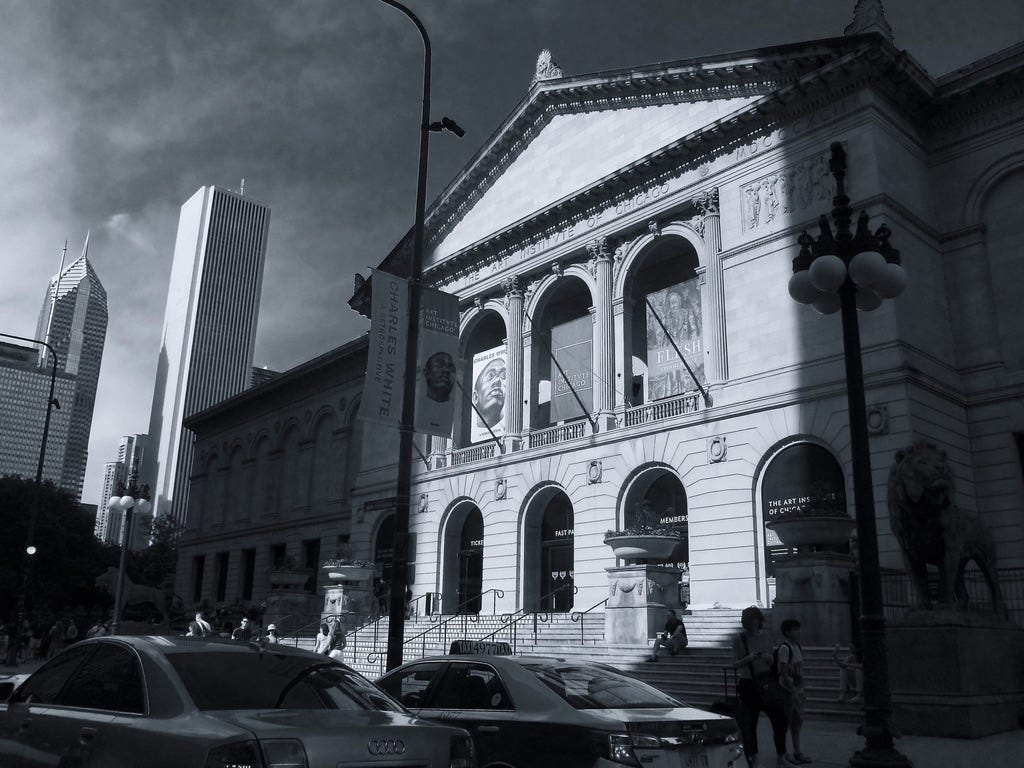
Stan Brakhage and the Art Institute of Chicago, 1970-1974

[An excerpt from The Sky Stretched Out Before Me: Encounters with Mystics, Anomalies, and Waking Dreams.]
The first time I saw Stan Brakhage on stage before our class in Fullerton Hall, I was interested to hear what he had to say but I knew next to nothing about him or his work. There was definitely something larger-than-life about his presence, accented by that thick swath of salt-and-pepper hair and a Fu Manchu mustache that gave him a vaguely Mongolian appearance. He chose his words carefully, and seemed intelligent. He had deep-set eyes, which was accented by the overhead lighting in the hall.
My other film professor at the school, John Luther-Scofill, said to me before that first class, “I strongly recommend you attend all of his talks.” When I asked why, John looked at me with that trademark poker face of his and replied, “He’s only the most important experimental filmmaker in the world, that’s all”—as if to suggest I was an idiot for not knowing. Which in a way I was.
That exchange took place during my first year at the School of the Art Institute of Chicago in 1970. I’d been to the museum any number of times while growing up and was awed by the artworks that graced its walls. I had been painting in oils for several years by that point myself and fell in love with the entire experience—the smell of the linseed oil, the texture of the paint as it squeezed out of the tube, and most dramatically, the magic of seeing a world of color and form emerge out of a completely blank canvas. From the start I felt surprisingly comfortable working in this medium, as though I’d been doing it for years. I somehow knew how to blend colors, work with perspective, and mentally calculate how shadows fell across curved surfaces, and other such things. I received a scholarship to the school based on some paintings I’d done in high school, and looked forward to learning new things.
The school certainly was a unique learning experience, but not always in the ways I expected.
One of the highlights was the chance to hear or meet some of the thinkers or artists who dropped by the school to discuss their work, like parapsychologist J.B. Rhine, artist Claes Oldenburg, or composer Philip Glass. While walking into the school one afternoon I passed an elderly woman heading towards the exit, only to have a fellow classmate come up to me a few seconds later and say, “Did you see her? That was Georgia O’Keeffe,” By then she had already disappeared into the throngs of pedestrians outside the building so I was unable to catch up to her and pester her with questions, but it was still a thrill seeing her at all. Probably the most impactful of those visiting figures involved the time Ram Dass came to school in the autumn of 1971 to promote his just-released book Be Here Now. Largely unknown at the time, he sat cross-legged up on the stage and spoke extemporaneously about most anything and everything. It was fascinating. It wasn’t my first exposure to Eastern thought, but he exploded on the scene with such force of personality and an interesting way of talking that it pretty much knocked all of us off our feet.
But alas, the art classes themselves at the school proved a disappointment. I came there hoping to learn more about classical techniques like glazing and underpainting, but abstract and conceptual art were all the rage, and none of my instructors seemed to know much if anything about more traditional methods, or if they did, they weren’t saying. (It’s possible that’s all changed at the school since then, but I don’t know.) The tipping point for me came one morning during freshman year when I brought a canvas to school I’d been working on since leaving high school, a surrealistic paint- ing I titled “Reunion of Elements,” influenced by Dali, Leonardo da Vinci, and others. I worked on it through the summer, and finished it early during freshman year.
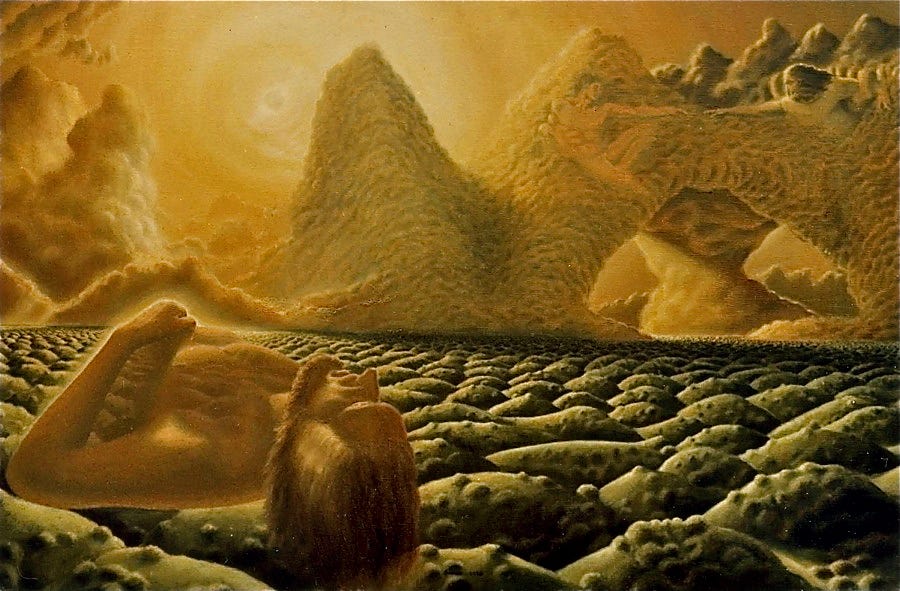
“Reunion of Elements” - 1970 (oil on canvas)
I was privately happy with it, but felt worried how my teachers would respond to it. It was certainly different from everything else my classmates were doing. When it came time for me to present it to the class, my instructor, a well-known local artist named Ray Yoshida, skewered it in no uncertain terms. “This is 1970, Ray,” he said, “not the Renaissance...”—and his comments only went downhill from there. His open disdain for my work had a withering impact on my 18-year old ego, especially in front of my classmates. That was when I began shifting my allegiance over to filmmaking classes, since I realized that continuing on with the painting ones weren’t likely to bear much fruit.
But that turn of events wound up having a silver lining. In contrast with the disappointment I felt with the painting classes, the film classes I enrolled in made for an extraordinary experience. I’d been tinkering with a movie camera for years by then, making amateur 8mm movies throughout grade school and high school. During the early 1970s, the School of the Art Institute of Chicago had arguably the best independent film program in the world, so for a film-lover like myself it was like entering seventh heaven. The focus was largely, but not strictly, experimental film. Whenever anyone asked me to define what experimental film was, I’d simply explain that it is to conventional cinema what poetry is to prose, with more of a focus on imagination, suggestiveness, and visual artistry than conventional narrative or storytelling.
My first instructor was John Scofill (who later changed his name to John Luther-Scofill), and was followed shortly after by my classes with Brakhage. John’s film work had a massive impact on me, and his visual sensibilities were closer to mine in some ways than Stan’s. But Stan’s influence was broader and his style challenged my sensibilities more dramatically. Over those next few years he treated us to a broad grasp of not just cinema but literature, music, history, and art. He spoke about writers, poets and artists I’d never heard of before, not to mention countless obscure filmmakers whose names are now largely lost to time, many of whom he knew personally. His interests seemed wide-ranging and his productivity jaw-dropping. It puzzled me then, just as it does now, how he managed to create several hundred films while attending to a large family, writing books, and conducting the mountains of research and correspondence necessary for those lectures, which ranged from discussions of Chaplin, Sergei Eisenstein, Carl Dryer, Fritz Lang, Orson Welles, F.W. Murnau and Jean Cocteau, to works of countless experimental filmmakers from the 1920s up to the present. Seeing all those films on the big screen (rather than on TV or on a computer screen, as many do nowadays) became an important part of the experience for me, and those screenings came to feel almost like attending church services in a way.
Of the narrative films we studied, I had my own personal favorites: Passion of Joan of Arc by Carl Dryer, Orphee’ and Beauty and the Beast by Jean Cocteau, M by Fritz Lang, Sunrise by F.W. Murnau, and Charles Laughton’s Night of the Hunter. But seeing Welles’ Citizen Kane was akin to a religious experience for me, with its unorthodox “jigsaw” timeline, cast of fascinating characters, revolutionary sound design, and of course its stunning cinematography. I frankly feel a little bit sorry for those who have only seen Welles’ film on small TV screens—or worse yet, even smaller smart phones.
At first, Brakhage’s own films struck me as strange, sometimes even off-putting, since they employed a visual vocabulary so different from what I had been familiar with in mainstream movies. That included shaky camera movements, abrupt cuts in quick succession, and unexpected emulsion flares and scratches that would have been scrubbed from any mainstream film. I’d sometimes done those sorts of things in my own home movies, generally less intentionally, but he managed to take all of that and convert it into art somehow. Most interesting of all, there were subtleties in his work that revealed themselves only after multiple viewings.
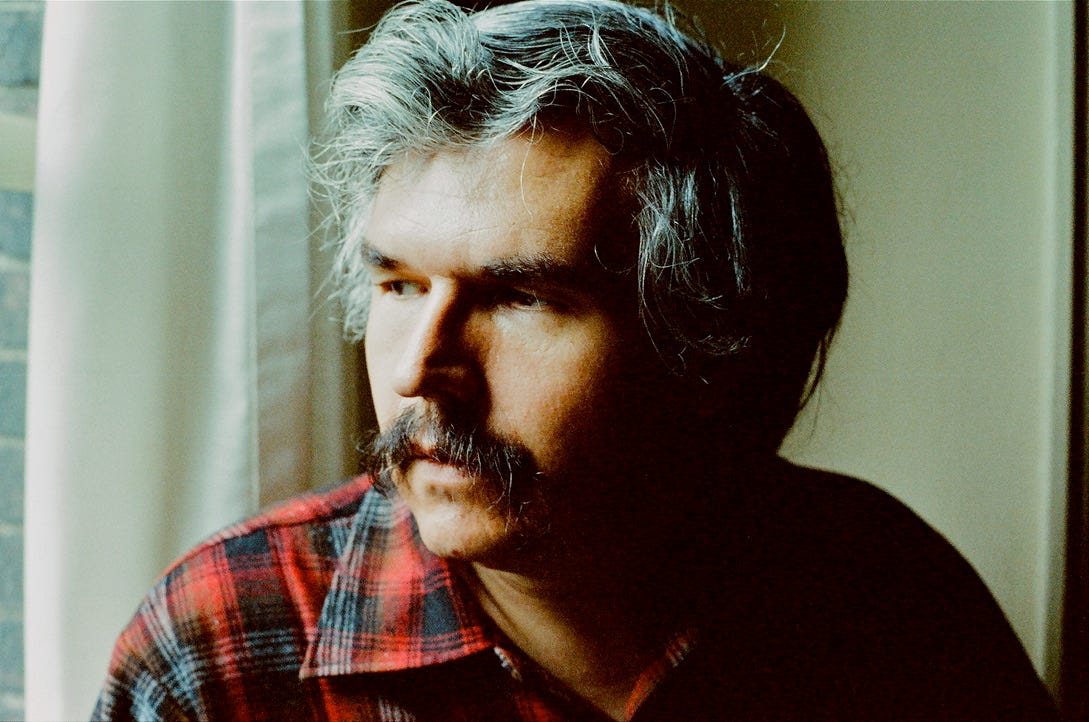
Star Brakhage, the Palmer House, Chicago 1982.
What I came to realize was that Brakhage was attempting nothing less than a revolution in how we think about film and its possibilities. Rather than rely on narrative storytelling or framing scenes in one-pointed Renaissance perspective, Brakhage was aiming to break free from those earlier conventions and explore the possibilities of film as a medium unto itself. I once heard Stan referred to as the “Picasso of filmmaking,” and that’s not a bad comparison, since both artists broke free from earlier visual rules and opened the door for those who followed. I never heard him express an affinity with any spiritual path, but there was something distinctly Zen-like in his approach to vision, in how he looked at things with what some call beginner’s mind. I suspect that’s a big part of the reason he remained so unknown to the larger world, even to many in the movie industry itself. His films didn’t pander to conventional notions of beauty or storytelling, nor play on viewer’s emotions with cheap sentimentality. Yet I could tell that my consciousness was somehow being altered and lifted up by that play of light being created up on the screen. His wasn’t a “beauty” achieved through manipulation and emotional button-pushing but through qualities of light and the alchemy of editing.
The Pleasure Principle
Ahh, there’s that word—manipulation. Prior to my classes with him, my own approach toward art revolved almost completely around ideals of beauty, with the aim of enveloping viewers’ brains in a rapturous haze of sublime pleasure, almost like a mind-altering narcotic.
Brakhage’s approach was altogether different. For him, manipulating audiences wasn’t just unappealing, it was immoral. Alfred Hitchcock once described his approach to directing films as being “an exact science of audience reactions.” Brakhage’s attitude couldn’t have been further from that. He felt that great art should never manipulate viewers towards predetermined ends, whether in service of fear, excitement, or even beauty. True art is inherently ambiguous and so vast in scope that it leaves itself open to many reactions. Years later I’d hear Joseph Campbell explain how writer James Joyce considered any artwork that manipulated viewers to be “pornographic.” Interesting way to describe it, I thought.
This is also one of the reasons why most of Stan’s later films were silent, since he was all-too-aware of how easily music can compel viewers to respond in predetermined ways. In one class he projected the famed muddy battlefield sequence in Welles’ Chimes at Midnight with the sound turned off, while in another class he did the same thing with the closing 15 minutes of Welles’ Touch of Evil. What was fascinating was how the former film suffered heavily from that lack of sound and music, while the climactic sequence in “Touch of Evil” looked even better to me without any soundtrack. It was an ingenious way to make his point about the effects of music in cinema, whether for good or ill.
That attitude towards manipulation wasn’t simply a shock to my cinematic sensibilities, but my attitudes towards life generally, and ignited a lifelong struggle for me with the entire notion of beauty—its purpose, its importance, and its effects on the mind. I know full well that our souls can be nurtured and healed by beauty, whether through art, nature, or our encounters with others. But I also know that beauty can hypnotize and anesthetize, and lull one into unconsciousness quite like a drug. I should know; I’ve been manipulated by beauty most of my life, in both constructive and destructive ways, from my creative projects and moments in nature, even to my relationships.
In the end, it left me wondering whether the purpose of art is to provide pleasure or to challenge and wake us up? Or both? It led me to scrutinize any situation in life that affected me strongly, whether that be an advertisement, a political debate, or simply an attractive stranger passing by me on the street. Stan once remarked how he always read at least three different biographies at the same time, never just one. When I asked him why, he said it was too easy getting caught up in someone else’s life and personality; their stories and personalities tend to take over your mind, he claimed, and can influence your thoughts to the point where you start to lose yourself. Reading multiple biographies gave him more distance, more freedom, he said. It was for much the same reason, I believe, that he didn’t do drugs, saying (in as many words) that he wanted to experience life without those filters. Comments like that intrigued me, and made me more aware of how the world affected me in ways I hadn’t thought about before.
The Interviews
For quite a few years after graduating from college I continued sneaking into his classes whenever possible, in order to continue absorbing whatever insights he had to offer, while also looking for chances to speak with him one-on-one. Though he was always friendly, he could be cranky sometimes, but never mean-spirited. We eventually struck up a correspondence by mail, and later by phone. I appreciated the opportunity to pick his brain on a variety of topics, and in 1980 approached him with the idea of doing a series of interviews, in the hope of turning them into a book at some point down the road. To my delight, he agreed to the idea, and we met on four occasions in his hotel room at the Palmer House.
During those conversations we talked about his philosophy of art, literature, and film, along with a generous helping of personal anecdotes from his years working in the industry. One of those stories involved the time he was presented with a lifetime achievement award at a film festival where famed director John Ford was also slated to be honored. Brakhage received his award first, and after the hand-over was complete, the host turned to Ford and introduced the elder master with a comment about having achieved his art “without the use of tricks or special effects”—a not-so-subtle dig at Brakhage. Having spent his entire career working with little more than a camera and an editing table, Stan was mortified. “No tricks or special effects?”, he said incredulously. “What do you call a multimillion dollar studio?”
During those conversations and in classes through the years, he expressed a certain skepticism about anything paranormal or metaphysical; yet I always had the impression there was more than met the eye to those offhand comments. That’s because every now and then little clues would slip through the cracks suggesting he had more experience with moments of “high strangeness” than he really cared to admit.
One example was his story about fellow filmmaker Kenneth Anger, who not only enjoyed a certain notoriety in film circles as a pioneering talent and chronicler of Hollywood’s dark underbelly in books like Hollywood Babylon, but also was an influential practitioner of magic—the occult sort, not the sawing-women-in-half-on- stage kind. As Stan related the story, he expressed some interest in what Kenneth and his friends were up to, so Kenneth and a few of those friends decided to instruct Stan into the basics of what they did. But Kenneth made it clear to Stan: if you really want to look into this, you need to be serious about it and not go into it halfway, since this isn’t child’s play. “So once the evening is over, you’ll need to decide one way or another,” he explained. Stan agreed.
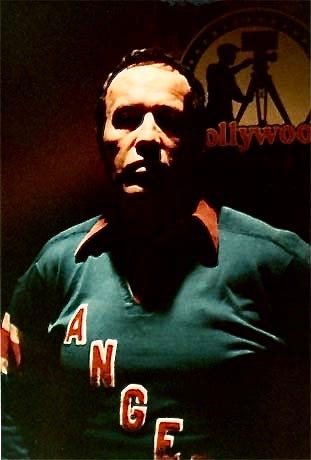
Kenneth Anger (taken at the School of the Art Institute, 1982).
Per their arrangement, Stan arrived at Kenneth’s house and sat down with him and the others around the kitchen table, as Kenneth began explaining exactly what they did, and the basic principles involved. Shortly after that started, however, the door- bell rang and in wandered another of Kenneth’s friends, someone with no involvement in their magical group, thereby interrupting this highly confidential conversation. The man sat down on one of the chairs, and began talking about some completely unrelated topic—at which point Kenneth calmly walked over to the stove behind the uninvited newcomer and turned on one of its burners with one hand while making a mysterious hand gesture in the air with the other. At exactly that moment, the guest fell unconscious in mid-sentence, his head drooping low—and remained that way until the group’s talk ended. It was only then, after the group had finished saying everything they wanted to say to Stan, that Anger walked back to the stove, turned off the burner while making another hand gesture, at which point the guest lifted his head and resumed talking exactly where he left off in mid-sentence, completely clueless about what had just transpired. Stan related the anecdote without further comment.
Around 1984 my contact with him gradually tapered off. I would sometimes call him on the phone or catch up with him at a film screening he was hosting in Chicago. I also continued to notice his influence on the film industry, as his stylistic innovations began filtering into mainstream films like Oliver Stone’s JFK or Julien Schnabel’s Diving Bell and the Butterfly. A couple former students of his from Colorado went on to create a hugely popular animated TV series called “South Park,” and even gave Stan a bit part in a live-action film they did early on.
It was in 2003 that I received news that he’d died, at the too-young age of 69. Apparently, his exposure to various toxic chemicals from working with film stocks having taken its toll. In memory of the fallen artist, the Princeton film historian P. Adams Sitney penned these words:
“He was a painter or poet in cinema, not a novelist like every- body else. In the entire history of the medium, when all the pop-culture interests have faded, a hundred years from now, he will be considered the preeminent artist of the 20th century.” [1]
Re-Vision
As a result of teachers like both Stan and John, a shift had taken place in my visual sensibility, not just about movies but about virtually everything else in my field of vision. The camera lens had become a magical instrument of discovery for me, an enchanted eyeglass through which to see my world from entirely new perspectives. Though I eventually stopped shooting movie footage, I became heavily involved with photography years later and found myself incorporating much of what I learned from those film- making years, especially in terms of trusting my intuition, learning from “accidents,” and looking at scenes from unconventional angles.
I was also inspired by Stan’s fiercely independent attitude towards his creativity, and how uncompromising he was in following the voice of his muse—despite all the trade-offs that entailed in terms of either income or popularity. That was a trait share by Kriyananda and Shelly as well, actually, both of whom pursued their spiritual callings without the slightest regard for what was or wasn’t fashionable or considered “respectable” by their peers at the time.
As for Brakhage’s legacy, there’s no telling whether P. Adams Sitney’s prediction will ultimately prove true; all I can really speak to is the legacy he left me. He opened my own eyes just a little bit further, and prompted me to look at things differently, and I’m grateful for that. [2]
Notes:
1. https://www.nytimes.com/2003/03/12/arts/stan-brakhage- avant-garde-filmmaker-is-dead-at-70.html
2. Though I shot thousands of feet of footage during my years at the Art Institute, that ultimately boiled down to just one film, which I began during freshman year but only finished after graduating, titled “Awakening.” The film was damaged in a flood years later, but I was able to salvage and twice restore roughly half of the film (twice), now re-titled “Awakening III”, which I posted on Youtube. Note: the film is silent for the first 45 seconds, after which the musical soundtrack I composed fades in.
I only attempted one other film in subsequent years, when in 2012 I took leftover footage from both my college days and even earlier high school and grade school years, and edited it to a musical recording I did at the time, calling it “Casting Shadows”—here (4 minutes):
Ray Grasse is a writer, astrologer, and photographer living in the American Midwest. He is author of ten books, most recently In the Company of Gods and So, What Am I Doing Here, Anyway? His websites are www.raygrasse.com and www.raygrassephotography.com.