
Beneath the Great Pyramid

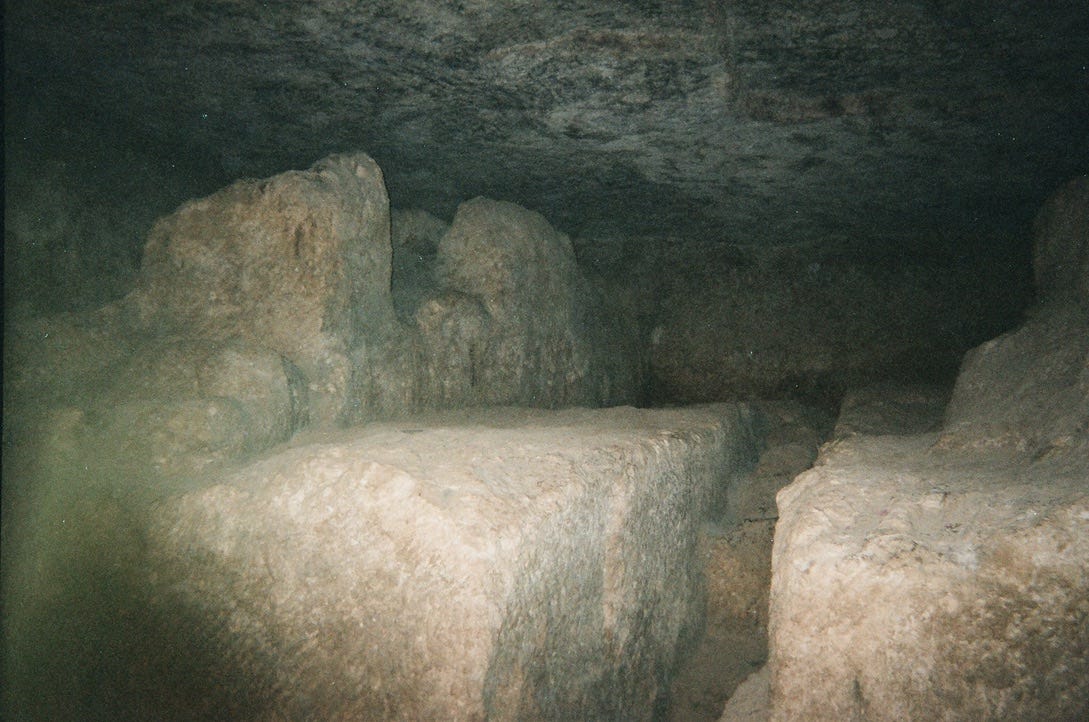
[An excerpt from The Sky Stretched Before Me, about an experience on the Giza Plateau in Egypt in 1997.]
The Great Pyramid is an engineering marvel, but also a great mystery. Aside from the lingering question as to how it was built, there is the problem of when it was built. In the 1980s a researcher from the University of Washington, Robert Wenke, carbon-dated samples of mortar obtained from the pyramid which contained wood, charcoal and reed, and yielded the surprising result that it was several hundred years older than previously believed. Later tests conducted by Robert Temple, using a different method, corroborated those results. Findings like these are perplexing since they seem to place the construction of the Great Pyramid near the very dawn of Egyptian civilization, long before it’s generally believed Egyptians had either the knowledge or social organization to accomplish such a feat.
While Boris, Hurtak and their crew were busy setting up for a shoot in the King’s Chamber, I decided to use my time to explore other parts of the Pyramid. After carefully examining the so-called “Grand Gallery” which cuts at an angle up through the pyramid, I set out to search the subterranean pit beneath its foundation, which is accessible via a narrow, slanted passageway extending down into the ground several hundred feet. Carved out of the plateau’s limestone bedrock, its narrow size forces visitors to make their way in a crouched-down position for the length of its two-hundred feet. This structure is no playground for claustrophobics, rest assured.
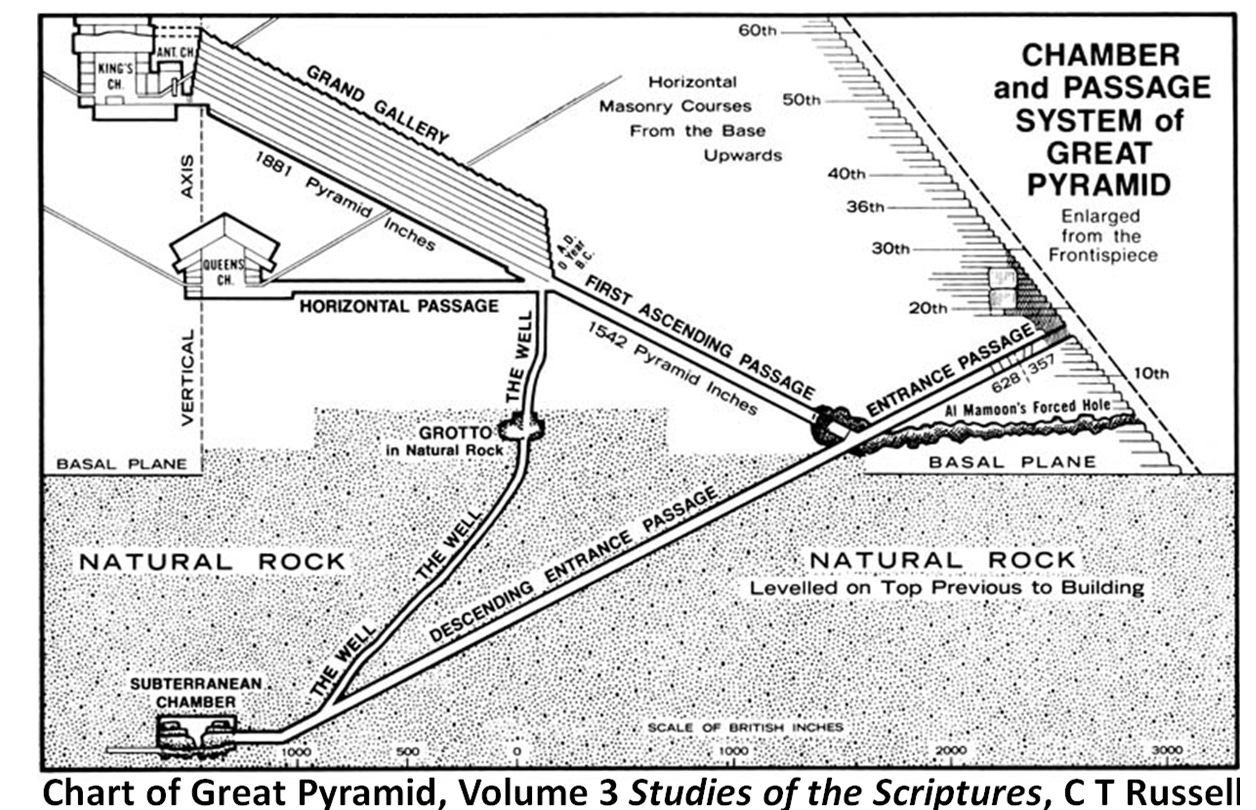
That downward passageway raises questions of its own regarding the building of the Great Pyramid, and how long it actually took to create. As independent researcher Gordon White summed it up,
“Constraint analysis is an engineering technique to determine where the bottlenecks lie in a building project. That is, which steps in a construction cannot be made to go faster and/ or also hold up the rest of the project...With specific refer- ence to the Great Pyramid, the descending passage...is only 42 inches square, meaning that only one worker at any one time could be carving it out. This provides a neat and mea- surable example of constraint analysis: it would have taken almost twice Khufu’s reign for a single person to carve out this passageway using a dolerite pounder, and that is working twenty-four hours a day. Not only is the pyramid too old to be a tomb, its construction cannot fit into the twenty-something year reign of Khufu.” [1]
I finally emerged into the pit at the shaft’s bottom, which appeared much more roughly-hewn than the rest of the Pyramid. Its original function still isn’t fully understood by Egyptologists; while some believe it’s an abandoned burial chamber, others suggest it may have served ceremonial or shamanic purposes. The simple fact of the matter is, we don’t know.Standing in the silence of the underground chamber, something about its muffled acoustics caught my attention, so on a hunch I decided to stomp down on the dirt floor as hard as I could. To my surprise, the resonance from that sound seemed to reverberate all the way up through the Pyramid, as if the entire monument had become a gigantic gong.
When I asked John Anthony West a few months later if he knew anything about this, he said he never heard about it, and certainly hadn’t tried it out himself. It reminded me of another experience I had in the Great Pyramid during a tour with John back in 1994. While lying in the sarcophagus and chanting a few obligatory “Oms” with John’s group that day—practically a rite of passage for many of those visiting the Great Pyramid—at one point I hit a certain note (which I later learned was F sharp) that caused the sarcophagus around me to resonate in an uncanny way, and my entire body to vibrate.
Between that sound up in the King’s Chamber and this one down inside the pit, it was easy to believe sonic effects like these were intentionally designed to be part of this structure’s function. The more time I’ve spent inside the Great Pyramid, the more I can’t help thinking this extraordinary structure might represent an advanced magical technology the likes of which we can’t fully comprehend, possibly involving a complex network of intentions, correspondences, and God-knows-what subtle energies, all coalescing to impact—what? The consciousness of humans inside of it? The broader life and destiny of Egypt? Perhaps even the entire world? I don’t claim to know, but I have no doubt there is far more to this structure than meets the eye.
After climbing back up from the pit through the passageway, I walked back outside of the pyramid and found a ledge slightly higher up on one of its sides, where I sat beneath the stars and watched the lights of Cairo sparkling across the horizon.
Notes
1. Gordon White, STAR.SHIPS: A Prehistory of the Spirits, Scarlett Imprint, 2016, p. 174.
Ray Grasse is a writer, astrologer, and photographer living in the American Midwest. He is author of ten books, most recently In the Company of Gods and So, What Am I Doing Here, Anyway? A fuller account of his experience in Egypt can be found in The Sky Stretched Out Before Me, but also here: https://www.dailygrail.com/2017/11/uncovering-the-lost-tomb-of-osiris/ His websites are www.raygrasse.com and www.raygrassephotography.com.