
ANCIENT EGYPT ~ THE MEANING BEHIND THE MAGIC
by John Anthony West

In 1991, I commissioned John Anthony West to write an article on ancient Egypt for an issue of The Quest magazine, published by the Theosophical Society, where I worked at the time. The article was planned to run alongside an interview I conducted with West for that same issue (which I recently posted on Substack on Aug. 7, 2025 - titled “Reconsidering the High Wisdom of Ancient Egypt ~ An Interview with John Anthony West”). But I felt it would be good to resurrect that essay as well, and have reproduced it here, along with a letter from a critical reader we received afterward, followed by John’s response. —R.G.
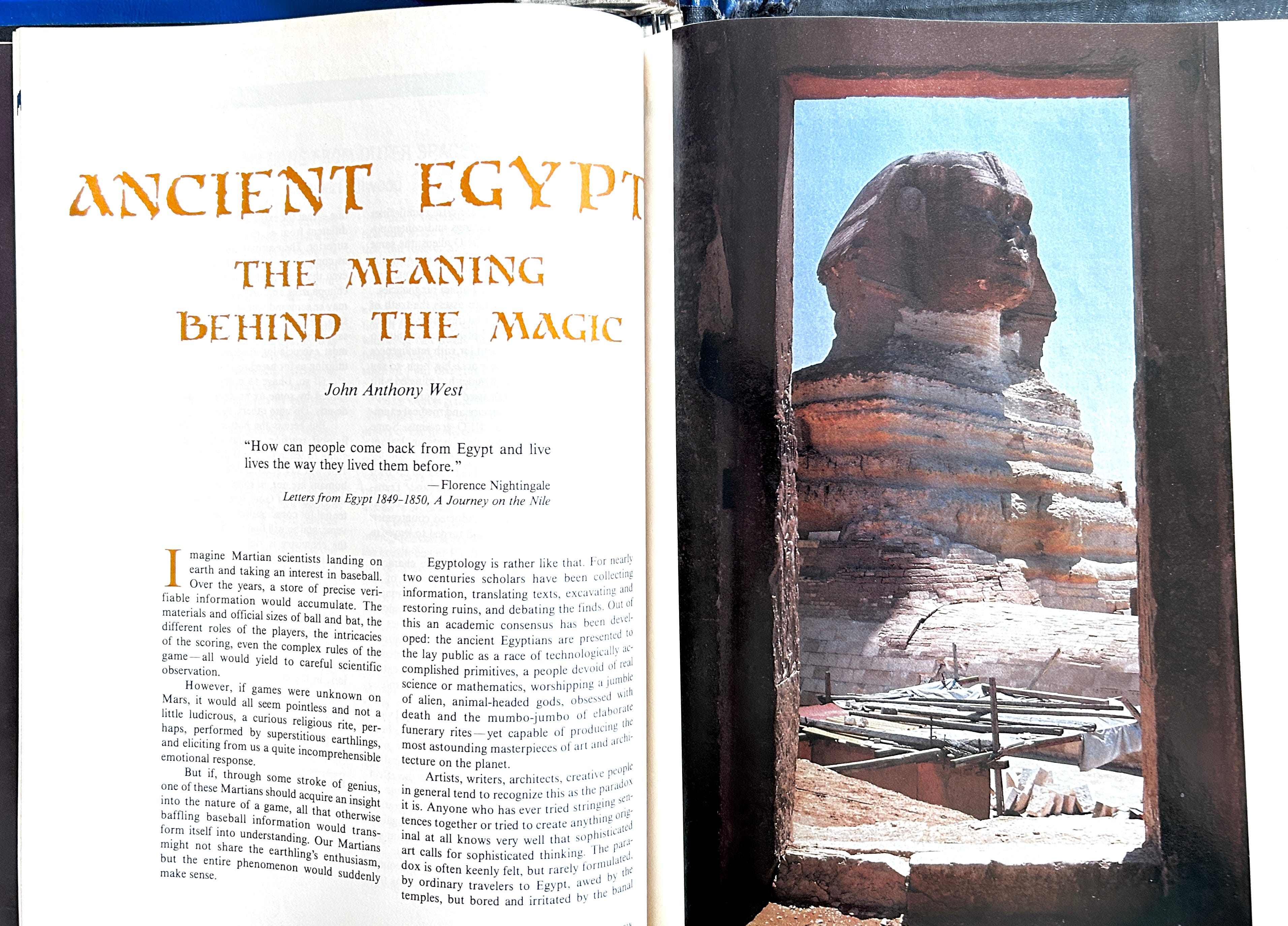
“How can people come back from Egypt and live lives the way they lived them before.” —Florence Nightengale, Letters from Egypt 1849 - 1850, A Journey on the Nile.
Imagine Martian scientists landing on earth and taking an interest in baseball. Over the years, a store of precise verifiable information would accumulate. The materials and official sizes of ball and bat, the different roles of the players, the intricacies of the scoring, even the complex rules of the game —all would yield to careful scientific observation.
However, if games were unknown on Mars, it would all seem pointless and not a little ludicrous, a curious religious rite, perhaps, performed by superstitious earthlings, and eliciting from us a quite incomprehensible emotional response.
But if, through some stroke of genius, one of these Martians should acquire an insight into the nature of a game, all that otherwise baffling baseball information would transform itself into understanding. Our Martians might not share the earthling's enthusiasm, but the entire phenomenon would suddenly make sense.
Egyptology is rather like that. For nearly two centuries scholars have been collecting information, translating texts, excavating and restoring ruins, and debating the finds. Out of this an academic consensus has been developed: the ancient Egyptians are presented to the lay public as a race of technologically accomplished primitives, a people devoid of real science or mathematics, worshipping a jumble of alien, animal-headed gods, obsessed with death and the mumbo-jumbo of elaborate funerary rites— yet capable of producing the most astounding masterpieces of art and architecture on the planet.
Artists, writers, architects, creative people in general tend to recognize this as the paradox it is. Anyone who has ever tried stringing sentences together or tried to create anything original at all knows very well that sophisticated art calls for sophisticated thinking. The paradox is often keenly felt, but rarely formulated, by ordinary travelers to Egypt, awed by the temples, but bored and irritated by the banal explanations supposed to account for it all. "If I have to hear about one more *$#&%+ holy of holies, I'll scream!" goes a common lament.
Unfortunately, academics are seldom creative; modern Egyptologists may be the least creative of an uninspired lot, and this paradoxical view of Egypt is presented to the lay public as though it were established fact. Such is the power of indoctrination: few of us care or dare to challenge dogma, especially when it comes disguised as scholarship and science.
This "official" view of Egypt has never been unanimous. A number of scholars (occasionally within, more often outside Egyptology) have always felt that something had to be wrong with this interpretation; that the magnitude and perfection of the work demanded a commensurately sophisticated knowledge; that a "game" was involved.
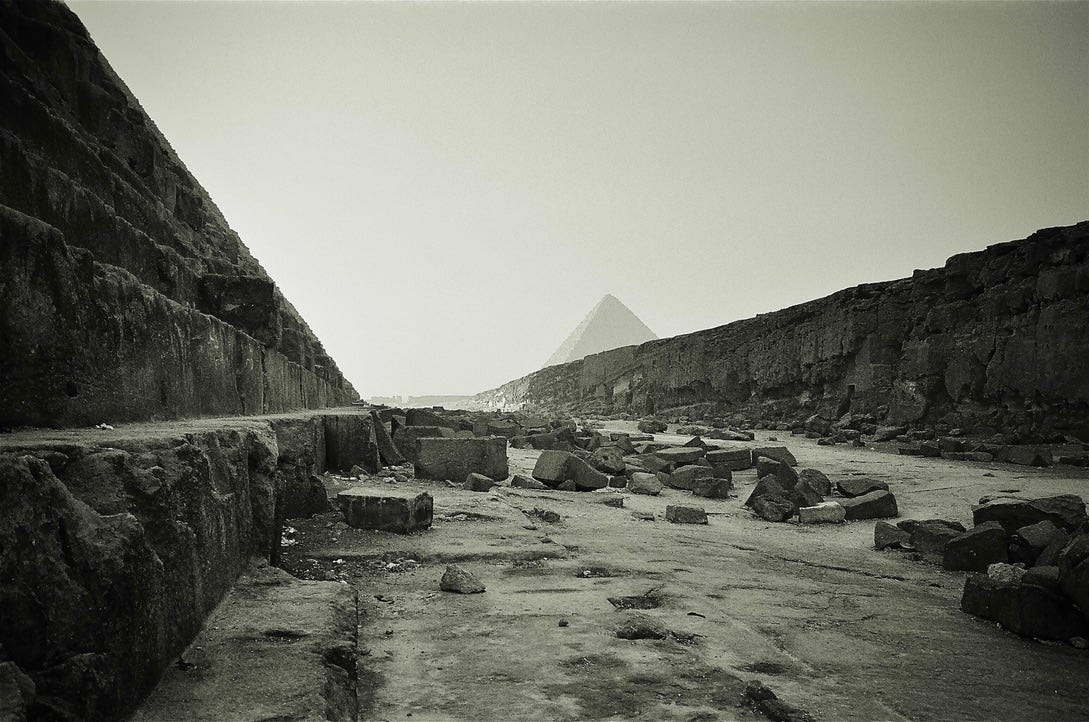
There have been innumerable attempts to decipher that game, and doubtless many were ill-founded. The Great Pyramid of Cheops, for example, has been variously described as an instrument directly inspired by God to foretell the second coming of Christ; as a gigantic hydraulic pump; as a landing and launch pad for alien spacecraft. Academic Egyptologists wield a comprehensive tarbrush. Whatever does not conform to the orthodox view of Egypt as a land of superstitious primitives gets liberally and equally smeared: no distinctions made. But just because some alternative theories are absurd, it does not mean all are. (Indeed, the accepted theory based upon paradox is the most absurd of all.)
In 1957, following nearly two decades of work in Egypt, mainly at Luxor, the Alsatian mathematician, philosopher, and Orientalist R. A. Schwaller de Lubicz published his massive, three-volume Le Temple de l'Homme (The Temple of Man). This exhaustively-documented work established the nature of the “game" responsible for Egypt as nothing had before.
Through the Symbolist interpretation (a name applied to Schwaller's work by both adherents and detractors), that unsettling paradox of masterpieces produced by superstitious primitives disappears for good. The art and architecture of Egypt reveals itself as a prodigious, ongoing expression of what Schwaller calls "Sacred Science" -the knowledge and conscious deployment of cosmic principles.
The notion of a sacred science is foreign to the secular cast of twentieth-century thinking. Nothing we learned at school would even suggest such a possibility and it's not easy to undo the extensive brainwashing all of us have been subjected to under the name of education. Still, it's possible to grasp the essence of what sacred science once was. See it as developing from the answer given to the perennial philosophical question that is just now being broached by modern physicists: Is there a purpose to creation and is humanity a part of that purpose?
Ancient Egypt (and all other religiously-based ancient civilizations) answered that question with a resounding "Yes." Egypt believed humanity to be consciously created by divine powers and the purpose of our being here is to reunite with our Creator - what Schwaller de Lubicz called "the return to the Source." Sacred science amounts to a systematic body of knowledge devoted to those divine creative powers and their interactions.
The chief themes of Egyptian sacred science were the creation of the world, and the role of humanity within creation. Egypt's incredibly complex mythology and its profusion of mysterious symbols can be seen as an inge-nous method of expressing those twin, interlocked themes.
THE PLAY OF NUMBER
The principles were associated with numbers. Numbers are the bearers of meaning. Thus, One is the number of the Absolute, or undifferentiated and unpolarized Consciousness; Two is the number of Polarity (positive-negative, male-female, initiating-receiving);\ Three is the number of Relationship (that which mediates the interchange of polarized forces); Four is the number of Substantiality or Matter (hence the Four Elements of the ancients); Five is the number of Potentiality, or Eternity; Six the number of Time and Space, and so on.
It is this play of number, understood precisely by the ancients, and written into the temples, tombs, and pyramids in geometry, harmony, and proportion, that is responsible for the powerful and undeniable effect they still produce upon us, even when we do not share or understand the beliefs of their ancient builders.
Once seen as embodiments or representations of cosmic and organic principles, the gods (all those bizarre animal-headed figures) finally become comprehensible as well. Fertilization, gestation, birth, growth, maturity, aging, death, and renewal are among the organic principles. Careful study of the habits or nature of the animal associated with the god usually reveals the reason for its choice. The upright, pregnant hippopotamus Tauret, for example, is the goddess of pregnancy or gestation —for what could be more pregnant than a pregnant hippopotamus? The dog/jackal Anubis is the guide through the underworld because of its extraordinary homing instinct. He presides over embalming and funerary rites because, as an eater of carrion, the dog/jackal is capable of turning putrefying flesh into fresh sustenance, or new life, for himself. The ibis, endlessly searching out its food in the mud, and the baboon, spending hours on its haunches in apparent silent contemplation, are the two animals chosen to represent Thoth, god of intellect or wisdom — whose two chief characteristics are search and contemplation. Thus Egyptian metaphysical conceptions are firmly rooted in careful observation of the natural, physical world. The stork, who migrates north in summer, but returns year after year to the same home, is used as the glyph for the soul, probably signaling an ancient Egyptian recognition of reincarnation, a belief otherwise denied by Egyptologists.
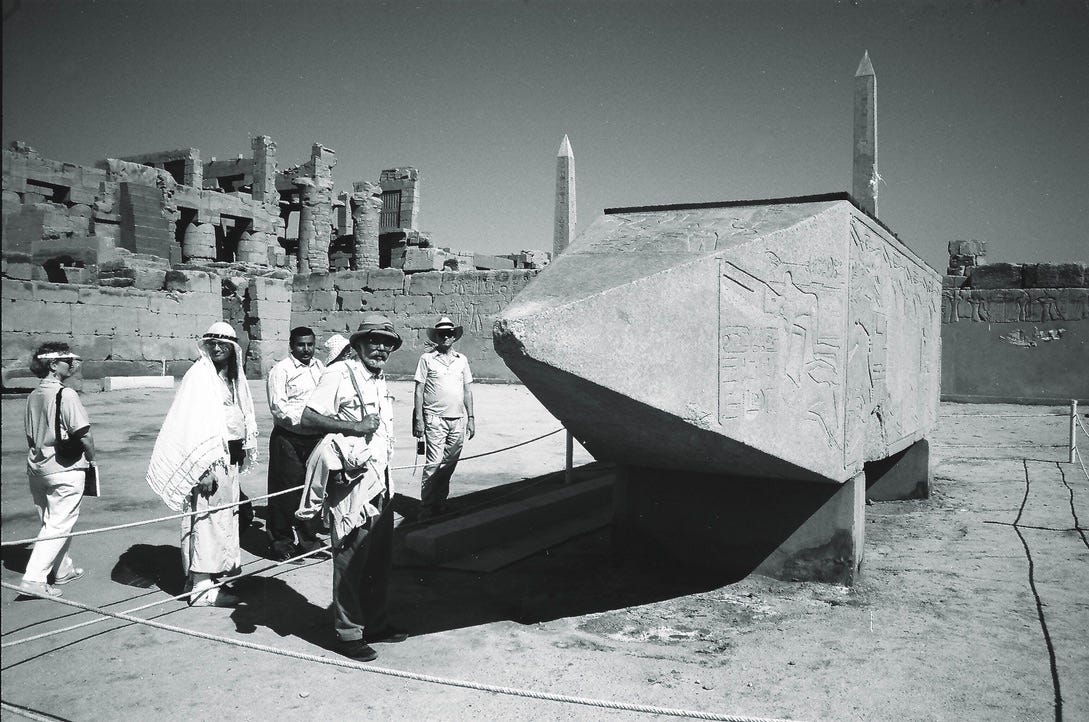
John Anthony West leading a tour group in Egypt, 1994.
In Schwaller's Symbolist interpretation, science, art, religion, and philosophy are fused into one vast, coherent doctrine. All those amazing temples, tombs, and pyramids may now be seen, not as mighty works carried out by servile masses and aggrandizing priests to satisfy the whims of egotistic pharaohs, but rather as instruments, designed scientifically, to put us back into quite literal contact with the gods. There is in fact no Egyptian word for temple; what we call a temple was, to the Egyptians, the "House of the God," that is to say: of the Principle. And the Principle, expressed through number, geometry, proportion, measure, myth, and symbolism can be evoked consciously and deliberately by those initiated into Sacred Science. When we of the twentieth century find ourselves moved (often to tears), awed, staggered by Egypt's amazing works, it is be-cause, without our consent, and without knowing why or how, we have been put momentarily in touch with the gods by people who knew precisely what they were doing and why they were doing it. The Symbolist interpretation illuminates both the "what" and the "why" of Egypt.
Even so, to return to our analogy of baseball and the Martians, it is in fact impossible to prove that baseball is a game, or even that games exist in the first place—no matter that the pieces all now fall into place, and the obvious and glaring paradox of masterpieces produced by primitives is resolved. For psychological reasons of their own (it makes them feel superior, more advanced, for example), the Martians may prefer to go on regarding baseball as the earthlings' religious superstition (al point that could perhaps be argued effectively by baseballphobes but that is not the issue here).
And the game analogy can be extended in still another direction, further complicating the matter: even those who acknowledge the existence of games tend to appreciate only those that are familiar. To the Briton, the allure of baseball is forever a mystery; cricket to Americans is an exercise in sustained boredom. (Actually I don't care what anyone says: cricket IS an exercise in sustained boredom!) So within Egyptology, Schwaller has made few converts to date, even among scholars who are not card-carrying atheists. Most Egyptologists simply reject him unread. But the symbolist approach is increasingly influential among artists, architects, writers, intellectuals, even a few scientists, and others not incapable of assessing the documented evidence supporting conflicting points of view. And of course, the bottom line is that evidence — supporting the symbolist, the orthodox, or any other theory. What is the evidence? Does it tally with the observed facts? Finally, a crucial element that might not play a major role in scholarly debates on other subjects — does the evidence tally with the emotional magic of the Egyptian experience?
On the page, these conflicting interpretations present an intriguing academic problem: here are two diametrically opposed schools of thought —as different, as the English say, as chalk and cheese. Yet both are based upon identical data. How is this possible? It is in Egypt itself that this problem takes on emotional and philosophical urgency.
The artistic impact produced by the art and architecture of Egypt is like nothing in the world. No amount of verbal description, no matter how eloquent or inspired, no painting, no photography, not even wide-screen cinema can capture the actual experience of Egypt. Try to imagine listening to all of Bach, all of Beethoven, and all of Mozart in sequence full blast on the stereo with no break in between. A trip to Egypt is something like that. The difference, for us, is that Bach, Beethoven, and Mozart worked within a familiar cultural frame-work, while the geniuses and sages of Egypt worked within one that is essentially alien 10 us in the twentieth century. We may be profoundly moved by their ancient works, but we cannot begin to understand them without help.
So it is on site, in the temples, tombs, and pyramids, that the radical differences between alternative theories come vividly to life. It is one thing, for example, to see the magnificent, elaborate reliefs of the temple of Abydos as a series of politically motivated superstitious rituals intended to propitiate the god (the orthodox explanation); it is quite another to follow them in sequence as a means of invoking in initiated devotees) a knowledge of, reverence for, and power over the cosmic principle of renewal, personified as Osiris.
The towering and majestic figures of Rameses II, carved into the rock cliffs at Abu Simbel, may be seen as monuments to that king's putative excessive egotism; or they may be seen as a prodigious warning to invaders that the domain of the forces of light, symbolized by the king, begins here, deep in Nubia.
The teeming and bizarre funerary texts in the royal tombs may be seen as the product of inflamed ancient imaginations, pathetic attempts by pre-Darwinian primitives to evade the finality of death. Alternatively they may be seen as complex (and still mysterious) practical manuals for the process of spiritual transformation: the central theme of the Egyptian religion, and the essence of all other major religions.
Schwaller's theories are rooted in unarguable measurements. No Egyptologist would quibble with the measurements. From the measurements flows the geometry, and the geometry in turn reveals the principles, which may then be applied to the myth and symbolism. Through the Symbolist approach, what was formerly incomprehensible, opaque, or simply gibberish suddenly acquires meaning.
Yet the academic mind seems to stop at the measurements and it is impossible to "prove" meaning. By the same token, it is equally impossible to prove meaninglessness. Devotees of the Church of Progress —the informal but ubiquitous religious institution that controls the seminary program sold to us all as education —equate meaninglessness with reason, and reason with science. Science is of course the rock upon which the Church claims it is founded. And so the belief in nothing, in meaninglessness, is fobbed off on us as "scientific But belief in nothing is simply negative credulity, a metaphysical premise, no more and no less metaphysical than belief in something, than belief in meaning or purpose — upon which Egypt was founded.
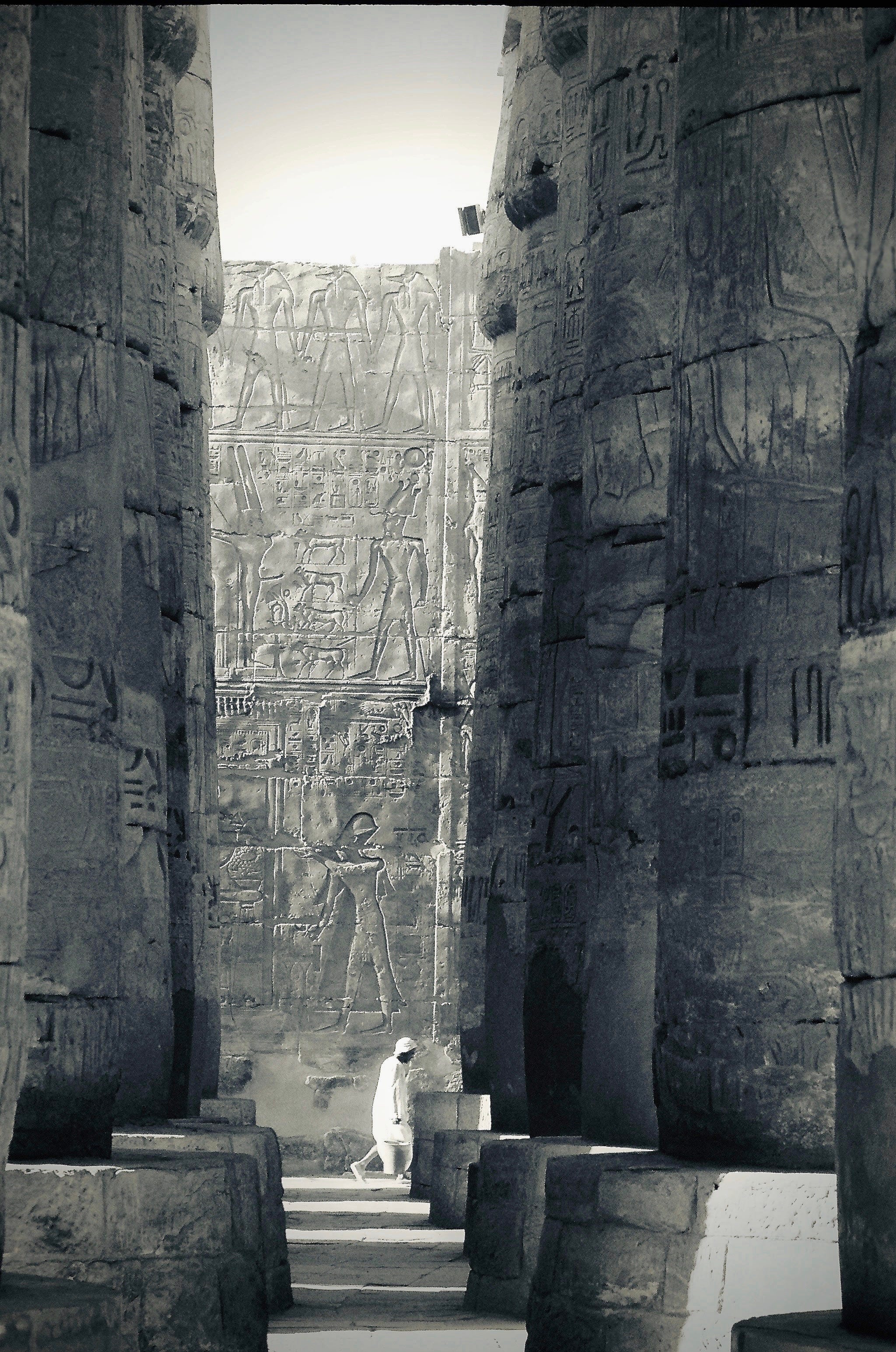
You do not have to be a good Christian, or religious at all, to recognize the validity of “By their fruits ye shall know them." The manifestations of these opposing metaphysical systems speak for themselves, and may be judged with some degree of objectivity — at least by those who have not had their sensitivities irreparably blighted by education. On the one hand we have our twentieth century, that is to say: Progress, with its nuclear energy, bacteriological and chemical warfare, the traffic jam, irreversible pollution of the earth, seas, and skies and striped toothpaste (yes, yes, I know: three cheers for the high speed dentist's drill, and this is written with a computer, not a goose quill; there is just no room here to extract a very small baby from an ocean of bathwater, toxic bathwater at that). On the other hand, as the very antithesis of Progress, we have the temples, tombs, and pyramids of Egypt, based upon a totally different set of values and philosophical principles. This is civilization. And it is at this point that academic Egyptology takes on a totally unexpected character.
If you think of Egyptologists at all, the chances are you conjure up a bunch of harmless pedants, up to their elbows in old papyrus, working out the details of Tutankhamen's laundry list. You don't think of them as sinister or dangerous. The illuminati responsible for the hydrogen bomb, nerve gas, and Agent Orange are dangerous; if you stop to think about it you see that the advanced beings who have given us striped toothpaste and disposable diapers are also dangerous... but Egyptologists?
Possibly they are the most dangerous of all—dangerous because false ideas are dangerous. (At any rate some false ideas are dangerous. Belief in the flat earth never hurt anyone though it made navigation problematic. Belief in a geocentric universe held back advances in astronomy but otherwise had certain metaphysical advantages. On the other hand, Darwinian Evolution— the only theory in the world less scientific than the Immaculate Conception —has probably done more damage than Stalin and Hitler combined.)
Academic Egyptology is dangerous because it maintains, in spite of the monumental visual evidence to the contrary, and in spite of Schwaller de Lubicz's magisterial and documented scholarly evidence, that the race responsible for the pyramids and the temples of Karnak and Luxor was less "advanced" than ourselves.
Thus, orthodox Egyptology amounts to still another covert operation within the Church of Progress. Its unspoken agenda is to maintain the faith, not to study or debate the truth about Egypt. (And, of course, the very notion of Progress is a matter of perspective: the maggot sees its world as a boundless field of seething, purposeful activity; the falcon flying above just sees a dead horse.)
Once we get a glimpse of the radical difference between Civilization and Progress, then the truth about ancient Egypt becomes a practical, even urgent concern. The gut emotional experience of an Egyptian temple or tomb (of any work of art for that matter), lies permanently outside the domain of scholarship. But the scholarly explanation applied to the experience makes a dramatic difference to our subsequent appreciation. By denying or suppressing the truth about Egypt, Egyptologists effectively prevent masses of people from understanding what a genuine civilization once was like.
This is not to say that ancient Egypt was Paradise, or even a Golden Age. Certainly it had its shortcomings and in time it, too, declined and fell. Nor was Egypt the only true civilization that existed in the past. Its chief importance for us is perhaps that our knowledge of it is not contingent upon texts and myths handed down over generations and changing with the times. Unlike China, India, Mesoamerica, and others, in Egypt we have access to the original art and architecture. The temples, tombs, and pyramids are still there for us to study, wonder at, and learn from. The symbolist interpretation allows us to appreciate, and to a certain extent assimilate that distant past, when human beings understood their divine potential—their foreordained role within the grand scheme —and acted accordingly.
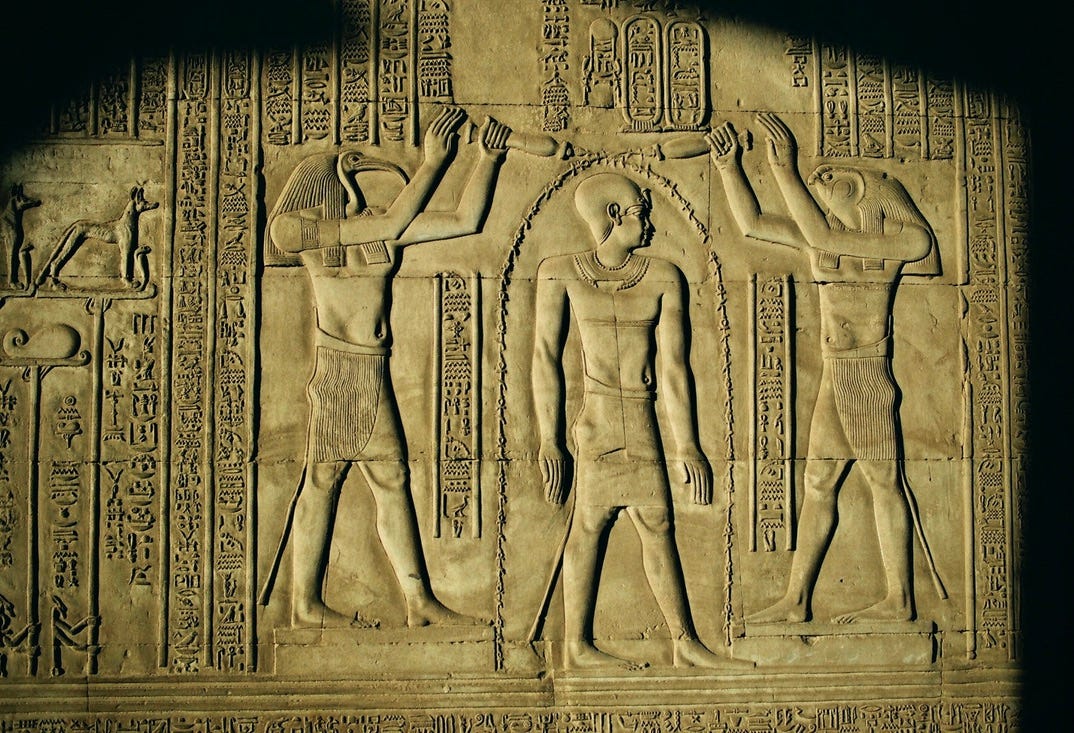
We have no civilization of our own. The headlines of every daily newspaper spell out for us the consequences of Progress. So an understanding of Civilization becomes imperative— if anything at all is to be salvaged from a future whose only real mystery is the extent and nature of the chaos that is to come.
Ancient Egypt could play the role of exemplar for the future. This is not to say that we will someday build temples and pyramids of our own, and revert to elaborate mummification rituals. We won't. But the Principles are eternal, and the doctrine of the transformation of the soul, the Return to the Source, is as valid now as it was then. It is up to us and to the generations that follow to express those Principles through an art and a science geared to a new era, and to find new ways to practice the to the great doctrine that gives meaning and purpose to our lives.
********
While John’s comments in both this article and the accompanying interview were extremely well-received by readers (in fact, both were picked up for reprinting by the magazine Science of Mind, where they enjoyed even greater readership), we received one critical letter-to-the-editor, which I felt was worth reprinting here both for that reader’s comments as well as John’s response:
To the editor:
John Anthony West does a great disservice to both the interested public and scholarly community by condemning Egyptologists as "dangerous" (The Quest, Winter 1991). As an academically trained Egyptologist, but by no means "orthodox," I feel it is necessary to clarify Egyptological methodology.
Contrary to what Mr. West believes, professional Egyptologists are not in the habit of "denying or suppressing the truth," (p. 22) rather they seek to discover the "truth," not by the "gut emotional experiences" which he advocates, but by referring to what the ancient Egyptians themselves have expressed in writing whenever possible, or by means of the archaeological record when inscriptions do not exist. The problem with the many alternative theories about the Egyptians which have been proposed over the decades is NOT that they are contrary to the opinions of Egyptologists, but that they very often contradict what the Egyptians themselves have revealed to us in their own words. In the great majority of cases, those individuals who have made spurious remarks about the Egyptians have never read a single hieroglyphic inscription. Would we let go unchallenged a biblical interpretation by someone who has never read the Greek or Hebrew text or an analysis of Hinduism by someone who never read the Vedas in Sanskrit?
The only way to truly understand any ancient people is to abandon a twentieth-century perspective, immerse oneself in that culture, and get "inside" the minds of those individuals, preferably by reading what they themselves have expressed. Certainly translating inscriptions is only the beginning of the process by which we come to know the ancient Egyptians.
Much light can be shed by looking to other cultures and traditions. Much can be learned by comparing the enigmatic scriptures of Egypt with other esoteric writings such as the Tibetan "Book of the Dead" and the Vedas and Upanishads of India. Theories will continue to be theories until they can be corroborated by some evidence other than emotions. Surely Mr. West must realize that basing one's opinions on emotions is dangerous indeed. Rather, an appeal to our spiritual selves would be more advantageous to all.
Although I am quite familiar with dry and uninspired (and yes, faulty) academic analyses of the ancient Egyptians, I cannot find fault with the discipline itself nor its methodology, but rather with the biases and subjective opinions of specific individuals (Egyptologists are after all human). The dilemma as I see it is to ground oneself firmly in the academic tradition (how else can you know what factual evidence has come to light?), and combine scholarship with a sense of the spiritual, by recognizing that individuals are more than assemblages of flesh and bones, but comprise spirit as well. Together the spiritual and the scholarly may breathe life into the dead Egyptians. Relying exclusively on one or the other results in a very unbalanced view of the ancients.
As for Mr. West's endorsement of Schwaller de Lubicz's work, putting any one of Schwaller's books in the hands of someone with no background in Egyptology is like giving War and Peace to a pre-schooler — it would make no sense whatsoever. Before anyone can begin to gauge the esoteric significance of ancient Egyptian texts, monuments, and artifacts, he/she must be acquainted with the basics of Egyptian civilization, the "exoteric" if you will.
Mr. West's comments on the Sphinx also need addressing. Whereas it is clear that the limestone outcropping from which the Sphinx was fashioned geologically predates anything of human construction in the Nile Valley, it by no means follows that the carving of the sphinx predates the construction of the pyramids. Additionally, the location of inscriptions by workmen on stones used to construct the pyramids indicate that those inscriptions were put on the surfaces before the stones were set in place. This firmly places the monuments of Giza in a historical context.
Granted that Egyptology is a fairly conservative discipline (as are most academic fields), still the findings of archaeologists and philologists have allowed us to see that the ancient Egyptians comprised a highly structured society in which politics, science, philosophy, and the arts all were grounded in a pervasive spiritual tradition. Modern man would do best to rediscover the divine matrix of which he is part, and of which the ancient Egyptians seemed so well aware.
Michael D. Calabria
Baruch College, New York, NY
BY JOHN ANTHONY WEST RESPONDS:
A defense of academic orthodoxy by a professed orthodox academic is difficult to counter in the few words allocated me by The Quest. The best I can do is to flatly maintain that academic Egyptologists routinely do NOT do any of the things Mr. Calabria says they do. They do NOT take into account what the Egyptians say about themselves; nor do they know what the ancient Egyptians are actually saying (if they did, the translations of the religious literature would not be so wildly disparate). Even if they had the words more or less straight, the meaning would elude them completely, precisely because they approach the subject from that analytical standpoint extolled by Mr. Calabria (try writing intelligibly about Beethoven without first feeling his music in your gut!). A grounding in Egyptology is the last thing you need to read Schwaller de Lubicz.
And any Egyptologist indiscreet enough to confess that he or she "combined scholarship with a sense of the spiritual" would be denied tenure and would probably be fired. If Quest readers would like to put these generalizations to the test they should refer to any popular book on ancient Egypt by any modern English-speaking Egyptologist, or better yet, consult any professional Egyptological journal to get a sense of the stupefying pettiness of the discipline as a whole and the barrenness of its methodology.
Finally, the Sphinx is not fashioned from a natural "limestone outcropping," it is in its entirety fashioned by human hands out of bedrock deliberately exposed to produce the Sphinx. In other words, ALL weathering to the Sphinx has taken place since it was carved, and it is the nature of that weathering that convinced hundreds of professional geologists attending our presentation at the Geological Society of America's convention in San Diego in October that the historical context invented for the Sphinx by Egyptologists is wrong. Mr. Calabria is not a geologist.
John Anthony West
Ray Grasse is a writer, astrologer, and photographer living in the American Midwest. He is author of ten books, most recently In the Company of Gods and So, What Am I Doing Here, Anyway? He worked on the editorial staff of the Theosophical Society in Wheaton, Illinois, from 1989 to 1999. His websites are www.raygrasse.com and www.raygrassephotography.com.