
A CONVERSATION WITH WILLIAM IRWIN THOMPSON

In early 1991 I conducted a lengthy interview with William Irwin Thompson, which appeared in the Spring 1991 issue of Quest Magazine. This exchange took place during a time of enormous socio-political change in the world, and it’s fascinating now looking back 35 years later at his observations. I’ve reprinted it here in full.

CULTURE, CHAOS, AND PLANETARY TRANSFORMATION
An Interview with William Irwin Thompson
By Ray Grasse
Ours is an age of extraordinary change. But while we may learn through newspapers, magazines, or TV the bare facts of these developments, it’s far more difficult to discern their broader implications and significance. For almost two decades, cultural historian William Irwin Thompson has been respected as one of the most eloquent interpreters of the contemporary experience. Having received degrees in anthropology, philosophy, and English literature, he began his professional career as an instructor of humanities at the Massachusetts Institute of Technology in 1965. He soon grew disillusioned with the intellectual rigidity and politics of university life, and left academia in 1972 to begin his own process of intellectual and spiritual exploration.
He’s sought to discover how creative individuals or communities outside mainstream society can effect lasting transformation, as exemplified by the early Christian monastic communities of lona and Lindisfarne. It was the latter group that provided Thompson with the name for the Lindisfarne Association, which he founded in the early 1970s. The association has brought together some of the most innovative and creative minds of our time in an atmosphere of fellowship, to explore topics such as ecology, sacred architecture, politics, and new science.
One does not always have to agree with Thompson’s conclusions to be struck by the sheer beauty of his language and the wizardry of his metaphors. Consider the following passage from his newly-written preface to his early works, At the Edge of History and Passages About Earth, which were recently republished as a single volume by Lindisfarne Press:
“Always at an edge with history, my imaginary landscape of literature is myth: the myth of the past, the myth of the future. Neither aloft on the summit of human evolution with a Sri Aurobindo, nor down in the noise of the surf crashing in conflict on the rocks, I look at the patterns of the waves, the movement of the sky, and infer the invisibly slow historic motion of the shifting tectonic plates. The wave that came in 1967 is now spent and only a few tidal backwater pools are still wet with millennial ecstasy. The counterculture of hippies and gurus, communes and New Age communities is finished; though, perhaps, its wave has hurled life up another inch on the beachhead of evolution.”
Since the publication of these two books in the early 1970s (the first was a semifinalist for the National Book Award in 1972), Thompson has gone on to write numerous other works on various aspects of planetary change. These have included The Time Falling Bodies Take to Light, Evil and World Order, and Imaginary Landscape. He also wrote a novel set in the period of Atlantis, Island Out of Time, recently reissued by Bear and Company.
In Imaginary Landscape, Thompson explores the meeting point of the scientific and mythopoeic imaginations and discusses how recent changes in planetary culture are reflected in the emergence of chaos theory in science. In view of the amazing developments that have transpired since the publication of this work in 1988, we thought it would be interesting to ask Thompson for his thoughts on the developments that continue to rock the world.
In recent years Thompson has divided his time between Zurich, Switzerland, and New York, where he is Lindisfarne scholar at the Cathedral of Saint John the Divine. We caught up with him for this interview in October 1990, only hours before his flight back to Zurich, where he spends each winter and spring.
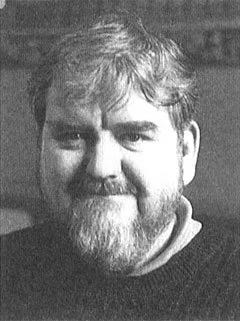
Quest: You’ve been living on and off in Europe for a few years, and I’m curious what perspective this has given you on what’s happening in America.
William Irwin Thompson: Well, naturally, distance sensitizes you to border crossing, so that it becomes more of a membrane when you return. I’ve become much more sensitive to the uniqueness of America, both in its historical role and in its present role in world culture. So, for that reason, it’s been really good to escape the ethnocentricity of Americans who, for the most part, aren’t aware of any other part of the world. You know, there have been studies showing that American high school students don’t know geography and can’t find Canada on the map; Americans often tend to be unaware of other parts of the world. I get phone calls in the middle of the night in Switzerland because Americans think that American time is everywhere. So living abroad for half the year makes me aware of just how provincial and arrogant Americans can be.
I can see that with the rise of Europe and the level of erudition and education in Europe, America is losing its singular position of world power simply because of its disintegrating educational system and its lowered standards of art, culture, and knowledge. I can see how incredibly committed America is to technology as a religious solution to all problems. America is much more heavily committed to the idea of electronics, personal computers, and “virtual reality” forms of art, to all these new electronic technologies, as a solution to everything. Europe hasn’t yet invested its spirit into this, and there still is a philosophical and mental orientation that has its roots in the Enlightenment and the Renaissance.
So, for all of those reasons I’ve learned an enormous amount by living in Europe, and really, I’m more like an electron with an orbit than a nucleus with a location. One of the old notions I think people have, both in Europe and America, is that you live in a place. I would say the new characteristic, because of modems and FAX, is that you live with a “pattern that connects,” and that you don’t have a simple location. There is a new pattern in which home, identity, and local culture is not the only thing going. So I’m constantly going in and out of the United States, and my “home base,” or my cultural base, or my office is still in New York City at the Cathedral of Saint John the Divine.
Q: So where do you think we are heading? What direction do you see for America?
WIT: It’s very hard to say because chaotic attractors are self-organization from noise, and they’re open-ended and, by their very nature, unpredictable. So people should never pretend to be smarter than is possible in this kind of system. You know, when you have just one or two parameters, you can sort of guess, but when you’re doing something as complicated as America, everything is going on at once.
So, you can say America is losing world hegemony, and in the monolithic sense of Rockefeller Center, with all the multinational corporations, that’s true. But on the other hand, America has also created a process of planetization of the economy because we, in effect, energized and set up our previous enemies, Germany and Japan, and created the system that enabled them very rapidly to become wealthy and dynamic! The system that we see succeeding in Germany and Japan is an American system, and the Soviet Union is now buying into that. So the loss of American hegemony is one thing, but there’s another quality coming on at the same time.
It does look like it’s sort of a return of the Middle Ages in the sense that nationalism is not as important as it used to be, but class, in a Marxist sense, has not gone away. In many ways, one’s access to education, whether one goes to Harvard or not, seems to be now a function of family. And the society is beginning to take on very medieval characteristics. There is a ruling class at the top that communicates through oral means, face-to-face.
Then there’s a scientific/technical class which would be like the “informational knights” these are the equivalents of the lords and the knights of the Middle Ages, and they communicate through electronic, scientific, and technical means. And then there’s a kind of artisanal class, and at the bottom there’s an underclass. So it’s almost like a return of the Vedic fourfold caste system: mouth, eye, hand, and rump. The oral class has the right accent, and has wealth; the class of the eye reads and studies, and has science and art; the class of the hand works; and the bottom is on its ass. So things are becoming extremely hierarchical as the rich get richer and the poor get poorer, and the smaller ruling class just rules the masses through pageantry and illusion. So television is the means of disseminating and creating this electronic state of entertainment, but the people who are outside are, by definition, not part of the “electro-peasantry.” Television really is the means that defines whether you are a knight of information or an electro-peasant.
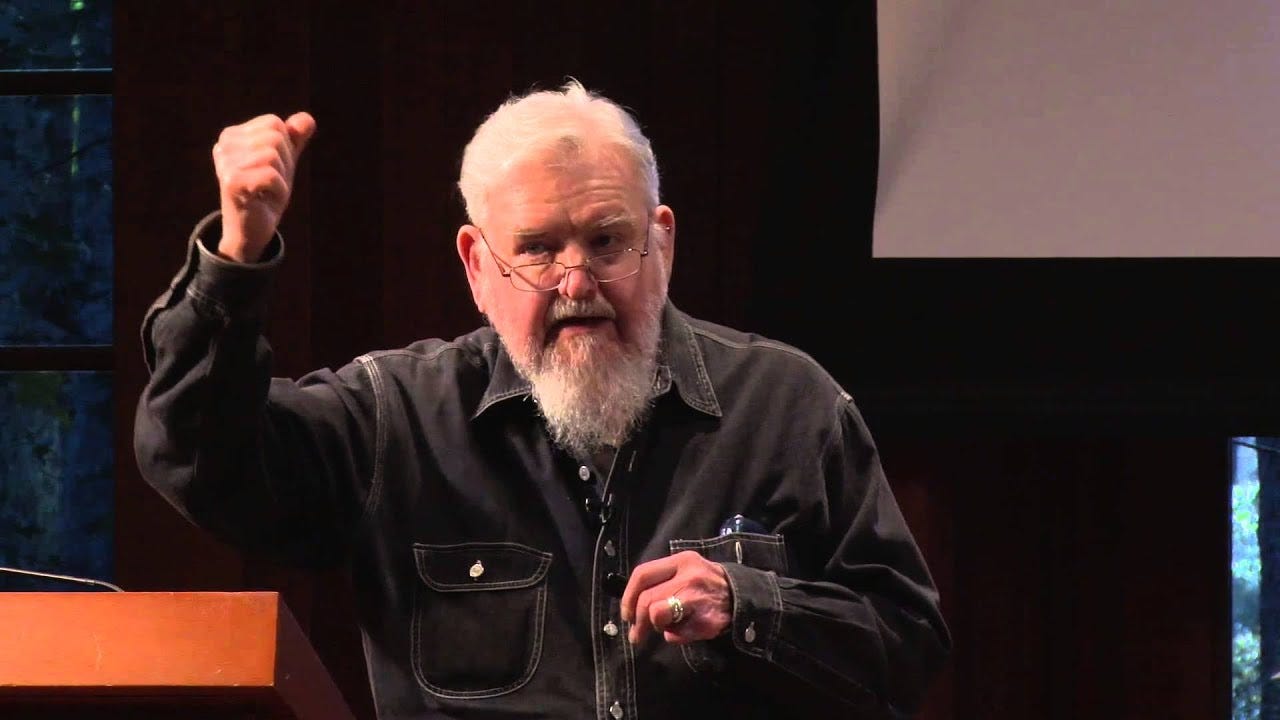
Q: I don’t know whether you were living in Europe when the revolutions took place, but I presume you have some thoughts on the broader implications of what happened there in these last couple of years.
WIT: I was in and out. Actually, I was in Seattle when they were dancing on the Berlin Wall, and then I was back in Zurich when the wall was coming down, so l’ve been going back and forth during the whole process. Europe’s just like America-it’s extremely complex-and so again I have to stress that people should not try to pretend to be smarter than is humanly possible. I mean, we’re talking about an international skinhead movement in which soccer games become forms of ritualistic war and invasion; we’re talking about a rise of ferocious anti-semitism in Warsaw, Budapest, and France at the same time that were talking about Europe 1992 and the United States of Europe as a world power; we’re talking about a decentralization in which you have the Europe of the regions, and everything is going on at once.
Eastern Europe has enormous problems. After fifty years of industrial poisoning from dialectical materialism, and no citizens’ environmental movement, they have a situation in which they don’t have our open group process for dealing with the politics of democracy. They know this, and so the human potential movement and the spiritual movement is enormously attractive to them. In the same way that Esalen Institute pioneered the Esalen Moscow Exchange a decade ago, the Open Center in New York is now beginning to set up relations with Prague, and there are various people from southern California in Budapest. A lot of spiritual teachers, Zen masters and people of that sort, are finding an enormous audience in eastern Europe, and the people there are trying to discover what we’ve had for the last twenty-five years-the whole mix of “Third Movement” psychology, Maslow, human potential, meditation, physical fitness.
So when you’re talking about Europe, you’re talking about people who are still back in the culture of philosophizing and smoking cigarettes. At one level, America is vastly inferior to Europe, but at another level it’s vastly more advanced. All of these things are just swirling around together, in a kind of electric blender. So what kind of planetary frappe comes out of it is anybody’s guess.
Q: Well, there’s been a lot of talk about the coming “United States of Europe” and the effects that will have, for better or worse. On the one hand, it will presumably make Europe a stronger economic and political power, but there’s also the concern that it could erase regional distinctions.
WIT: No, it won’t erase regional distinctions. The patterns that we experienced in the nineteenth century in building Canada and the United States were based on the railroad and print, and these are not the technologies of communication and expression now. What is happening is the creation of global economies almost, economic “biomes” — like the Pacific Rim, Europe, North America — with the southern hemisphere trying to figure out how it’s going to relate to that.
What you see in the Gulf crisis is that those Islamic countries that define themselves as part of Europe 1992 have joined with the United Nations in condemning Iraq. So you’ve got Morocco, Turkey, Egypt, and Syria basically saying, “Look, we’re around the Mediterranean, we want to be part of the economy of Europe.” What Khadaffi found from Reagan’s air strike on him was that all the Libyan shares in Olivetti got dumped back in his lap because Olivetti had merged with AT&T, and this multi-national is trying to come online for planetary sciences, defense contract and all the rest of it. When they realized that Libya owned too large a controlling interest in Olivetti, threatening its whole relationship to AT&T, they dumped Libya. So Libya has learned that to be excluded from this is to really be put in the rear end of the world economy. Now you find Khadaffi talking like a moderate. So the Gulf crisis is restructuring Europe. Whereas before, Israel was always the toehold of the European scientific mentality in the medieval world of Islam, that’s now getting much more complicated as various Islamic countries are strongly trying to integrate with Europe and Israel has become dominated by reactionary, theocratic parties. At the same time, however, you’ve got intense regionalism going on all over.
So, I think you’ll see a different kind of ecology of mind in an electronic era with FAX and modems and television and ethnic languages on cable TV. America is now becoming polylingual the way Europe is, even though English is still the economic and scientific language of communication for Europe. The plurality of languages doesn’t seem to be disappearing. In many ways, German reunification has nailed the lid on the coffin of French as a world language. Before, the French kept hoping that theirs could become the language of civilized discourse once again, now they know there’s no chance in hell for that. It’s very complicated, but I don’t think you’re going to see regionalism go away. Sweden, Austria, and Switzerland are also trying to figure out how fast or how slow they should move toward the European Community. I would say that ‘92 has been overemphasized, and that there are still a lot of social problems to be dealt with, such as the role of Turkish guest workers in Germany, the role of languages, and the problem of anti-semitism. Jacques Attali, the French economist, predicts the decline of the United States and the rise of Europe and the Pacific Rim. But that just describes what’s going on right now; it’s kind of a linear extrapolation. I think it’s more complicated than that.

Q: You talked about the Pacific Rim, and that brings me to some of your own work. You’ve spoken about global cultural transformations as related almost to geographical shifts in history. Could you explain that? How are the two connected?
WIT: In a sense, we’re now beyond the period of Pacific Shift. That was a good catch phrase for the postwar phenomenon, up to the eighties. It described the rise of Los Angeles, the aerospace industries, Silicon Valley, Disneyland, and the growth of American trade with the Pacific countries-even beyond that with European countries. Now, with the rise of eastern Europe and the Amazon deforestation ecological problem, we really need a biospheric definition of water. If you go back to the language I used in Pacific Shift, I started with “riverine,” meaning the Tigris, Euphrates, and Nile (and Huang-ho, Yangtse, and Indus). Then you move to the Mediterranean classical period of culture, up to the time when Venice was the world economic city. Then move to the Atlantic — to Spain, England, and Amsterdam —when the colonization and the modern period was created. Then came the Pacific Shift of the postwar period, say from ‘45 to ‘90. Now we’re in the “biospheric” period where water isn’t an “oceanic” space to cross, but more of a Gaian metabolic system interacting with continental plates, volcanoes, and the gaseous atmosphere as well as the sea. This is why I’ve made my political philosophy based more on the Gaia hypothesis and have called it “Gaia politique” instead of geopolitics.
Q: Could you explain how one can base a political stance on the Gaia hypothesis?
WIT: Every time you have a shift in political thinking, it’s rooted in the philosophy of the times. If you’re talking about the commons and John Locke and private property, and the rise of mercantilism and then capitalism, you’re talking about a vision of nature that has to do with various agricultural properties — namely, the end of medieval shared space, the fencing in of the commons, the Enclosure Acts, and the pauperization of the lower class and their sa transformation into an industrial proletariat.
You then have laws articulated through fences, and you have a whole formation of what McLuhan called the “Gutenberg Galaxy.” All the these institutions of written books and written the laws interact in the age of print with new Enlightenment values. So from Locke to Jefferson, you have a coherent movement based on science, philosophy, and politics. Now are at the end of the territorial nation-state, and at the end of the age of print, and we move into electronic pulses of information and currency on a planetary scale. We end up with identity formations that take on the characteristic of almost “musical” polities that can’t be grounded on turf or nation-states, and we begin to see identity much more as a symbiotic process.
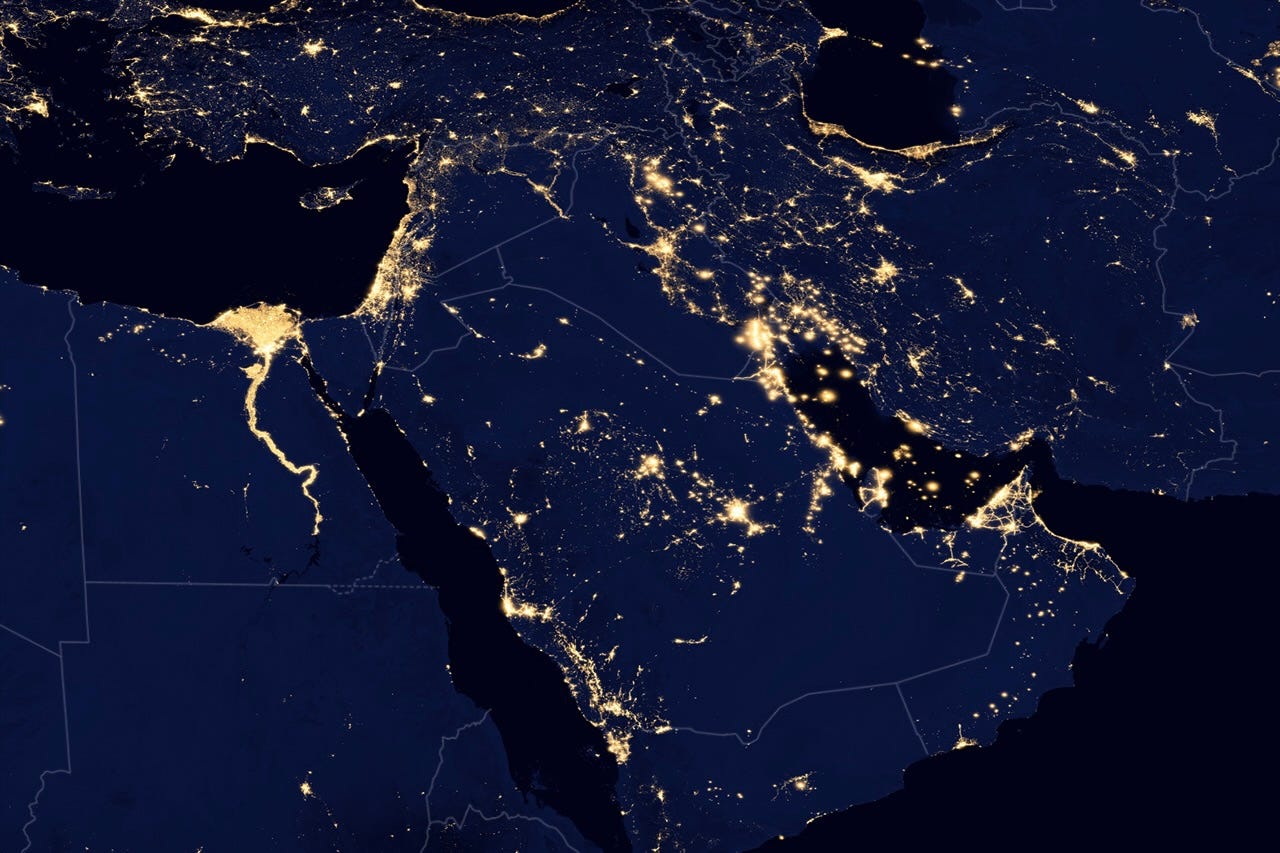
Take a look at the problem in the Middle East. If you try to solve it in terms of turf and raw lines and say, okay, this part is Kuwait, this part is Iraq, this part is Palestine, and this part is Israel, you will violate the actual biological nature of the metabolic processes of exchange and interaction that are going on. And, you’ll create unending violence, which is what we’ve done for the last fifty years. If you understand, say, through the biology of Lynn Margulis, that these entities that produce identity, be they called Kuwaitis or Palestinians, endosymbiants in a cell — part of the architecture of the cell — then you can’t just carve them out and isolate them. You have to understand how they work, and therefore you need new metaphors. Look at now mitochondria live, how chloroplasts live, how genes have identity but also how enzymes in the cytoplasm affect the genetic inheritance in the nucleus. You have to go back to school and try to understand life in order to deal with the politics of life.
And, lo and behold, both Lynn Margulis and Jim Lovelock give us instructive examples of how continents and oceans are involved with cloud formation, how cloud formation affects the temperature, and how the part and the whole interrelate. If we are instructed by that, then we have to understand that all the ways in which we’re trying to solve the problems of the Middle East won’t work, because were using territorial polities to solve the problems of noetic polities, and that just won’t work.
It’s a category mistake. As Marshall McLuhan said, politicians are always trying to solve the problems of the present with the ideas of the past.
Q: But isn’t that a mistake that not only the outsiders make, but the insiders as well-the people living in those areas?
WIT: Yes, although there’s a peculiar unconsciousness going on, on the part of the terrorists. They understand that they are working with television, and are basically performers in a planetary space. They also understand that their political leverage and impact is going to be massively magnified by the global electronic media, so the manipulation of the means of communication begins to be part of their revolutionary technique. Generally, the old-fashioned territorial nation-state says, maintain the monopoly on the means of communication and the means of violence. Only our armies are legitimate.” So it’s OK for the Israeli Air Force to bomb Beirut, but it’s not OK for the Palestinians to fight back. That’s the traditional way. And the Israelis will say,”We cannot sit down and negotiate with terrorists.” Now, this is nonsense! When the Irish achieved independence, the British Prime Minister had to sit down with Michael Collins in Whitehall. Michael Collins was the supreme terrorist of the Irish Revolution. George Washington was a terrorist. He wasn’t putting his revolutionary army out in the front to fight the Redcoats in the way that they fought in Prussia, he was hiding behind trees and picking them off like flies. He used the techniques of the weak against the techniques of the consolidated strong. So as long as the Israelis say that the Palestinians are terrorists and they can’t negotiate, this thing will go on for another fifty years.
Q: What does the “Gaia politique” have to offer?
WIT: Well, basically, you have to respect the notion of membrane rather than wall. The territorial sovereign nation-state, as we know, came out of the Treaty of Westphalia at the end of the Thirty Years War. That nation-state system won’t work. We’re talking about identity structures based on language and culture, and these cultures don’t map on nation-states. For example, you’ve got the Kurds in Iraq, so if you try to give everybody a piece of turf, you’re going to end up with cultural entropy and a division ad infinitum. The Soviet Union is now facing this. Identity is produced through cultures and languages, and the metabolic process has to be affirmed. But it is not affirmed, necessarily, by giving everybody a piece of turf.
While the UN is in the Middle East, and all the armies are there, we should have a UN conference on the entire Middle East situation. Gorbachev and Schevardnadze are basically right, and Bush is wrong. We cannot isolate Iraq as one problem; we have to look at the whole problem of the Palestinians, and we have to realize that a lot of the battles we’re fighting are over arbitrary lines in the sand that the British Empire created at the end of the Second World War. Once we begin to understand the production of identity and value —and of course economic value is part of this—then we have to approach it in a different way.
There are many different solutions, not just one supreme smart one. Obviously, Jerusalem should probably belong to the United Nations, and be a shrine city of the Abrahamic religions and belong to the planetary heritage of planetary culture. This was originally proposed by the UN when the state of Israel was being brought into birth. And the Palestinians have to be given some means by which their culture and languages are affirmed in interaction with all the other Middle Eastern cultures. It would take the United Nations to figure out an appropriate negotiated settlement for this, but the notion of the sovereign independent nation-state, with a monopoly of terror, would probably have to go. What the Russians have suggested is to take instruments of genocidal violence out of the Middle East. Of course, Israel won’t stand for that, because it means not only taking poison gas and missiles away from Iraq, it means taking atom bombs away from Israel. So, only the United Nations can solve this problem. As long as all the aircraft carriers are there, and the United States is working in concert with the United Nations, it’s a good time to really confront the problem of the Middle East.
Notice that as soon as we ended the cold war, and European civilization from Moscow to Missoula integrated, the shadow of Europe was summoned forth and we ended up with the return of Islam and some kind of return of the Crusades. This is “old karma” left over from the formation of European civilization that has never been solved, so it’s not going to go away. And we won’t have a planetary culture until we’ve solved this one-Islam as the shadow of Europe.
Q: I’ve even wondered if the whole Iran/ Iraq region, being the historic location of Persia, might not have deeper roots in the Zoroastrian dualism that lies at the heart of many of our Western problems.
WIT: Oh yes, well this is certainly the case with Iran. But we’re basically dealing with medieval mentalities that think with fixed geometries. This is why I’ve tried to work with the theories of the evolution of consciousness of Rudolf Steiner and Jean Gebser by dealing with the evolution of mathematics. The medieval worldview is definitely a worldview of rigid, inflexible geometries of center and periphery, and these don’t map onto the world of capitalism.
Fundamentalism, to put it in dynamical theory, occurs whenever an attractor begins to disintegrate in an accumulation of noise, and it’s drawn toward a different basin of attraction. There are basically three: a point attractor, a periodic attractor, and a chaotic attractor. Noise builds up until it becomes intolerable and the old attractor dissolves. When noise becomes intolerable, it generates fundamentalism and paranoia and hysteria; you get Christian fundamentalism, Islamic fundamentalism, Marxist fundamentalism in China.
These are increasingly rigid, and can’t handle complexity, so they crack. The old die off, and the young, who can handle complexity and who have a new mathematical imagination, come on the scene. But when fundamentalisms of any variety try to control experience, through hysteria and fear, they only create more noise, more terror, and more fear. And the more rigid they become, so that they can’t bend, they just break. They can create one hell of a mess in the fifty-odd years in which they postpone things. It looks like China has basically postponed their global integration for another generation. But sooner or later, they will crack. We saw Marxist fundamentalism crack in 1989, and now the big question is, what is the role of Islam in a planetary culture? Is it going to be just the planetary nativistic movement, or is it going to evolve into something else? It’s an open question.

Q: You’ve mentioned “chaotic attractors” and chaos theory a lot in your most recent work. You seem to feel that chaos dynamics represents one of the great metaphors of our own age.
WIT: Well, yes. It’s part of the evolution of consciousness. Chaos, unfortunately, is the wrong word, because it gives people the wrong image; you know, we’re really dealing with the sciences of complexity. Chaos is basically only
“chaotic” if you have a linear, causal, reductionist mentality. If you have a more biological mentality, then what you’re talking about are the sciences of complexity. When we created the Renaissance, we created capitalism and interest, and mathematics for falling bodies in calculus. In 1972, we entered a new era in which planetary dynamics were articulated by Dennis and Donella Meadows in their work on global processes, Limits to Growth. At the same time, Rene Thom in Paris created “catastrophe theory” as the kind of return of visual thinking in phase-portraits and geometries of behavior. And then that got developed by Smale and Lorentz, Geigenbaum, Abraham, and others into what is now known as “chaos dynamical theory.” So this period represents the explosion of this new planetary culture. And of course, my whole career, from founding Lindisfarne in 1972, has been to articulate the new planetary culture as being distinct from the mere internationalism of, say, 1945 to 1972.
We have now a new spirituality, what has been called the New Age movement. You, as a theosophical institution, would be aware that the planetization of the esoteric has been going on for some time. Now we have spirituality coupled to new mathematical ways of understanding behavior. This is now beginning to influence concepts of polity and community in ecology, and global polity, so this is the “Gaia politique” we were talking about earlier. This mathematical imagination is inseparable and co-emergent with all these other artistic and musical developments. It’s all one, in the way that it was all one in the Renaissance. So whether you’re talking about David Spangler or Phillip Glass or Ralph Abraham or Jim Lovelock or Lynn Margulis, you’re talking about planetary culture.
Q: Do you feel, then, that planetary culture can ever become a spiritual connection, or must it remain technological and intellectual? Wendy Doniger, for example, has talked about the difficulty of ever having a truly planetary mythology that could meet the needs of many cultures [see Quest, Winter 1990]. Does this planetary culture truly have spiritual potential?
WIT: Of course, it does. Most of my writings have actually been tracking the spiritual side of it. The first phase, coming on the back of the British Empire, was the planetization of the esoteric. And that had to do with movements like Theosophy and the Brahmo Samaj in India, back in the days of Annie Besant. That has been part of this global movement. Of course, you can go beyond Theosophy to the way that Francis Yates tracked the rise of modernism in the Rosicrucian Enlightenment.
The Enlightenment, with its valuation of the individual, the political liberation in American democracy — all these have their roots in the Rosicrucian Enlightenment. We can also go back to John Dee and the rise of the Royal Academy with Newton and Boyle and Bacon. So there isn’t separation between technology and spirituality ever, you know, whether you’re talking about Paleolithic culture and Great Goddess culture as I’ve traced it in The Time Falling Bodies Take to Light, or the relationship between mathematics and art in the Italian Renaissance. You have to think in terms of emergent phenomena, where sailing ships and interest as a form of perception of economic value, and Renaissance painting and architecture, and Galileo and calculus all are part of a change from one worldview to another, from medievalism to modernism.
And the same thing is going on now. Around the turn of the twentieth century, we had the Parliament of World Religions; a lot of gurus came to the United States, and a cultural exchange continued through World War II. Just as in the Crusades we didn’t conquer Jerusalem, but we discovered the Platonic manuscripts, which helped the Renaissance. In World War II, Japan got Detroit’s automotive industry, and we got Zen monasteries in California. That’s the way cultural exchange always works, with D. T. Suzuki and Zen coming to America, and with all the Indian gurus like Yogananda coming to America. The esoteric tradition of the New Age has been going on for a long time, and has been articulated by people like W. B. Yeats and Rudolf Steiner. And Steiner has influenced people like Saul Bellow, Joseph Beuys, and Owen Barfield. So it’s totally spiritual; you just can’t separate spirituality from culture. The whole New Age movement, with friends of mine like David Spangler —that’s inseparable from jet travel and electronic means of communication. So this way of thinking-either/ or and separation-by-turf, is a very modernistic, renaissance way of thinking, and it won’t map onto the actual way we live in contemporary society.
Q: Do you feel that there is any danger, with increasing technology, and the increasing influence of, say, television, of a “loss of soul”?
WIT: Well, everything is dangerous. You know, rocks can be carved or they can be hurled. The moral ambiguities of technologies have been with us since the very dawn of human cultures. Civilization includes the rise of militarism — “civilization” meaning 3500 B.C. The first wave of pop-technology in the sixties included a kind of appropriation of the astral plane through LSD; and now we’re experiencing the appropriation of the etheric plane through electronic technologies and environments of electronic noise, whether virtual reality immersion suits, or goggles, or just extremely low radiation environments. This is eroding the autonomy of the individual etheric body, and will create collective pathologies that will tend to break down the sovereign self-and the nation-state and private property — all of the structures that we’ve inherited from, say, 1500 to 1972. And there will be a lot of evil in this. People will be taking crazy drugs and wearing goggles that will give them cataracts; they’ll get epilepsy from electronic meditation helmets; and they’ll take a lot of neuro-receptor drugs that will give them early Alzheimer’s in their forties. Just as you saw a lot of heavy metal and rock musicians going deaf in their thirties from the culture of loud noise and rock music, you’re going to be seeing zillions of casualties from the new electronic environment. Steiner prophesied some of this stuff when he talked about the preparation for the incarnation of Ahriman. So the “Ahrimanic” qualities of electronics are there. On the other hand, Steiner also said you can’t flee from Ahriman because it’s also part of the “Christic” dialectic of the evolution of human consciousness and incarnation.
The ultimate effect of these “evil” things — and this is why in my last three books I’ve been trying to study the role of evil as the annunciation of the next level of organization — is to break down the membrane of the sovereign self. Well, angelically— that’s what Buddhism says there is no self as an absolute, totally independent, corpuscular thing, there’s only infinite relatedness in all directions. So whether you come at it angelically, through Buddhism, or demonically, through electronic technologies, you’re burning the candle at both ends for the modernistic concept of the independent sovereign state, with the sovereign individual in his private property defending it against all comers with his AK-47 rifle. That world is over, and we are implosively being involved in everyone, and that’s another phenomenology of planetary culture.
Q: A key concept that reappears through all of your writings is the notion of the “innovator on the outside,” and how, in the spirit of T. S. Kuhn, scientific or cultural revolutions frequently are initiated by individuals working on the outside of the mainstream. Whom do you see as being the innovators of our own time who might be looked back to as key catalysts of change in planetary culture?
WIT: Well, “in and out” is part of the old topology of center/periphery dynamic. This works out into the idea that there are institutions that have a monopoly on culture, and these would be Washington or Harvard. When I became unconsciously or mystically-how-ever you wish to describe it sensitive to the new planetary culture in 1972, 1 quit the university and founded Lindisfarne. I decided not to create an institution, but an association and a community. One was progressive and the other was regressive. The community looked back to a “return to nature.” The association invoked the “distributive lattice” of cognitive science and its reimagination of nature. whole aim was to shift away from the institution as a container maintaining a monopoly on value, like a museum or bank, toward a noetic association as an intellectual concert, and a faculty as an intellectual chamber music ensemble. So for the last eighteen years I’ve been performing kind-of concerts of intellectual chamber music with precisely these kinds of people that I think are more important than the conventional professors.
This is why I’ve chosen to work with people like Lynn Margulis, or Jim Lovelock, or Francisco Varela. Certainly, when I started working with them, they weren’t as famous as, say, E. O. Wilson at Harvard, or Stephen Jay Gould, or Gerald Edelman at Rockefeller in New York. But ultimately, I think, just to deal with the three people that I have worked with so closely in Imaginary Landscape, I would say that Varela, Lovelock, and Margulis are more prophetic of the future than either Wilson or Edelman. And right now, Wilson, Gould, and Edelman are supremely, triumphantly powerful, famous, and in charge of the culture.
Q: Many people are familiar with the work of Lovelock and Margulis, largely because of their association with the Gaia hypothesis. But they may not be quite as familiar with Varela, someone you’ve written about a great deal in your last book. How might you summarize his contribution to contemporary thought?
WIT: Well, Varela’s work is a little less accessible in the sense that it’s more formalistic. He’s dealing with a calculus of self-reference and self-organization from noise, and trying to create a philosophy of biology that unites evolutionary theory with immunology, and cognitive biology in the perceptual system of vision. Part of what is fascinating about Varela is that he’s kind of the “dharma heir” of Gregory Bateson, in that he is a marginal figure to the dominant North American figures. But his interest is not so much in one particular theory (so that you could say “This is the “Varela effect), but in the “pattern that connects” those three cognitive domains and what they have to say for global dynamics, and the shape of behaviors that will inspire our political thinking. One important idea in Varela is the shift from adaptation as the dominant metaphor, to natural drift. That kind of refinement of evolutionary theory changes the notion of the world from that of an objective thing out there” with a niche that you have to adapt to or die, to a kind of Prigogine “flow” where all the animals within the system are in concert metaphorically, and are extruding their evolutionary landscape. Of course, Varela’s not the only one thinking this way; so is Stuart Kaufman, a brilliant biologist at Penn. But Varela was quite sensitive to this very early; he got his Ph.D. at Harvard at age 23.
I’ve emphasized Varela a good deal partly because I’ve had occasion to meet and work with him, and am sympatico. But we also are talking about spirituality, and the fourth thing that’s interesting about Varela, and that will become clear when his major work, The Embodied Mind: Cognitive Science and Human Experience, comes out, is the relationship of his thought to planetary philosophy, Buddhism, and contemplative practice. Now, you tell me who else in the world has taken evolutionary theory, immunology, perceptual cognitive biology, and artificial intelligence —all of that—and mapped it onto European continental phenomenology, and then related it to Buddhism and Asian thought! I don’t know anybody else who’s done that. Varela and my son Evan Thompson have co-authored this work, and it now Eleanor Rosch, a cognitive psychologist from Berkeley, has joined them as the work’s third author. I think this book will have a long shelf life, because it brings together a psychol-ogist, a neurophysiologist, and a philosopher, all of whom have had deep training and study in Buddhism. For me, this book, which I have watched grow from a conversation with Varela over Dos Equis in a Mexican restaurant in Boulder, Colorado in 1980, to manuscripts being written in Paris, Toronto, Berkeley, and Dharamsala, is itself a concert of planetary culture.
Ray Grasse is a writer, astrologer, and photographer living in the American Midwest. He is author of ten books, including The Waking Dream, An Infinity of Gods, and Under a Sacred Sky. His websites are www.raygrasse.com and www.raygrassephotography.com.
Adored this man. No longer any molten minds with his approach around. His The Time Falling Bodies book changed my life.