
A BRUSH WITH KUNDALINI

[This has been adapted from my book When the Stars Align.]
In my modest experience with meditation through the decades, I’ve had a few moments of heightened clarity here and there, where I felt as though I was beginning to “wake up” just a little bit more. In my book The Sky Stretched Out Before Me, I wrote about the months I spent at a Zen monastery in upstate New York and described some of my experiences there.
But there is one experience from that time I didn’t include in that book, which touches on something commonly referred to as “kundalini.” I’d like to talk about that one here.
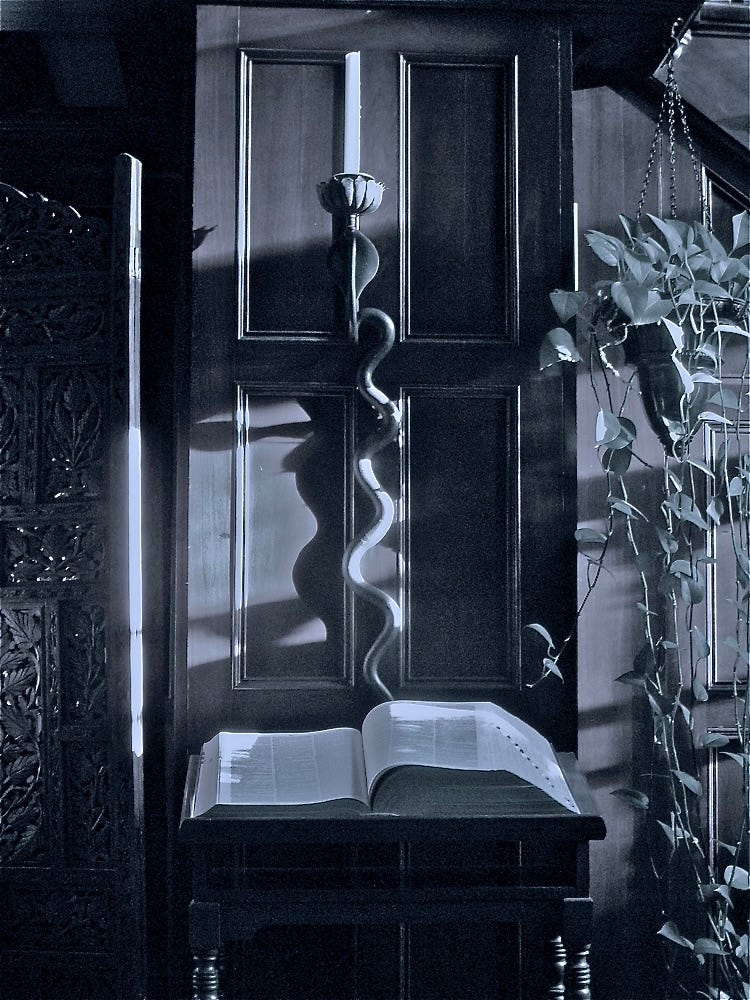
To be clear, this wasn’t a fully realized version of that state, but it was just realized enough for me to gain a little insight into the phenomenon. There are a host of misconceptions around this subject, I believe, and what I’d like to relate here sheds a somewhat different light on it than what has generally been described.
My experience took place shortly before I was set to leave the monastery, during an event called rohatsu, an intensive seven-day silent meditation retreat conducted in the lead-up to New Year’s Eve. Every day of rohatsu, meditation sessions are progressively extended until the very last day, December 31, with that day being devoted almost entirely to sitting meditation (with short periodic breaks every forty minutes or so, devoted to silent walking meditations).
In the hours leading up to midnight on that final day of the year, I had been doing my best to focus my attention as fully as possible on the technique at hand, which at that point was the sound MU, held silently. Eventually, I began to feel as though my mind was settling down, with the inner mental chatter that normally plagues me being nearly absent. I could tell that I was burrowing deeper into the moment, into the NOW.
At some point during this process I began noticing the energies throughout my body drawing into the middle of my spine, and slowly begin percolating upward. I say “percolating” because that comes close to describing what it felt like. It was an extremely pleasant sensation, and the analogy I came up with later to describe it was this:
Imagine a seven-story building stuffed with thousands of helium-filled balloons on all its floors, but with an empty elevator shaft in the very center of the building. Then imagine that all the doors to that elevator shaft begin opening, starting with the ground floor then continuing on up through the higher floors, with all the balloons now filling into that central shaft and gently floating up to the top of the building, culminating at the penthouse.
That comes close to describing how it felt to me. I was convinced that if I could simply sustain my focus on the meditation technique a bit longer, and move even more fully into the moment, that percolating energy would soon funnel up into my head and converge into the middle of my forehead—and then shoot out from there. This wasn’t a conceptual notion; I somehow knew that’s where this was heading, since the “I” observing all this was actually located up there. Everything was coming gradually to a point, and that point was up in my third eye, which is where “I” was.
But as it turned out, the bell signaling the end of the meditation period—and indeed, the entire seven-day sesshin—rang out from the end of the hall, thus bringing my burgeoning meditative experience to an abrupt end. I was disappointed, because I was convinced that with just ten more minutes I would have experienced what the teachings describe as “mind and body dropped,” where all physical and mental perceptions fall away in pure awareness. But I was nevertheless grateful to have experienced what I did, since I felt that I learned some important things from it.
Perhaps the most important of those was the realization as to just how natural this all was. The energy moving up my spine wasn’t so much struggling to ascend as it was returning to its source. Another analogy would be a beach ball. If you’ve ever tried holding one underwater, you’d know that getting it to move up to the surface doesn’t require you to force it upward so much as to let it go. Do that and it will naturally ascend upward. One might also think of a hot air balloon; one way to get it to ascend higher is to simply drop its ballast off the sides.
Likewise, the natural abode of consciousness is in those higher levels of being, so that consciousness naturally wants to ascend. Getting it to do so requires simply “dropping ballast”—letting go of heavy thoughts, emotions, and attachments. But while that may be a natural process, it doesn’t necessarily come easy, in light of how fixated we can be on those cognitive sacks of ballast.
The common perception that kundalini is somehow coiled up at the base of the spine like a sleeping serpent, as some books describe it, seemed terribly misleading to me, as if to imply this energy was stored down below, when in fact its roots were much higher up. In the kundalini experience, all of reality is simply enfolding back into its source.
I came up with another analogy to describe this process: that of a movie projector. Your ordinary projector sends light and imagery out towards an external theater screen; but imagine if all of that light and imagery being projected outward could somehow retract back up into the projector bulb itself. Rather than being “coiled up” in the theater screen somehow, the light is reverting back to its true source—the projector bulb. That’s what happens in full-blown samadhi as well, I’d suggest, where all the varied phenomena of experience retract back into their seat and source within the third eye, or ajna chakra.
(To be clear, most mystics regard the raising of kundalini as being just one half of the overall awakening process, the other part being the bringing of that realization down into everyday life, and manifesting it through one’s ordinary actions and relationships. After all, Moses didn’t just ascend to the mountaintop, he came back down again!)
Since that experience, I’ve also realized how helpful moments of inspiration can be to furthering the process of meditation. I’ve developed the habit of beginning my own meditations by first conjuring up a memory of some inspiring experience—such as the memory of a crystalline starry night out in the desert, or the face of a beloved person or pet from my past—and using that as my starting point.
Even when my meditations don’t go deep, which is frankly most of the time, starting off that way never fails to trigger some subtle awareness of the energies in my spine.
For that matter, I’m convinced that any time we experience a truly inspirational moment, those energies automatically begin centering and ascending upward through the spine.
This experience also gave me new insight into a meditation technique I learned in the Kriya Yoga system but with analogs in other meditative traditions—Coptic, Sufi, Taoist, and others. That is to imagine a current of light ascending and descending along the full length of the spine. (That’s a simple description; various traditions add further nuances, such as coupling that visualization with a mantra or breathing technique, or imagining the current moving around the spine in a specific direction.) The point of these techniques isn’t to force the energies up the spine as much as to gently coax them. Which is all the more reason why it can be helpful to begin one’s meditation with an uplifting or inspiring visualization, prayer, piece of music, or loving memory, simply to help lift the energies.
I remember reading accounts of kundalini when I was young that made it seem like the experience was akin to a psychotic episode, or like sticking your finger into a wall socket and experiencing a shock! From the likes of those descriptions, it seemed potentially dangerous, and disturbing. To be clear, I do believe there are potential dangers to lifting the spinal energies too early or fast, especially if someone isn’t grounded. In those cases, it does no good to awaken higher states of awareness, since it can cause even greater imbalances, or even to overloading or “frying” the subtle circuits.
I now believe most of those earlier accounts didn’t describe actual kundalini but rather what happens when the energies veer off to the right or left sides of the spine. As Goswami Kriyananda and Shelly Trimmer sometimes suggested, kundalini is a purely balanced energy, whereas the “kundalini” experiences described in some books seem more like examples of shakti, which involves the more emotional and compulsive energies of those channels alongside the spine, known as ida and pingala. When I’m affected by something emotionally, whether positively or negatively, my body wants to move—that’s a more active form of shakti. But the sensation I experienced at the monastery felt extremely balanced and peaceful to me, with no compulsion or strong emotionality attached to it at all.
Since that time at the monastery, I’ve not had an experience like it again—and that’s all right. I’ve come to believe if I can move through my days with just a bit more balance and equanimity, that’s quite enough for now.
POSTSCRIPT: I thought it might be useful here to include something Shelly Trimmer said many years ago on this topic, although stated in more symbolic and cryptic terms. The following paragraphs are just a small part of a much longer discourse the Kriya Yoga teacher delivered many years ago, which I included the transcription of in my book When the Stars Align, in a chapter titled “Esoteric Astrology.” He’s talking here about the balancing of consciousness at the various chakric levels, and its subsequent ascension up the spine to the “third eye,” or ajna chakra; but he relates this process symbolically to both astrology and alchemy, and the planetary associations with the various levels. (See my Substack article “Astrology and the Chakras” for more details on those connections.) Here is that portion from the talk:
“These seven become seven states of awareness, balancing the maze so that the spirit might climb back unto itself. But each center must grow stronger than the maze to maintain its balance. This can only be accomplished through self-discipline. Neither by drugs or by magic may a being stand herein, save by the magic of self-discipline.
Saturn is the symbol farthest away in the arc from the spirit, the Sun. Saturn is the foundation, the first stepping-stone, the gross matter, the earth, the symbolic lead of the inert soul.
Next is Jupiter, order or law, like mathematics both abstract and practical. The first beginning of growth of the spirit in its upward climb, thus benevolent, bountiful, symbolizing water, and the metal tin, because it is more electropositive than the metal lead of Saturn.
Next in distance from the head is Mars, unitizing action, the symbol of fire. Here the spirit feels the first creative flames of freedom, which is symbolized by iron, which is still more elec- tropositive than either tin or lead. If Mars becomes unbalanced, disruptive energies are the result.
Next we come to [the environment and love?] of Venus, the balanced memory of the soul. On one side lies the many splendored facets of the memories of spirit (Taurus) and on the other, the wavering balance of this and that (Libra), the associative uncertainties—the result of unbalanced selfishness or of balanced self- less love. Venus is symbol of air and the metal copper, which is still more electropositive than the three metals below it.
Next we come to the symbol of Mercury. It is closest to the spirit and communes with it—the symbol of communication. On one side, it can fall away and oscillate first in one direction then in the other (Gemini). On the other side, it can fall away, criticize, measure and analyze the pros and cons of all things that exist within the maze of the soul (Virgo). In balance alone does it commune with the spirit. Mercury is like unto ether and the metal mercury, which is still more electropositive than the other metals below it.
We now come to the Moon, which is sensitizing and reflective. It is sensitive to and reflective of all things, and if the other five symbols below it are balanced, those dual symbols, then the Moon is reflective of the pure spirit alone. It is then the negative aspect of the Self and reflects the ultimate truth. It is silver in its nature, for silver is more electropositive than all the other metals below it.
Next is the radiant Sun—the amplifier of all that is below, if all else below it is balanced, and it beholds the reflection of itself and amplifies its own spiritual awareness. The spirit has now arrived at the pinnacle, the ultimate expression of itself. It may now move through the maze of Self, beholding its glories and wonders, never again becoming lost. For the spiritual awareness of Self is ever greater than the awareness of the things in the maze.
And the All of Itself is held in the equilibrium of balance, and that is the concealed mystery of Self, that is the equilibrium of Self. And the King of things is dead and its crown is found no more. And the spirit may behold the All of Itself in balanced equilibrium, and the golden wave of Self-creating eternal bliss. The Sun is symbolized by the metal gold, which is more electropositive than all the other six symbolic metals below it. This is what the alchemists meant by transmuting base lead into spiritual gold.”
Ray Grasse is a writer, astrologer, and photographer living in the American Midwest. He is author of ten books, most recently In the Company of Gods and So, What Am I Doing Here, Anyway? His websites are www.raygrasse.com and www.raygrassephotographer.com.
I really appreciate your perspective on the chakras and kundalini. I agree, I'm also not one to accept the idea of the serpent laying dormant. In my own experience, there has been one kundalini yoga kriya in particular that brought me into the balance you describe. Though, I didn't feel the energy along my spine. Mine, instead, was a sense of blankness followed by a sensation at my third eye. Like a pulse.